
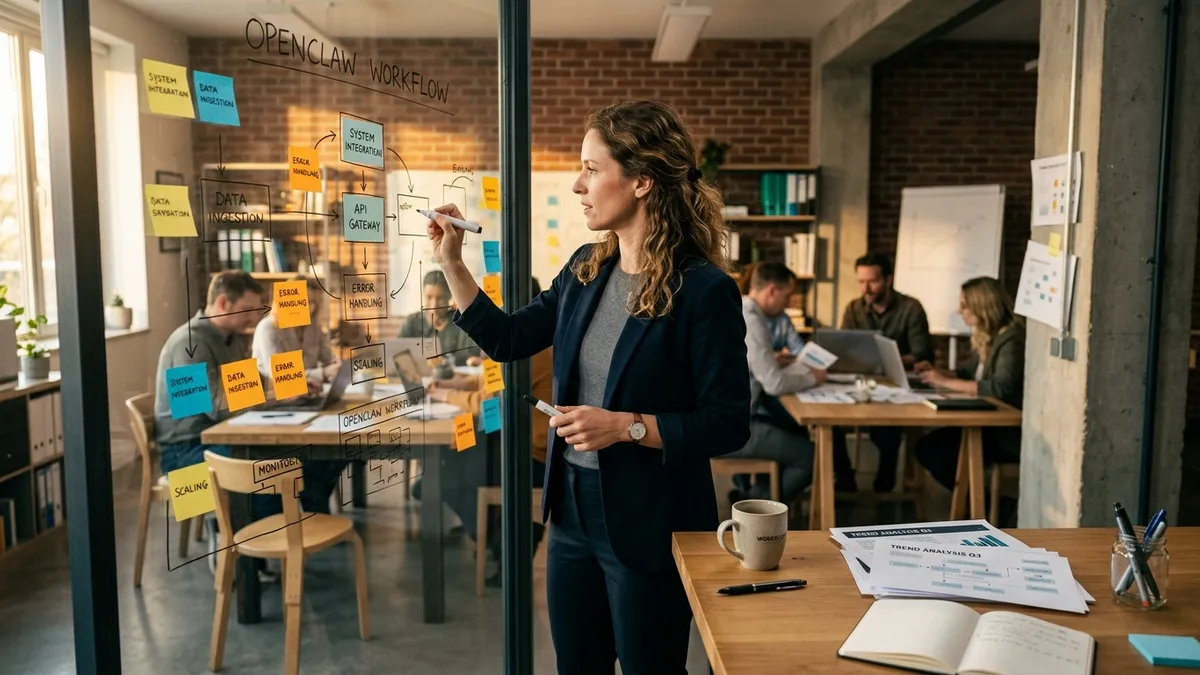
A practical OpenClaw trend on Wednesday, August 26, 2026 is that repeatable AI work is being packaged less like a chat trick and more like an operator system. Current primary sources from OpenAI, Anthropic, GitHub, and the Model Context Protocol project all point in the same direction. Instead of relying on a single long prompt, teams are increasingly defining reusable workflow files, attaching deterministic hooks, and running bounded background tasks that can be reviewed later. That combination matters because it fits how real small businesses and creators actually operate: they need recurring work to happen on schedule, stay inspectable, and remain easy to revise without rebuilding everything from scratch.
In OpenClaw terms, this trend lines up with the mechanics already visible in custom skills, cron jobs, heartbeats, and browser control. The interesting shift is that the broader agent tooling market now treats those ideas as normal building blocks rather than niche power user habits. The new baseline is not “ask the model better.” It is “write the workflow down, narrow the tool surface, and keep the run reviewable.”
Workflow files are replacing prompt memory as the durable asset
Recent documentation makes the file-based shift unusually explicit. Anthropic's Claude Code skills guide says users should create a SKILL.md file when they keep pasting the same checklist or multi-step procedure into chat, and notes that the skill body loads only when needed. GitHub's June 9, 2026 post on custom agents in Copilot CLI describes a similar pattern from the repository side: repeated workflows can be captured in Markdown agent profiles with frontmatter describing role, tools, and guardrails, then versioned alongside the project. For operators, that changes the center of gravity. The durable asset is no longer the last successful prompt. It is the instruction file that survives the session.
This matters most for solo operators and small teams because their work tends to repeat in narrow loops. A creator may run the same research, outline, QA, and publishing sequence every week. A small SaaS team may repeat bug triage, release checks, changelog drafting, and customer reply prep every day. OpenClaw coverage of founder daily operations and newsletter production already reflects this logic: the work gets more dependable when the procedure lives in files and can be invoked again tomorrow.
Hooks are turning vague guardrails into deterministic automation
The next part of the trend is that workflow files are increasingly paired with event-driven enforcement. Anthropic's current hooks guide says hooks run shell commands automatically at specific lifecycle points and give deterministic control so certain actions always happen instead of relying on the model to remember. That distinction is important. Operator workflows often fail not because the core reasoning is weak, but because a review, formatter, notification, or validation step is skipped under pressure.
For an SMB or creator operation, hooks can be small and practical. After a content draft is generated, a hook can send it through a formatter or style checker. After a code edit, a hook can trigger tests or open a review queue. When the agent pauses for approval, a notification can route attention back to the owner instead of forcing constant terminal watching. This is the same operator shape described in internal OpenClaw articles on approval-first background workflows and verify steps in operator workflows: the system becomes more trustworthy when the checks are attached to the lifecycle rather than left to memory.
Background tasks are making long-running work easier to supervise
The other major signal is that asynchronous execution is being treated as a first-class pattern instead of an awkward edge case. The July 28, 2026 MCP specification lists Tasks as an extension for asynchronous, long-running operations with polling, mid-flight input, and durable handles. OpenAI's August 19 post about Codex as a platform says codex exec can run a bounded agent workflow for a script, CI job, or one-off background task and return structured output. OpenAI's August 25 post on automating repetitive work with Codex adds an especially practical layer by describing review and approval boundaries around recurring workflows documented in notebooks.
This is valuable for operators because useful work often exceeds one sitting. Research sweeps, regression checks, catalog cleanup, inbox processing, and multi-step publishing all benefit from being resumable and inspectable. OpenClaw's guidance on durable task handles and reviewable handoff packets fits the same broader market pattern. The winning design is not maximal autonomy. It is a background run that stays bounded, leaves artifacts, and surfaces clear decision points.
Specialized workers are staying narrow on purpose
One reason this operator stack is becoming more practical is that the components are getting narrower, not broader. Anthropic's subagents documentation describes custom subagents with their own prompts, tool restrictions, permission modes, hooks, and skills. GitHub's custom agents examples likewise focus on specific repeatable jobs rather than one giant assistant for everything. The pattern is consistent: one file defines the procedure, one worker handles a bounded task, hooks enforce required steps, and a background system manages time and approvals.
That is especially relevant for service businesses, operators, and creators who need simple stacks that can be maintained without a full platform team. A marketing consultant can keep one workflow for lead research, another for proposal QA, and a third for weekly reporting. A media operator can separate sourcing, transcript cleanup, and publishing prep. A solo founder can wire a morning market scan to a scheduled run and save hands-on review for only the outputs worth escalating. OpenClaw knowledge pages on sales prospecting and GitHub repo maintenance show how those narrower loops map to real work.
What this means for today's operator builds
As of August 26, 2026, the strongest verified signal is not that agent systems are becoming magically hands-free. It is that the most useful ones are being assembled from reviewable workflow files, deterministic lifecycle triggers, and background execution surfaces with explicit control points. For OpenClaw-style builders, the implementation takeaway is straightforward: start with one repeated workflow, write the procedure into a file, attach only the tools it really needs, add a verify or notification step where failures usually occur, and run it on demand or on schedule. That is a smaller promise than “fully autonomous business agent,” but it is also the design pattern most clearly backed by current primary sources.
Sources
- OpenAI Developers: Automating repetitive work at OpenAI with Codex (August 25, 2026)
- OpenAI Developers: Codex as a platform: build on the open agent harness (August 19, 2026)
- Anthropic Claude Code Docs: Automate actions with hooks
- Anthropic Claude Code Docs: Extend Claude with skills
- Anthropic Claude Code Docs: Create custom subagents
- Model Context Protocol specification (July 28, 2026)
- GitHub Blog: From one-off prompts to workflows: How to use custom agents in GitHub Copilot CLI (June 9, 2026)