
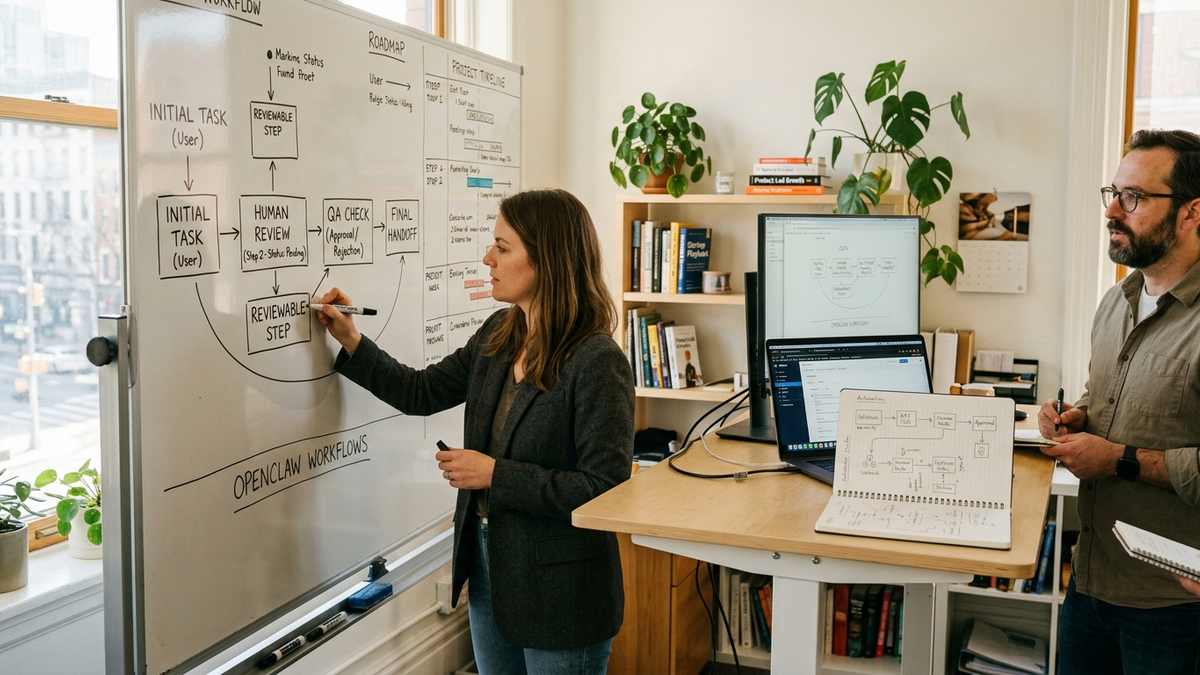
A practical OpenClaw trend on August 5, 2026 is that the most useful agent workflows are being packaged as reviewable handoff packets rather than left to run as one opaque chain of prompts. The packet can take different forms: a queued issue suggestion, a code review note with attached context, a plan.md file, a session log, or a creator brief assembled by an agent and paused for approval. The common pattern is not maximum autonomy. It is a workflow that gathers evidence, leaves artifacts behind, and stops at a checkpoint where a person can make a fast decision.
Recent primary sources from OpenAI, GitHub, Google, and Anthropic all point in that direction. OpenAI's June 25, 2026 report How agents are transforming work says users are shifting from short chatbot exchanges toward delegated, long-horizon tasks, with heavy users running multiple parallel agents. GitHub's July 23, 2026 changelog on agent automation controls in GitHub Issues adds approvals, confidence levels, and rationale to issue changes. GitHub's July 29, 2026 update on Copilot code review with agent skills and MCP brings repository rules and outside context directly into review. Google's July 16, 2026 post on Conductor's plugin shift says plugins can package skills, rules, MCP servers, and hooks while preserving persistent Markdown artifacts such as spec.md and plan.md. Anthropic's April 8, 2026 engineering note Scaling Managed Agents describes the session itself as an append-only log of what happened. OpenAI's July 16, 2026 case study on Codex as a collaborator for the creative team shows the same structure spilling beyond engineering into prototype building, workflow design, and creative implementation.
The packet is becoming the thing operators actually manage
That matters because a long transcript is a weak operating surface. A transcript may show what an agent attempted, but it is hard to scan, compare, reuse, or hand to another person. A packet is smaller and more actionable. It contains the evidence gathered so far, the change being proposed, the reason for it, and the next decision. GitHub's July 23 release makes that logic unusually explicit. Suggested changes can now wait in a panel instead of applying immediately. They carry confidence ratings and rationale, which turns the agent's output into a bounded review object rather than a hidden background process.
For OpenClaw operators, the same pattern maps onto existing building blocks. Repeated instructions belong in custom skills. time-based routines belong in cron jobs. Human follow-up belongs in heartbeat reviews or explicit session queues. The useful unit is no longer just the run. It is the packet that survives the run.
Reviewable handoffs fit how small teams actually work
The strongest evidence for SMB and creator relevance comes from how these sources describe the middle of the workflow, not only the model. OpenAI's June 25 report says more users are delegating work that would take a person more than an hour, and the heaviest users are spreading work across multiple parallel agents. Once work becomes longer and more parallel, someone needs a clean way to re-enter. A founder does not want to reread a huge transcript to approve a client summary. A solo creator does not want final publishing tied to the same thread that handled source gathering. A small software team does not want every repo automation acting without a visible rationale.
GitHub's code review changes reinforce that point. Skills in.github/skills and MCP-based context let review comments pull in standards and outside information without making the review itself unreadable. Google's Conductor update does something similar in a more file-centered way by preserving spec.md and plan.md while simplifying the conversation that produces them. Anthropic's managed-agents architecture reaches the same destination from the systems side: the session log, harness, and sandbox are separated so the work can be resumed, inspected, or swapped without collapsing the whole flow.
Creators and service operators are using the same pattern
The OpenAI creative-team case study is a useful reminder that this is not only a coding story. The report says Codex helps creative teams move faster in concepting, workflow design, and technical implementation, reducing the gap between idea and prototype. That has a direct operational reading for small teams. A creator can let an agent gather references, connect APIs, or prepare prototype assets, then review the packet before anything is published or handed to a client. A service business can let an agent inspect web dashboards through browser control, summarize changes, and route the result into a review step before any message goes out.
That implementation style is consistent with earlier site coverage of inspectable review queues, persistent workflow artifacts, and founder daily operations. The new August 5 signal is narrower: the handoff packet itself is becoming the operator interface.
OpenClaw implementation is moving toward durable packets, not bigger prompts
The practical takeaway from the current source set is that agent reliability is increasingly being achieved outside the prompt. The durable parts of the workflow now include the packet, the artifact, and the review surface around them. That is why so many useful OpenClaw implementations now revolve around a simple sequence: collect context, package the result, pause for review, then continue. Operators who want dependable outcomes are increasingly formalizing those steps instead of trying to compress the entire workflow into a smarter chat request.
As of August 5, 2026, that appears to be the more realistic path for founders, creators, and small teams. The latest official releases do not suggest that human oversight is disappearing. They suggest that it is being redesigned into faster, smaller, better-instrumented handoffs. In OpenClaw terms, the winning workflow is less like a monologue and more like a packeted conversation between agents, tools, and the operator who still owns the final move.