
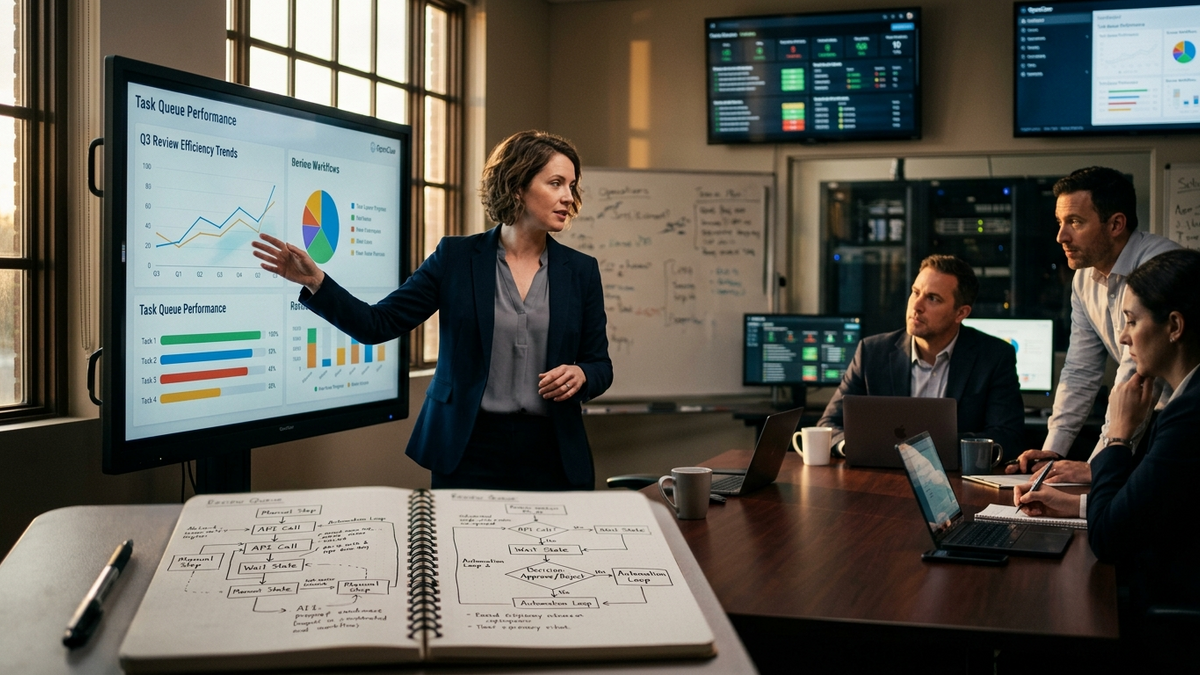
A practical OpenClaw trend on Thursday, August 13, 2026 is that useful agent work is increasingly being packaged as durable tasks that end in a review queue instead of trying to finish everything inside one live chat turn. The shift matters for founders, creators, and small operators because their highest-value automation work is usually not fully autonomous publishing or buying. It is recurring operational work such as research collection, inbox triage, browser checking, repo sweeps, and content preparation that benefits from running in the background and returning a clear packet for human review.
Current primary sources point in the same direction. OpenAI's Background mode guide says long-running work can execute asynchronously without timeout and connectivity issues. OpenAI's MCP and Connectors guide describes approval controls and filtered tool access for remote MCP servers. Anthropic's June 2026 engineering post How we contain Claude across products reported that users approved roughly 93 percent of permission prompts, which it presented as evidence that prompt-by-prompt approvals can lose their value. Anthropic's current documentation for skills and its August 2026 engineering post on managed agents both emphasize bounded harnesses and task-specific execution. The Model Context Protocol's Tasks overview formalizes the same idea by letting tools return durable handles that can be polled later rather than blocking until completion.
The operator unit of work is changing from a prompt to a task handle
The most important change is not just that models can do more. It is that useful workflows are being organized around a different unit of work. Instead of asking an agent to finish a whole job in one sitting, operators can now launch a run, let it gather evidence or complete a batch process, and return later to inspect the result. MCP Tasks make that pattern explicit, while OpenAI background mode gives it a practical implementation path for production systems.
For OpenClaw-style routines, that structure fits work that already has a natural waiting period. A morning market scan can run while the operator is in meetings. A content pipeline can collect sources first and draft only after the source packet passes review. A maintenance routine can inspect issues, branch state, or analytics before a second stage with broader privileges ever becomes relevant. That is closer to how small teams already work than the older dream of one giant all-purpose agent.
Approval fatigue makes review queues more useful than endless prompts
Anthropic's June 2026 approval data is one of the clearest signals in the current market. If users approve roughly 93 percent of prompts, constant permission checks do not automatically create meaningful supervision. Review queues solve a different problem. They concentrate human attention at the end of a stage, when there is enough evidence to judge whether the workflow should continue, rerun, or stop.
That is why narrower tool access matters so much. OpenAI's MCP guide makes it possible to keep one stage read-heavy and reversible, while a later stage can hold the tools that actually send, publish, purchase, or modify live records. Instead of approving every intermediate motion, the operator approves a completed packet. That packet might be a ranked lead list, a research brief, a browser audit, or a prepared draft.
Reusable skills are becoming the operator-facing packaging layer
The second practical pattern is that reusable skills are replacing giant copy-pasted prompts as the control layer for repeatable work. Anthropic documents skills as reusable instructions that Claude can apply when the task matches. In practice, that means small operators can package a source-collection workflow, a client reporting pass, or a store-monitor check without rebuilding the procedure from memory every time.
That maps cleanly to OpenClaw guidance on custom skills, cron jobs, and heartbeats. A skill defines the procedure. A cron or heartbeat decides when to run it. A durable task handle or background run gives the workflow time to finish. The human sees the result at the moment it is useful, not every minute while the job is still moving.
Managed harnesses favor stage-specific workflows over giant agent stacks
Anthropic's August 2026 managed agents post is also notable because it argues for general interfaces that can accommodate many different harnesses rather than one permanent master workflow. That is highly relevant for SMBs and creators. Small operators usually do not need an organization-wide agent platform. They need a good harness for one sales research routine, one content production system, one store-monitoring loop, or one software maintenance queue.
Recent OpenClaw coverage has been moving in this direction already. The site's articles on reviewable background runs, inspectable review queues, and tool narrowing workflows all point to the same implementation pattern: smaller stages, narrower privileges, and clearer handoff packets produce systems that are easier to trust and easier to debug.
What operators should implement now
The practical takeaway is to redesign one recurring workflow around stages instead of prompts. Keep the first stage limited to evidence gathering. Let the second stage transform that evidence into a draft, queue, or checklist. Reserve any externally consequential tools for a final step that runs only after review. If the workflow needs to take longer than a normal interactive exchange, use a background run or a task handle rather than forcing the entire process through a live session.
That pattern is not abstract governance language. It is a practical operating model for small teams that want AI to stay busy without making supervision meaningless. The trend on August 13, 2026 is that durable tasks, reusable skills, and review queues are turning agent systems into something closer to an operator back office: asynchronous, inspectable, and much easier to fit into real work.