
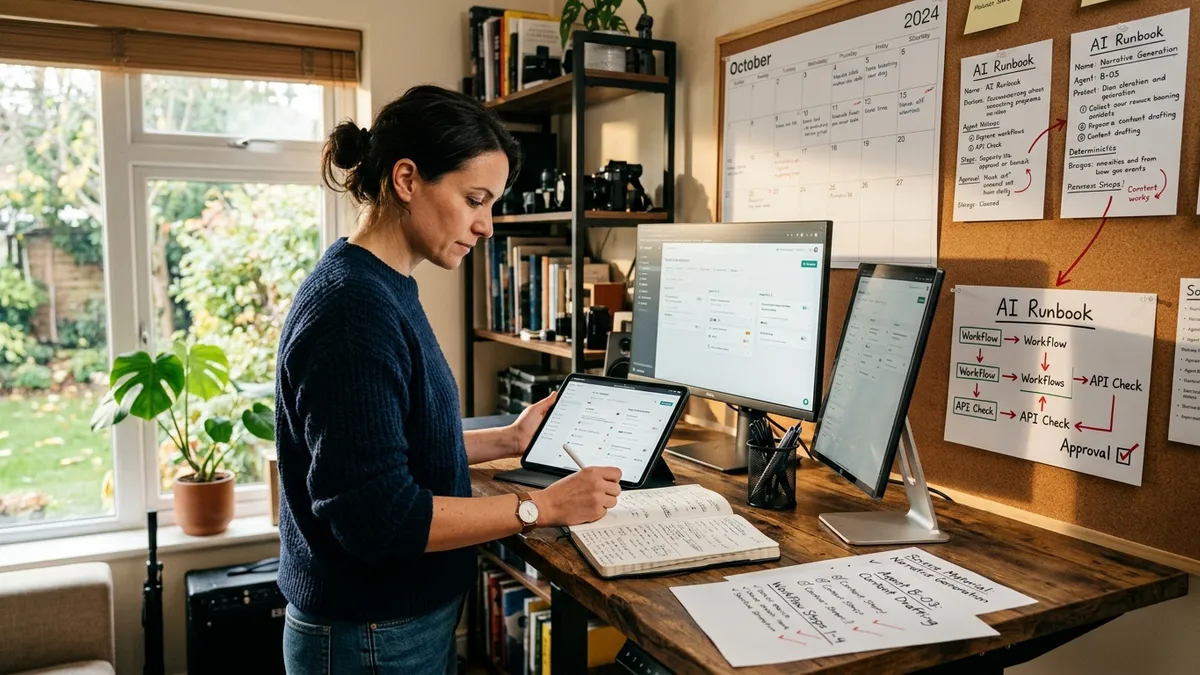
A practical AI agent trend on June 3, 2026 is the move toward deterministic operator workflows. Instead of asking one general-purpose agent to improvise an entire business process, solo operators are increasingly combining fixed orchestration, managed execution environments, and explicit review checkpoints. The shift matters because it lowers failure risk for the kinds of recurring tasks that independent builders and lean service businesses actually run every day: research collection, inbox triage, content production, repository maintenance, and customer follow-up.
The strongest recent evidence comes from official product and documentation updates published over the last several weeks. Microsoft on May 14 introduced Conductor, an open-source CLI for multi-agent workflows defined in YAML, with routing kept deterministic instead of delegated to a language model. Google on May 19 launched Managed Agents in the Gemini API, giving builders a single-call way to provision a sandboxed agent that can reason, use tools, and execute code. OpenAI, GitHub, Anthropic, and n8n have each added related pieces around repeatable workflows, connectors, and human supervision.
Why deterministic workflows are gaining traction
Deterministic orchestration is attractive to solo operators because it makes agent behavior easier to inspect and cheaper to maintain. Microsoft's Conductor launch argued that teams kept rewriting the same glue code for research assistants, code review flows, and document generation pipelines. Its answer was to define workflow structure in a diffable file, keep context flow explicit, and treat human oversight as a built-in step rather than a patch applied later. That framing lines up with what small operators need most: predictable handoffs, clear retries, and fewer hidden decisions.
This does not mean the system becomes rigid or unintelligent. It means the reasoning model works inside declared boundaries. The practical distinction is the same one described in recent coverage of production reliability: the winning pattern is usually bounded autonomy, not unrestricted autonomy. For small teams, structure is often the feature that makes an agent usable at all.
Managed execution is replacing local improvisation
Google's Managed Agents release shows the second part of the trend. The company said builders can now create an agent through a single API call that provisions an isolated Linux environment for tool use and code execution. For solo operators, that is significant because it removes a layer of custom infrastructure work. A founder building an automated research or coding workflow no longer has to assemble every sandbox, runtime, and execution policy by hand before testing the business idea itself.
OpenAI's April 22 Workspace Agents guide points in the same direction from a different surface. It frames agents as tools for repeatable workflows rather than one-off prompts and emphasizes shared systems, standard handoffs, and real-world process constraints. That language is notable because it describes operator work more than model novelty. The trend is no longer just smarter outputs. It is better packaging for recurring tasks.
Prompt-to-workflow tooling is becoming easier to author
Another reason this pattern is spreading is that the authoring layer is getting simpler. GitHub's Agentic Workflows technical preview lets users describe repository automation in plain Markdown and convert it into standard GitHub Actions. n8n's AI Workflow Builder similarly lets users describe a workflow in natural language, then inspect and refine the generated nodes.
These releases matter beyond software engineering. They show the market standardizing around a repeatable pattern: describe the goal in natural language, generate a visible workflow, inspect the steps, connect credentials and tools, then refine the process over time. That pattern closely matches the operator playbook already outlined in scheduled agent runs and custom skills, where repeatability comes from turning good prompts into reusable operating procedures.
Connectors and tools are now the real implementation bottleneck
Anthropic's May 18 announcement that it would acquire Stainless underlined another practical trend: agent usefulness increasingly depends on access to reliable SDKs, CLIs, and MCP-compatible tools. For a solo operator, the hardest part of a workflow is often not prompt quality but system access. If an agent cannot reliably reach the inbox, repository, spreadsheet, CRM, or research source, the workflow still collapses back into manual coordination.
This is why small operators are beginning to value tool maps, runbooks, and approval lanes as much as raw model capability. They need a system that knows what it may call, what evidence it should gather, and when a human must step in. The same logic appears in workflow blueprint coverage, where the central operational asset is a documented loop rather than a single magic prompt.
Where solo operators are applying the pattern first
The most credible early use-cases are narrow and measurable. Research-to-brief pipelines are one example: an agent gathers sources, drafts a structured summary, and pauses for approval before publication. Another is content repurposing, where one approved workflow produces article outlines, social drafts, and checklist items from the same source set. A third is repository maintenance, where scheduled agents triage issues, summarize pull requests, or analyze CI failures with recommended next actions instead of silent changes.
These are not hypothetical abstractions. They map directly to the types of repeatable tasks discussed in founder daily operations and GitHub repo maintenance. The trend is strongest where the operator wants continuity and leverage, but still needs the right to interrupt, approve, or redirect work at key points.
The implementation takeaway for June 2026
The clearest lesson from recent releases is that solo operators are not waiting for perfectly autonomous agents. They are adopting systems that combine deterministic routing, managed execution, better connector layers, and human review. That combination makes agents easier to test, easier to recover, and easier to trust in production.
In practice, the next step for a small business or creator operation is not to hand over an entire function to one model. It is to choose one recurring task, define the trigger, lock down the tool access, document the fallback, and decide where approval belongs. The latest tooling from Microsoft, Google, GitHub, OpenAI, Anthropic, and n8n suggests that this workflow-first approach is becoming the default operating pattern for agent systems aimed at real day-to-day work.
Sources
- Microsoft Open Source Blog, "Conductor: Deterministic orchestration for multi-agent AI workflows"
- Google Blog, "Build managed agents with the Gemini API"
- OpenAI Academy, "Workspace agents"
- GitHub Changelog, "GitHub Agentic Workflows are now in technical preview"
- Anthropic, "Anthropic acquires Stainless"
- n8n Docs, "AI Workflow Builder"