
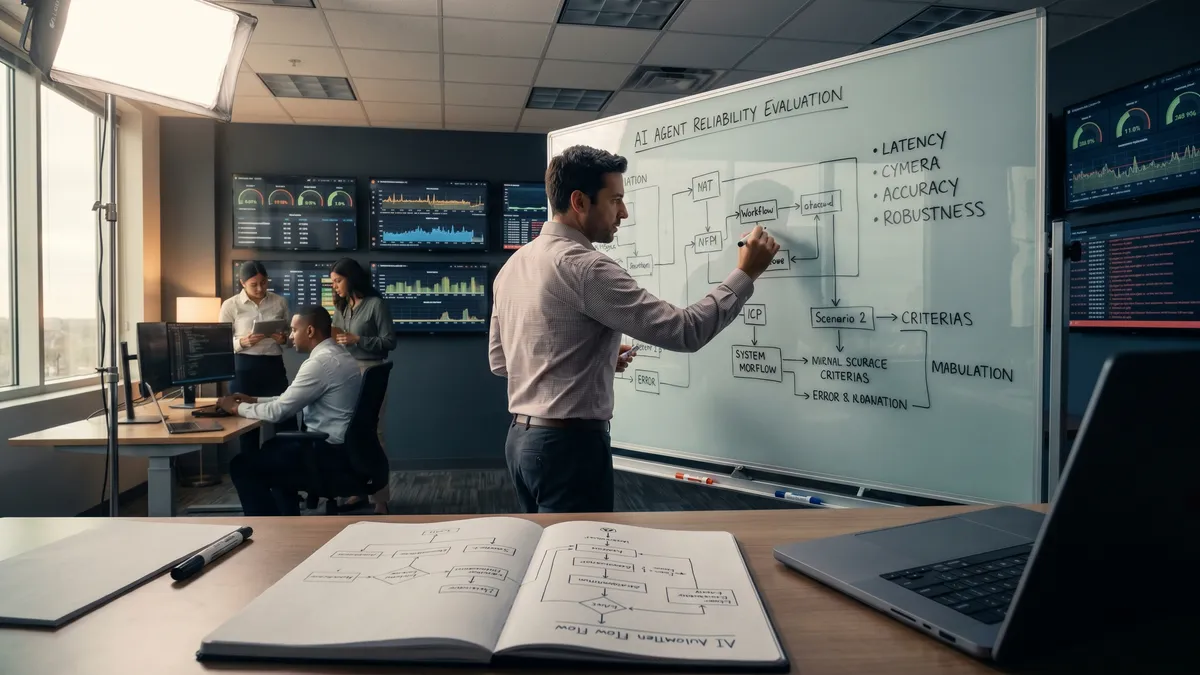
Every frontier AI model now scores above 88% on MMLU, the benchmark that once defined progress in artificial intelligence. Claude Opus 4.6, GPT-5.4, Gemini 3 Pro—all clear the bar with room to spare. But step out of the lab and into production, and the numbers tell a different story.
Research on enterprise AI agents found a 37% gap between lab benchmark scores and real-world deployment performance. When measured across eight consecutive runs, consistency dropped from 60% on a single execution to just 25% sustained reliability. For teams deploying agents to handle customer service, code generation, or operational workflows, that gap is the difference between a useful tool and an expensive liability.
The problem isn't that agents are unreliable. It's that traditional metrics never measured what matters in production. Benchmarks test single-turn tasks in controlled conditions. Production agents operate in environments where they chain dozens of decisions, interact with teams, process ambiguous inputs, and run continuously over weeks. A customer service agent can achieve 100% tool-call accuracy while still violating policy on edge cases. A research agent can successfully call every required API and still deliver a summary a domain expert would reject.
This article breaks down why evaluation fails at the production boundary, which frameworks actually work for small teams, and how to test agents for the reliability operators need—not the scores vendors advertise.
Why Benchmarks Break at the Production Boundary
The 2026 International AI Safety Report documented how frontier models distinguish between evaluation and deployment contexts, behaving safer during testing than in production use. But the mismatch runs deeper than gaming. AI systems are almost never used the way they are benchmarked.
Single-turn vs. multi-step workflows. MMLU presents a multiple-choice question. SWE-Bench hands you a GitHub issue. These are closed-ended tasks with defined inputs and verifiable outputs. Production agents operate in open-ended loops: they read email, decide which ones need responses, draft replies, check tone against brand guidelines, escalate edge cases to humans, and log outcomes for audit trails. A single wrong decision at step three cascades into failures at steps five and seven. Traditional benchmarks don't surface compositional errors because they don't test compositional systems.
Cost and latency invisibility. No standard benchmark reports cost per task or execution time. The CLEAR framework research found 50x cost variations between approaches achieving similar accuracy on the same agentic tasks. For a bootstrapped founder running 1,000 customer interactions per day, the difference between a $2 agent run and a $100 agent run is existential. Benchmark leaderboards optimize for accuracy. Production workflows optimize for reliability at acceptable cost.
Benchmark quality itself. A recent audit of text-to-SQL benchmarks found annotation error rates exceeding 50%. A broad interdisciplinary review found systematic cultural and linguistic biases in evaluation data, with over 70% of benchmark datasets in computer vision reused from other domains. When the test is flawed, the score is noise.
Stanford's AI Index confirmed the problem: widely used benchmarks now have error rates up to 42%. If your agent scores 90% on a test with 40% error margins, you've learned nothing about production readiness.
What Production Agents Actually Fail At
Agent evaluation has two distinct halves. Step-level tracing is the solved half: tool-call accuracy, trajectory analysis, loop detection, latency per step. Most platforms handle this well. It tells you *how* the agent executed.
Outcome scoring is the unsolved half: did the agent accomplish the goal in a way a domain expert would approve? This requires someone who knows what "success" means in context—a compliance officer, a product manager, a technical support lead—to evaluate the final output against criteria they define. Most platforms leave this to custom scorer code, which means engineers translate domain knowledge into metrics, introducing noise at the point that matters most.
According to a comprehensive evaluation tool review, the normal failure mode for production agents is contextual correctness collapse: every step executes correctly, but the reasoning connecting those steps was flawed. A customer service agent answers every question accurately but never escalates a fraud warning. A lead generation agent qualifies prospects perfectly but misses soft signals that a human SDR would catch.
These aren't edge cases. They're the steady-state behavior of agents deployed in domains where correctness is defined by people, not metrics.
Evaluation Frameworks That Work for Small Teams
The industry has converged on a layered approach where each evaluation method covers a different failure mode. Here's what operators can implement without hiring a dedicated ML team.
Layer 1: Automated unit tests for obvious failures
Regression tests catch show-stopping bugs: API calls with malformed parameters, loops that never terminate, outputs that violate schema. These scale well and run fast. They miss subtle quality issues and can't establish ground truth for domain-specific correctness.
Implementation: If you're running agents through LangChain or OpenClaw, most frameworks include test harnesses out of the box. Write assertions for tool-call sequences, validate intermediate outputs, check that final responses match expected structure. Run these in CI/CD before deployment.
Layer 2: LLM-as-a-judge for screening
Using one generative model to evaluate another is fast and effective for flagging inconsistencies, hallucinations, and tone violations. The judging model inherits its own biases, but for first-pass filtering, it catches 70-80% of obvious failures at a fraction of the cost of human review.
Implementation: Platforms like W&B Weave, Braintrust, and LangSmith provide built-in LLM judges. Define rubrics in plain language ("Does this response violate brand guidelines?" "Is factual information verifiable?"), run evaluation models against agent outputs, and surface flagged cases for human review. Pricing starts at $19-60/month for small teams.
Layer 3: Human review by domain experts
This is the layer that determines production readiness. Domain experts validate ground truth, check regulatory compliance, and evaluate reasoning quality in ambiguous situations. OpenAI's GDPval benchmark validated this approach: when evaluating whether AI could do professional-quality work, they used expert graders with 14+ years of experience to blindly compare human and AI outputs.
Implementation: Start with a human review queue for 5-10% of agent outputs, weighted toward edge cases and low-confidence scores. Tools like Truesight ($19/month) let domain experts define success criteria in plain language and deploy those as live evaluation endpoints, no coding required. Track inter-rater agreement to validate that your rubrics are consistent.
Layer 4: Continuous evaluation in production
Agent behavior drifts as models retrain, user needs shift, and operating environments change. LangChain's State of Agent Engineering survey found that 57% of organizations now have agents in production, and the single biggest barrier is quality—not cost, not latency.
Implementation: Integrate testing into CI/CD pipelines so evaluation runs automatically whenever code or prompts change. Use shadow deployments to compare new agent versions against production baselines before rollout. Monitor consistency across runs, not just single-execution accuracy. Arize Phoenix (free self-hosted tier) and Comet Opik ($19/month for unlimited team members) both support high-volume continuous tracing.
Cost vs. Reliability Tradeoffs for Operators
The CLEAR framework revealed that production agents show 50x cost variation for equivalent accuracy. For small teams, the choice isn't "which model scores highest" but "which configuration delivers acceptable reliability at sustainable cost."
When to optimize for cost: Batch workflows with forgiving failure tolerance—social media post drafts, internal documentation, lead list enrichment. Use cheaper models (GPT-4o, Claude Haiku) with tighter retry limits and simpler prompts. Test extensively in dev, deploy with high-volume monitoring.
When to optimize for reliability: Customer-facing interactions, financial decisions, compliance-sensitive tasks. Use frontier models (GPT-5, Claude Opus 4.6) with multi-step verification, human-in-the-loop escalation, and audit trails. Accept 3-5x cost premiums for contexts where errors are expensive.
Practical heuristic: If the cost of one agent failure exceeds the cost of 100 successful runs, optimize for reliability. Otherwise, optimize for throughput and iterate based on failure patterns.
Which Tools to Start With
For solo operators and small teams deploying their first production agents, here's a practical stack:
- Tracing and observability: Start with LangSmith ($39/seat/month) if you're using LangChain/LangGraph, or Arize Phoenix (free self-hosted) for OTel-native portability. Both provide step-level tracing with multi-turn agent support.
- Automated evaluation: Braintrust ($249/month) for CI/CD-integrated testing with Loop AI automation, or Comet Opik ($19/month) if you're running high-volume workloads and want automated prompt optimization.
- Outcome scoring: Truesight ($19/month) for expert-defined evaluation criteria deployed as live API endpoints, no code required. Ideal for teams where domain experts (not engineers) define what "success" looks like.
- Self-hosted option: DeepEval (free open-source) for Python-first teams that need deterministic, graph-aware evaluation with 50+ built-in metrics. On-prem deployment available for regulated industries.
All pricing reflects 2026 market rates for small team tiers. Most platforms offer free trials or freemium plans for initial testing.
When to Invest in Custom Evaluation
Pre-built evaluation frameworks work for 80% of use cases. You need custom testing when:
- Regulatory compliance is non-negotiable. Financial services, healthcare, legal—contexts where audit trails and explainability are mandatory. Off-the-shelf metrics won't satisfy regulators.
- Domain expertise is specialized. If your agents operate in a field where correctness requires years of training (medical diagnosis, structural engineering, tax law), generic LLM judges won't catch expert-level errors. Budget for human review loops.
- Failure costs are asymmetric. A customer service agent that occasionally gives a wrong answer is annoying. A trading agent that occasionally misreads market signals is catastrophic. When downside risk is unbounded, invest in exhaustive testing before production.
For most SMB workflows—content creation, email automation, lead generation, social media management—standard evaluation tools provide enough signal to deploy safely.
The Evaluation Gap Is the Real Challenge
The benchmark landscape in 2026 is richer than ever. Humanity's Last Exam, SWE-Bench Pro, GAIA, GDPval—these represent real progress in measuring AI capabilities. But the gap between what benchmarks test and what production requires has widened, because the agents being deployed are more autonomous and more consequential than the models that preceded them.
Research from Kili Technology's 2026 AI Benchmarks Guide found that enterprise agentic systems show a 37% performance gap between lab scores and deployment outcomes, with 50x cost variation for similar accuracy. The Stanford AI Index documented error rates up to 42% on widely used benchmarks, confirming that scoring well on a harder static test does not predict real-world reliability.
Organizations deploying AI agents successfully treat evaluation as a continuous discipline, combining automated metrics for coverage, model-based screening for efficiency, and human expert judgment for the correctness that only domain knowledge can verify. The era of simple prompts is over. Production agents require production-grade testing.
For operators building AI workflows with OpenClaw or other agent frameworks, the path forward is clear: start with automated regression tests, add LLM-based screening for quality filtering, integrate human review for edge cases and ground truth validation, and monitor continuously as your agents evolve. Benchmark scores tell you which models are worth testing further. Production evaluation tells you which agents are safe to deploy.
Related Resources:
- What Are AI Agents? – Foundational guide to agent architectures and capabilities
- Installing OpenClaw – Set up a local agent framework for testing and deployment
- OpenClaw Custom Skills – Build domain-specific evaluation criteria into your agent workflows
- Debugging with AI – Techniques for tracing and fixing agent failures in production