
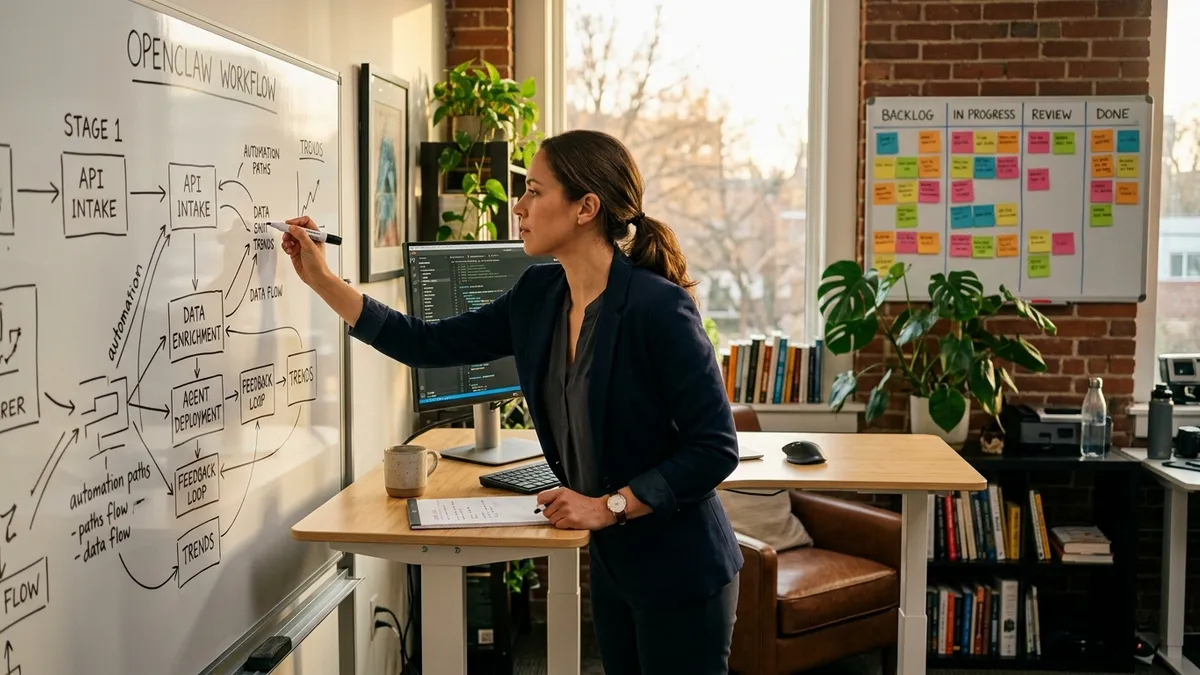
OpenClaw’s 2026 momentum is increasingly visible in how people run it, not just where they install it. Across solo operators, creator businesses, and lean SMB teams, the practical trend is a shift from one-off prompts to repeatable workflow blueprints. These blueprints are lightweight operating systems: message intake happens in familiar channels, tasks are routed into scheduled and event-driven flows, and the operator stays in control through explicit review checkpoints.
Public release notes and documentation now reflect this pattern clearly. OpenClaw has continued shipping improvements around real-time steering, channel integrations, and operational reliability. In parallel, broader agent ecosystem documentation from OpenAI and Anthropic continues to emphasize composable, asynchronous, and operator-supervised patterns over brittle, fully autonomous pipelines. The result is a practical implementation wave for teams that care less about AI theater and more about daily throughput.
Trend signal 1: channel-first operations are becoming the default interface
OpenClaw’s core product positioning remains channel-native. The project documentation and repository describe a single gateway that can route activity across messaging surfaces including WhatsApp, Telegram, Slack, Discord, and others, with one control plane for sessions and tools. For SMB and creator teams, that matters because work already starts in chat: customer requests, campaign edits, publishing approvals, and internal handoffs happen there first.
Instead of forcing operators into a new dashboard for every action, this model keeps request capture inside existing communication streams. Teams then move structured tasks into repeatable flows using OpenClaw’s automation and routing features. This is consistent with patterns covered in OpenClaw chat app workflows and founder daily operations, where low-friction intake is the first reliability win.
Trend signal 2: cron and background execution are replacing manual babysitting
The second visible trend is operational timing discipline. Teams are scheduling recurring jobs for routine work, then letting longer runs complete asynchronously. OpenClaw release notes in May include ongoing work on queueing, active run status controls, and operational performance improvements in the gateway. This aligns with the broader ecosystem direction: OpenAI’s background mode guidance and Anthropic’s agent engineering guidance both point to asynchronous execution and clear orchestration boundaries as core production behaviors.
In practice, this means operators stop hovering over every run. A small team can schedule lead-enrichment summaries, support queue pre-triage, repo hygiene checks, or daily marketing drafts at fixed windows, then review outputs on cadence. Teams exploring this path often begin with OpenClaw cron jobs and extend with heartbeat monitoring so unattended work remains observable.
Trend signal 3: implementation is shifting from “agent magic” to explicit runbooks
A notable operational change in OpenClaw-heavy teams is documentation-first execution. Instead of relying on implicit prompts, teams are writing short runbooks that define trigger conditions, tool boundaries, escalation paths, and quality checks. This mirrors OpenClaw’s own docs emphasis on security defaults, sender allowlists, and controlled exposure practices. It also reflects lessons from small-team deployments: reliability improves when “what happens next” is written down.
The pattern is simple but effective. Operators define:
- Trigger: schedule, inbound channel event, or manual command.
- Execution lane: lightweight tasks vs longer background tasks.
- Review rule: auto-accept for high-confidence outputs, queue for human review when uncertain.
- Fallback: retry, alternate tool path, or human takeover.
This runbook structure is increasingly common in adjacent coverage such as operator runbook automation and operator workflow patterns.
SMB and creator use-cases where this trend is strongest
OpenClaw workflow blueprints are currently strongest in operations where consistency and timeliness are more important than novelty.
- Content production pipelines: recurring research capture, draft assembly, formatting checks, and channel-ready summaries.
- Sales and lead handling: scheduled account scans, response drafting, and next-action queues for human approval.
- Founder operations: daily planning packs from inbox/calendar signals and action rollups sent to messaging channels.
- Dev and maintenance ops: issue triage summaries, dependency watch tasks, and routine status updates in team chat.
These are not hypothetical use-cases. They map directly to documented OpenClaw capabilities around channel routing, session tooling, and cron-driven automation, plus cross-ecosystem practices around asynchronous agent task handling.
What operators should implement now
The evidence suggests a pragmatic rollout sequence for small teams.
- Start with one daily loop tied to a measurable business action.
- Use explicit review gates before external sends or customer-facing updates.
- Separate short and long tasks so quick channel responses are not blocked by heavy runs.
- Track three metrics: completion rate, escalation rate, and time-to-usable-output.
- Keep runbooks editable and update weekly based on failure patterns.
This approach keeps implementation costs low while building a dependable baseline. Teams can expand scope only after a loop proves stable for several cycles.
Near-term outlook
OpenClaw trends today indicate consolidation around operator-grade workflow design: channel-native intake, scheduled execution, bounded autonomy, and routine quality checks. For SMB and creator teams, this is a practical maturation phase. The strategic advantage is not having the most autonomous assistant, but having a repeatable system that ships useful work every day with manageable oversight.
In short, OpenClaw’s most important trend in 2026 is blueprinting. Teams that codify how work enters, runs, and gets reviewed are converting agent capability into operational reliability.