
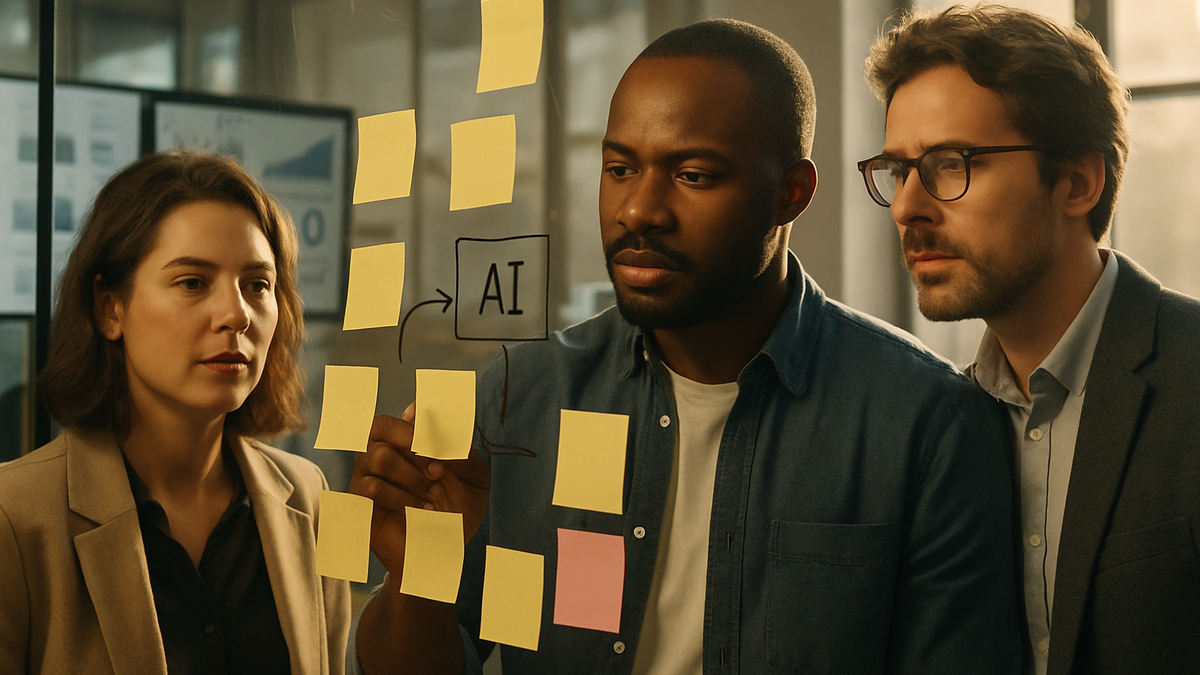
OpenClaw operators in 2026 are increasingly using agents as components in end-to-end workflows, not as standalone chat tools. Across independent studios, local service businesses, and small online teams, the implementation trend is consistent: fewer isolated prompts, more routable systems with memory, auditability, and human checkpoints.
This pattern mirrors wider market movement. Gartner projected that agentic AI would be embedded in a large share of enterprise software by 2028, but the near-term impact is already visible among smaller operators because lightweight orchestration stacks are now accessible and cheap enough to run daily (Gartner). The key difference in the SMB and creator segment is implementation style: operators prioritize speed, recoverability, and low-maintenance design over formal transformation programs.
From Prompting to Process Design
Operators report that raw model quality matters less than workflow architecture once systems move into production. The most common migration path starts with one successful chat prompt, then wraps it in scheduling, source ingestion, post-processing, and delivery. In OpenClaw environments, that often means converting ad hoc requests into reusable playbooks and skills, then chaining them to external services.
That shift is documented in OpenClaw’s own architecture and tool model, which emphasizes first-class actions, memory retrieval, and session orchestration instead of single-response chat behavior (OpenClaw GitHub). Teams applying this model usually begin with operational templates similar to founder daily operations and then specialize by role.
The Stack Pattern: Orchestrator + Agent Runtime + Human Approval
A practical stack has emerged for small operators:
- Workflow orchestrator: n8n or Make for deterministic triggers, retries, and app-to-app routing.
- Agent runtime: OpenClaw sessions for context-heavy reasoning, content drafting, and exception handling.
- Approval layer: explicit human confirmation before external side effects, especially publishing and outbound communication.
The orchestrator role is important because it reduces token burn on predictable steps. n8n’s queue mode and retry guidance, for example, are now frequently adopted by smaller teams to isolate failures and keep pipelines moving (n8n Docs). OpenClaw is then used where language judgment or cross-file context is required.
Model Context Protocol and Tool Interoperability
Another major trend is protocol-level interoperability. Anthropic’s Model Context Protocol (MCP) has accelerated the idea that agents should connect to tools through shared interfaces, reducing one-off integration effort (Anthropic MCP announcement). In operator terms, this lowers switching cost. A creator who builds a source-ingestion or publishing tool once can expose it to multiple model runtimes with fewer rewrites.
For OpenClaw operators, this reinforces a design rule: keep business logic outside any single model where possible. That pattern appears in internal implementation guides such as newsletter production workflows and in production examples like workflow reliability playbooks.
What SMB and Creator Teams Are Actually Automating
The highest-adoption use-cases remain practical and repetitive:
- Weekly content repurposing from long-form source material into platform-specific drafts.
- Lead qualification summaries pulled from forms, inboxes, and call transcripts.
- Client-status digests assembled from project tools and shared each morning.
- Research briefs that monitor selected feeds and flag anomalies for review.
These flows align with broader automation behavior documented in Zapier’s 2025 AI in the workplace reporting, which found heavy use of AI for drafting, summarizing, and repetitive process acceleration rather than fully autonomous decision-making (Zapier report). OpenClaw adopters are generally implementing the same principle, with explicit checkpoints when a workflow affects customers, revenue, or reputation.
Reliability Is Becoming the Competitive Edge
In 2026, operator differentiation is less about “who has AI” and more about “whose automation fails gracefully.” Teams that win are instrumenting every stage: logs for tool calls, bounded retries, timeout-aware fallbacks, and escalation rules when confidence is low. This is particularly relevant for solo operators who cannot babysit long-running jobs.
OpenAI’s Structured Outputs and function-calling improvements contributed to this trend by making machine responses easier to validate before execution (OpenAI). In practice, OpenClaw users combine strict output schemas with downstream deterministic actions, then reserve freeform generation for narrative tasks. Guidance in self-hosted automation patterns reflects this layered approach.
Implementation Pattern for the Next 30 Days
Current trend data points to a repeatable rollout pattern suitable for SMB and creator teams:
- Pick one weekly bottleneck with clear before-and-after metrics (time spent, cycle time, or error rate).
- Split deterministic and cognitive steps, assigning routing/integration to orchestrators and reasoning to OpenClaw sessions.
- Add a mandatory approval gate before any external publish/send action.
- Log everything for two weeks, then trim unnecessary model calls.
- Package the flow as a reusable template for the next client, channel, or product line.
This incremental method has become the default because it controls risk while delivering immediate operational gains. It also matches the practical guidance in AI social media systems and recent OpenClaw trend coverage such as SMB creator workflows.
The headline for 2026 is straightforward: OpenClaw is no longer primarily a prompt interface for experimentation. In operator environments, it is being deployed as a workflow runtime inside broader automation systems, with humans supervising exceptions and final decisions. For small teams, that implementation pattern is quickly becoming standard operating procedure.