
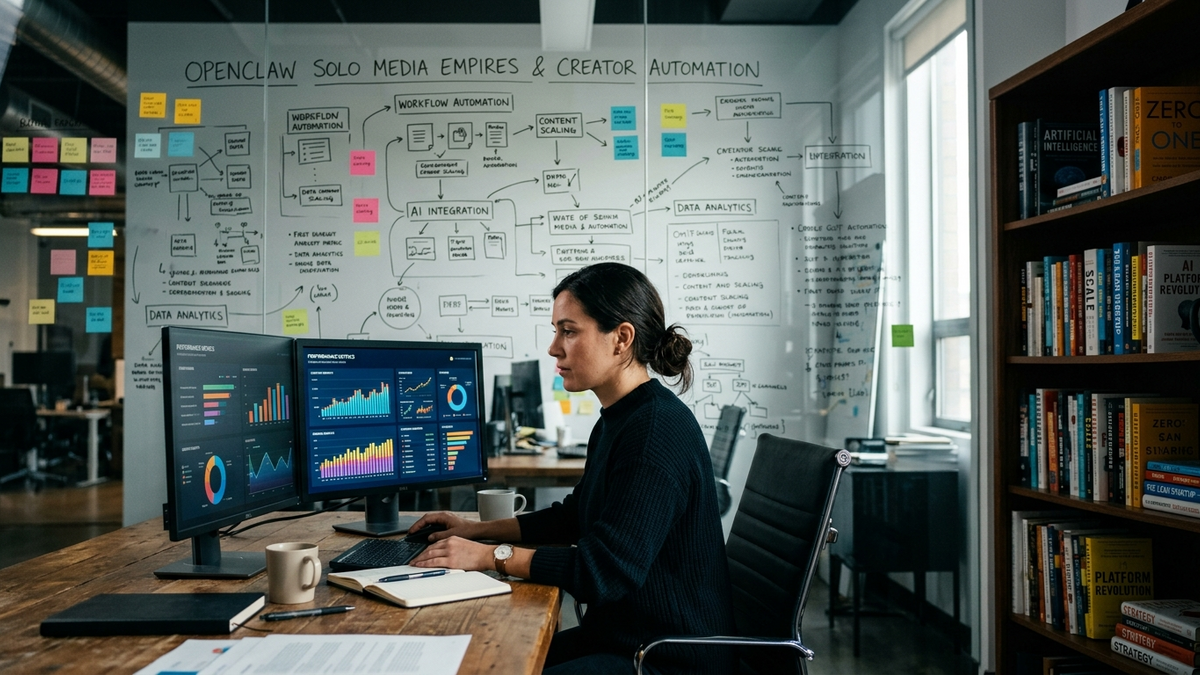
The barrier to building a full-scale media brand has never been lower. In the past, running a successful multi-channel content business required a team of researchers, writers, editors, and social media managers. Today, solo operators and creators are orchestrating these complex processes using open-source autonomous agents. At the center of this shift is OpenClaw, a framework that has become the backbone for what industry insiders are calling the "solo media empire."
From Manual Creation to Agentic Supply Chains
For years, content creators were bottlenecked by their own bandwidth. Burnout was common as the demands of publishing across YouTube, TikTok, newsletters, and blogs grew. The introduction of generative AI helped with drafting, but the operational friction—moving data between tools, scheduling, and formatting—remained a manual burden.
OpenClaw's approach to automation changes this paradigm by turning single AI instances into interconnected, proactive content creation ecosystems. Instead of prompting an AI for every piece of content, creators are deploying OpenClaw pods that run continuous supply chains. These agents scour RSS feeds, analyze trending topics, draft scripts, generate complementary images, and stage the final outputs in CMS platforms—all without requiring a human prompt to start the process.
According to recent data from the Creator Economy Institute, solo operators utilizing multi-agent workflows report a 300% increase in content output while reducing screen time by over 15 hours a week. A similar report by TechCrunch emphasized that the biggest competitive advantage in 2026 is no longer capital, but the ability to effectively orchestrate these autonomous workflows.
The "Heartbeat" of a Solo Empire
A key pattern emerging among high-output creators is the use of OpenClaw heartbeats. Traditional automation relies on explicit triggers (like a new email or a specific API call). Heartbeats, conversely, allow agents to wake up periodically, assess their environment, and decide if action is needed.
For a media brand, an OpenClaw heartbeat might run every three hours. The agent wakes up, checks a monitored list of industry news sites, synthesizes any breaking stories into a newsletter draft, checks the current social media calendar, and queues up corresponding social posts. If nothing significant has happened, the agent goes back to sleep. This proactive posture mimics having an always-on editorial team, ensuring that a solo operator never misses a cycle.
Cost Performance and the Creator Advantage
What makes this trend so significant is the accessibility of the technology. Early autonomous agents were prohibitively expensive, leading to an environment where only heavily funded organizations could afford orchestration at scale. However, the rapidly falling costs of model inference and the maturation of local and hybrid AI deployments have dramatically shifted the landscape.
As detailed in our breakdown of cost performance for SMBs, a solo creator can now run a full suite of OpenClaw agents for less than the cost of a single software subscription. The ability to run smaller, specialized open-source models for routine tasks—reserving frontier models only for complex reasoning—has democratized the creation of multi-agent workflows.
Researchers at Hugging Face point out that local-first, privacy-respecting agentic execution is now a priority for small businesses, putting tools like OpenClaw squarely in the spotlight.
Building Resilient Workflows
Building a solo media empire isn't just about output; it's about reliability. Creators are moving away from fragile, linear automation towards self-healing agentic workflows. When an OpenClaw agent encounters an API change or a failed upload, it can often debug the issue, adjust its approach, and retry without human intervention.
This level of resilience allows operators to focus entirely on strategy, creativity, and community building. As highlighted by Wired's analysis of solo businesses, the most successful solopreneurs are those who treat their agents not as tools, but as an infrastructure layer.
To dive deeper into the technical setup required for these workflows, check out our guide on deploying AI-generated applications and the latest patterns in OpenClaw workflow orchestration.
Looking Ahead
As we progress through 2026, the definition of a "media company" is fundamentally changing. The scale of operation is no longer dictated by headcount, but by the sophistication of an operator's agentic infrastructure. For solo creators willing to master these new tools, the leverage is unprecedented. The next major media empires will likely start in a single folder, orchestrated entirely by a cluster of OpenClaw agents.