
The conversation around AI agents has shifted from what they can do in controlled demos to which architectural patterns actually survive production deployment. According to recent analysis from developers and operators across multiple platforms, the most successful AI implementations in April 2026 share a common trait: structured orchestration rather than emergent behavior.
From Demo Agents to Production Workflows
Early AI agent systems relied primarily on prompt loops—user input triggered reasoning, which triggered tool calls, which generated answers. Everything happened inside loosely defined flows. As documented in a recent workflow pattern analysis, this approach worked for demonstrations but frequently collapsed under real-world complexity.
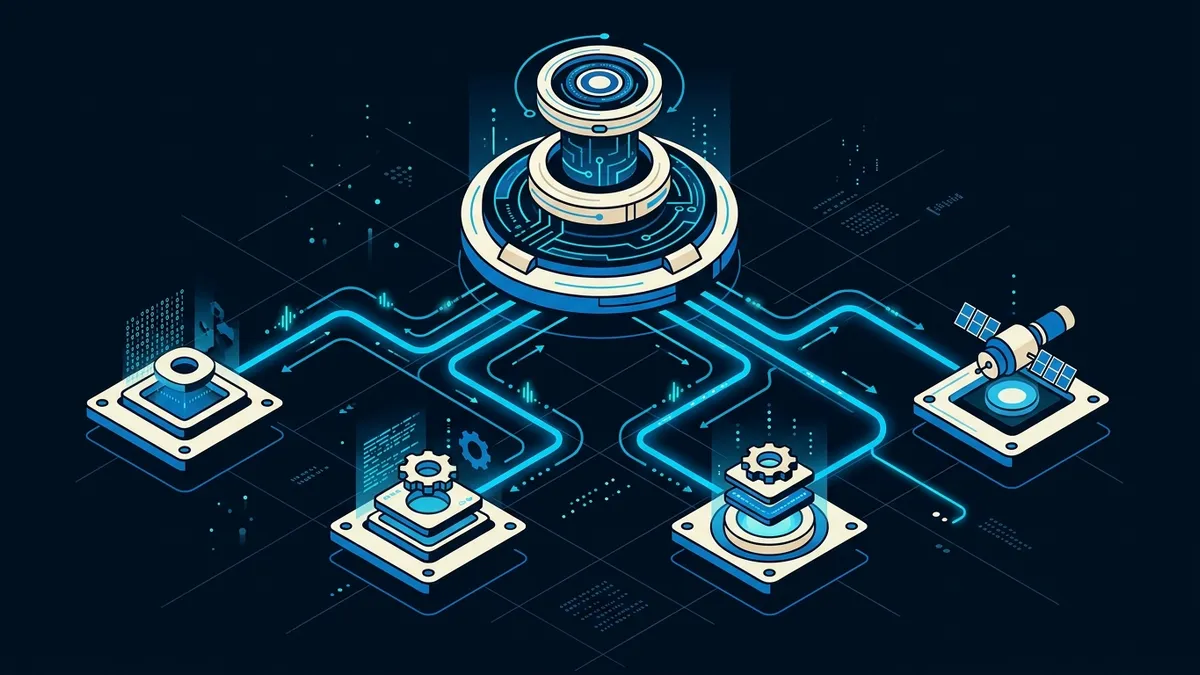
The dominant pattern emerging in April 2026 centers on explicit state transitions. Instead of relying on models to figure out sequencing, developers now define discrete states, clear transition conditions, and structured handoffs between specialized sub-agents. This architecture creates systems that are debuggable, observable, and resilient—critical qualities for operators running AI workflows in production.
Five Patterns Gaining Adoption
Analysis from platform operators and open-source communities reveals five patterns seeing consistent implementation across small teams and solo operators:
1. Modular Sub-Agent Specialization
Rather than one generalist agent attempting every task, teams are deploying specialized sub-agents for distinct domains. A planning agent breaks down high-level requests, a code generation sub-agent handles implementation following established patterns, a testing agent validates output, and a documentation agent maintains records. As noted in a developer tooling survey, this separation mirrors how functional teams actually work and creates debuggable systems where failures can be traced to specific agents.
2. Adversarial Review Loops
Production implementations increasingly use multiple agents in adversarial configurations to improve output quality. One agent generates code or content, a second agent explicitly looks for security holes, edge cases, logic errors, and missing test coverage. This pattern replicates the adversarial nature of code review processes but delivers instant, consistent feedback at scale. Early implementations show particular effectiveness for high-stakes workflows involving authentication, payment processing, and data pipelines.
3. MCP-Based Context Integration
The Model Context Protocol has emerged as critical infrastructure for operators needing AI agents to access real business context. Rather than manually copying data into prompts, MCP connectors let agents query databases, pull tickets from project management tools, read documentation, and interact with internal APIs. This transforms context from a constraint to a first-class resource. Developers working with OpenClaw and similar frameworks report that agents with structured MCP access make dramatically fewer hallucinated assumptions. Documentation for implementing MCP connections is available in the OpenClaw custom skills guide.
4. Terminal-Native Agent Control
A quiet renaissance is occurring at the command line as terminal-based agent interfaces gain traction. These tools navigate codebases contextually, run shell commands and test suites, manage version control, and operate in long-running loops without constant supervision. The terminal agent model appeals to developers because it's composable (agents can be piped and scripted), portable (no GUI dependencies), and respects existing mental models of development workflow. Productivity gains are particularly notable for large-scale refactors and migration tasks touching multiple files simultaneously.
5. Persistent Project Context
Rather than treating each agent invocation as isolated, production workflows now maintain persistent context across multiple sessions. Agents work inside sandboxed environments with real file systems, ongoing project state, and historical memory of prior decisions. This pattern enables scheduled heartbeat checks and recurring cron workflows that maintain continuity. Self-hosted platforms like OpenClaw implement this through workspace-based memory files, while cloud platforms provide isolated containers.
Self-Hosted vs Cloud Platform Tradeoffs
A comprehensive platform comparison covering 11 agent systems reveals a clear split in April 2026: self-hosted open-source options versus managed cloud platforms. For operators prioritizing data sovereignty and zero vendor lock-in, frameworks like OpenClaw, CrewAI, and Paperclip offer free deployment with full control. These platforms are technically ahead in areas like self-improvement, organizational delegation, and community skill libraries.
Cloud platforms trade control for convenience. No-code builders like Lindy and Relevance AI let non-technical users deploy agents within hours, though credit-based pricing models generate user complaints about unpredictable costs. Subscription-based platforms provide cost transparency but typically constrain execution capabilities. The choice depends on team composition: operators with technical capability should evaluate self-hosted options, while teams needing immediate deployment without infrastructure management benefit from hosted platforms.
SMB Implementation Economics
Cost analysis from small business implementations shows AI agents now accessible at price points starting from $20 per month per agent for managed services, or zero marginal cost for self-hosted deployments (excluding infrastructure). A small team spending $200-500 monthly on AI agents can replace workflows that previously required 2-3 full-time employees.
The highest-ROI workflows for small operators fall into predictable categories: lead follow-up automation (60-second response times replace 4-24 hour delays), invoice generation and payment tracking, tier-1 customer support (handling approximately 80% of routine inquiries), social media content generation across platforms, and inventory monitoring with predictive reordering. Implementation timelines for these workflows typically span 30-90 days from pilot to production deployment.
The Compounding Capability Problem
The most technically interesting development in April 2026 involves agents that genuinely improve over time. Self-hosted platforms like Hermes from Nous Research implement self-improvement loops: when an agent encounters a new problem and solves it, the solution gets extracted into a reusable skill stored as structured markdown. Subsequent encounters with similar problems become faster and more reliable.
OpenClaw's community skill marketplace (ClawHub) demonstrates this pattern at scale, hosting over 13,700 community-contributed skills. Operators report that agents using these skill libraries handle domain-specific tasks with increasing competence. This contrasts sharply with cloud platforms where improvements require vendor updates rather than local learning. For solo operators and small teams, the compounding capability advantage of self-improving agents represents a meaningful long-term differentiator. Setup guidance is available in the OpenClaw setup documentation.
Implementation Anti-Patterns
Documented failures from early 2026 implementations reveal consistent mistakes. Attempting to automate five or more workflows simultaneously overwhelms teams and creates debugging nightmares. Removing human review steps too early results in tone-deaf or confidently incorrect outputs reaching customers. Assigning AI agents to handle sensitive communications (terminations, crisis response, complaint resolution) without human oversight damages relationships agents lack the empathy to manage.
Inadequate documentation creates single points of failure when the person who configured agents leaves the team. Successful implementations treat agent configurations like code—version-controlled, peer-reviewed, and thoroughly documented with trigger conditions, decision logic, and escalation procedures clearly specified.
Forward Indicators
The patterns consolidating in April 2026 suggest a clear trajectory: away from monolithic prompt-driven agents toward modular, specialized, orchestrated systems with explicit state management. Operators report that the best results come not from using the newest models but from thoughtfully integrating AI into existing workflows with tight, purposeful touchpoints.
The gap between five-person teams and 500-person companies continues shrinking as structured orchestration patterns become accessible to solo operators. Self-hosted platforms provide compounding capability advantages for technical users willing to manage infrastructure, while managed platforms deliver speed to deployment for teams prioritizing convenience over control. The differentiation increasingly centers on implementation patterns rather than underlying model capabilities.
For operators evaluating agent implementations, the April 2026 lesson is straightforward: start with one high-impact workflow, implement structured orchestration from the beginning, maintain human oversight during initial deployment, and expand methodically based on measured results. The technology is production-ready; the challenge lies in disciplined implementation.