
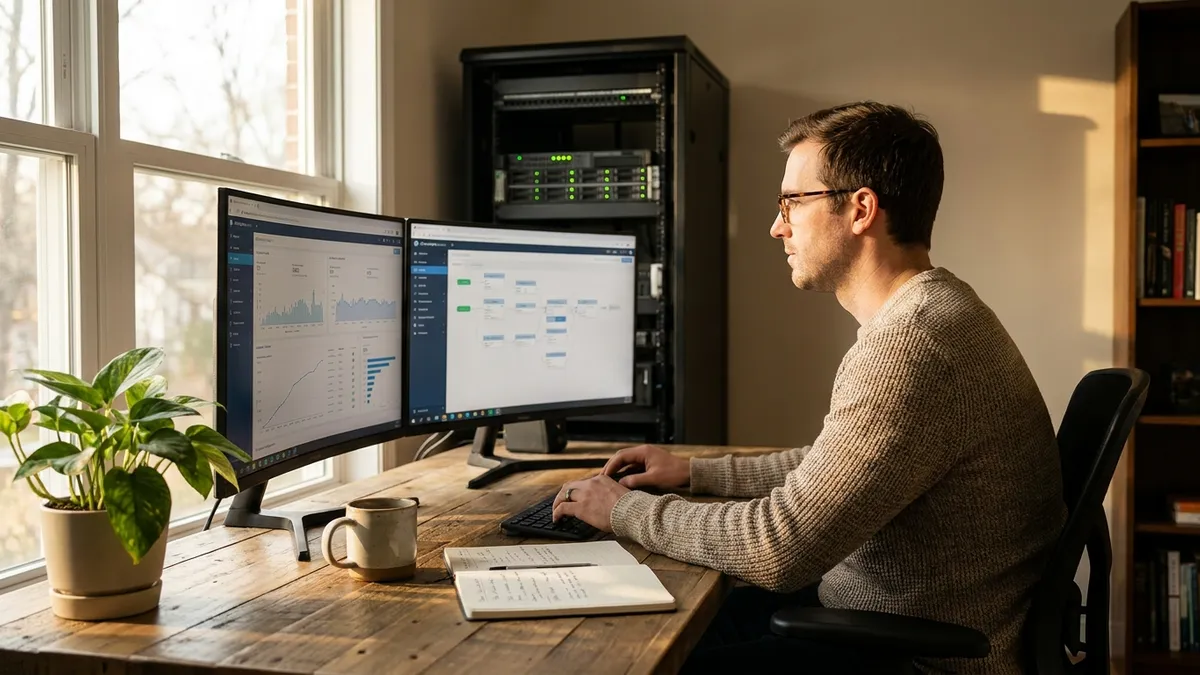
The autonomous AI agent market is experiencing a significant shift as small business operators and independent creators move away from cloud-based SaaS platforms toward self-hosted solutions that offer greater control over costs, data, and customization.
According to recent industry analysis, businesses implementing AI agents in 2026 have reported operational cost reductions of 30% or more within the first quarter of deployment. Yet the economics of SaaS-based agent platforms—often priced between $20 and $200 per month per seat—are prompting many operators to explore open-source alternatives that can be deployed on existing hardware.
The Economics Driving Self-Hosted Adoption
The decision to self-host AI agents is fundamentally driven by total cost of ownership. A comprehensive analysis published in March 2026 highlights that operators running multiple agents through SaaS platforms can face monthly bills exceeding $500, while self-hosted alternatives require only infrastructure costs—often under $50 monthly for modest compute resources.
For solo operators and small teams, the math is straightforward. A business running three specialized agents for customer support, content generation, and workflow automation through cloud platforms might spend $300-600 monthly. The same functionality deployed on a dedicated server or even a consumer-grade workstation can reduce ongoing costs to the price of electricity and occasional model API calls when cloud inference is needed.
Active Open-Source Projects Enabling Local Deployment
The self-hosted agent ecosystem has matured considerably. Research published by Fast.io in early 2026 evaluated over 200 open-source agent projects, filtering for active maintenance, local LLM support, and genuine tool integration capabilities.
Several frameworks have emerged as production-ready options:
- Cline (formerly Claude Dev) offers deep VS Code integration with Model Context Protocol support for 251+ tools, enabling developers to run coding agents locally while maintaining approval-based execution controls
- AutoGPT, one of the earliest autonomous agent projects, continues active development with support for local inference through GPT4All and Ollama
- CrewAI introduces multi-agent collaboration frameworks where specialized agents handle research, writing, and review tasks cooperatively
- Flowise provides visual agent builder interfaces that allow non-technical operators to design workflows without writing code
These platforms share common architectural patterns: support for local language models through Ollama or LM Studio, extensible tool integration systems, and persistent storage for maintaining context across sessions. For operators concerned about data privacy or working in regulated industries, the ability to ensure sensitive information never leaves local infrastructure represents a critical requirement that SaaS platforms cannot satisfy.
Real-World Implementation Patterns
Deployment strategies vary based on technical capability and use case complexity. According to testing conducted across three business types—e-commerce, local services, and B2B consulting—successful implementations typically follow a staged approach.
Operators begin by identifying the highest-value repetitive task: email management, social media scheduling, report generation, or FAQ responses. Rather than attempting to automate entire workflows immediately, they deploy a single agent focused on that specific function and measure time savings over 30 days. Most successful adopters expand to 3-5 specialized agents within six months once they understand configuration patterns and edge case handling.
The technical barrier to entry has decreased substantially. Tools like OpenClaw provide structured frameworks for managing agent lifecycles, while platforms like n8n and Flowise offer visual workflow builders that eliminate the need to write integration code. For operators comfortable with command-line interfaces, tools like Open Interpreter provide natural language control over local system operations.
Infrastructure Considerations and Storage Requirements
Self-hosted agents require persistent storage for outputs, logs, session state, and retrieved context. For single-agent workflows, local disk storage is sufficient. However, multi-agent systems introduce complexity: file conflicts when multiple agents write simultaneously, loss of ephemeral state during restarts, and lack of sharing mechanisms when human review is required.
Standard approaches include local disk for prototyping, S3-compatible storage (AWS S3, Cloudflare R2, self-hosted MinIO) for teams already in cloud ecosystems, or specialized solutions that integrate with Model Context Protocol for standardized tool access. The choice depends on whether the operator prioritizes zero recurring costs (local disk), durability and team access (cloud storage), or agent-native workflows (MCP-compatible platforms).
Privacy and Control as Competitive Advantages
Beyond cost considerations, data sovereignty increasingly drives adoption decisions. Small businesses working with client data under privacy regulations, content creators managing proprietary intellectual property, and consultants handling confidential business information face regulatory and competitive risks when routing sensitive data through third-party cloud services.
Self-hosted deployments ensure complete audit trails, eliminate third-party data sharing agreements, and provide operators with the ability to comply with data residency requirements. For businesses serving clients in regulated industries—healthcare, legal services, financial advising—this capability can be a market differentiator.
The Tool Integration Challenge
While self-hosted agents offer control and cost advantages, they require more configuration effort than turnkey SaaS platforms. Operators must handle model selection, inference infrastructure, tool integration, and error handling themselves. The reliability testing frameworks that mature SaaS platforms provide out of the box must be built or adapted for local deployments.
However, the open-source ecosystem is addressing these gaps. Projects like AgentSkills provide reusable tool packages, while frameworks like LangChain and Semantic Kernel offer standardized abstractions for memory, planning, and tool orchestration. Operators who invest time in initial setup gain the flexibility to customize agent behavior precisely for their workflows rather than adapting their processes to fit SaaS platform constraints.
Hybrid Deployment Models Emerging
Rather than choosing exclusively between cloud and self-hosted architectures, many operators are adopting hybrid approaches. Routine tasks with predictable patterns run on local agents using smaller open-source models, while complex reasoning tasks that benefit from larger models route to cloud APIs on-demand.
This pattern optimizes cost and capability. A customer support agent might handle 80% of inquiries locally using a 7B parameter model fine-tuned on company documentation, escalating only complex or ambiguous cases to GPT-4 or Claude through API calls. The result is reduced inference costs while maintaining quality for edge cases.
Implementation Guidance for New Adopters
For operators considering self-hosted deployments, industry practitioners recommend starting with established frameworks rather than building from scratch. Platforms like OpenClaw with heartbeat monitoring, Flowise for visual workflows, or Open Interpreter for code execution provide proven starting points.
Critical early decisions include:
- Identifying the single highest-value task to automate first
- Selecting whether to use local models exclusively or hybrid local-cloud inference
- Establishing persistent storage patterns before scaling to multiple agents
- Implementing approval mechanisms for actions that modify data or interact externally
Most successful implementations measure success not by the number of agents deployed but by actual time savings and operational cost reduction over 90-day periods.
The Maturation of Local Agent Infrastructure
The trend toward self-hosted AI agents reflects broader maturation in the autonomous agent ecosystem. As open-source models reach quality thresholds sufficient for real-world tasks, as tool integration standards like MCP gain adoption, and as operators gain experience configuring and managing agent systems, the technical gap between cloud platforms and self-hosted solutions continues to narrow.
For small business operators and independent creators, the ability to deploy capable AI agents on existing hardware—maintaining full control over data, costs, and customization—represents a shift in who can benefit from autonomous AI systems. The question is no longer whether small operators can access agent technology, but rather how quickly they can adapt their workflows to leverage it effectively.
Sources
- 7 Open-Source AI Agents You Can Self-Host in 2026 - Medium, March 2026
- Top 10 Open Source AI Agents You Can Run Locally in 2026 - Fast.io, 2026
- Best AI Agents for Business Automation in 2026: 90-Day ROI Test Results - SmartAI For Biz, 2026
- The 10 Best AI Agent Builders 2026 - Airtable, 2026
- Self-hosted AI sandboxes: Guide to secure code execution in 2026 - Northflank, 2026
- Best 7 Free AI Agent Platforms to Build Autonomous Workflows in 2026 - Mobit Solutions, 2026