
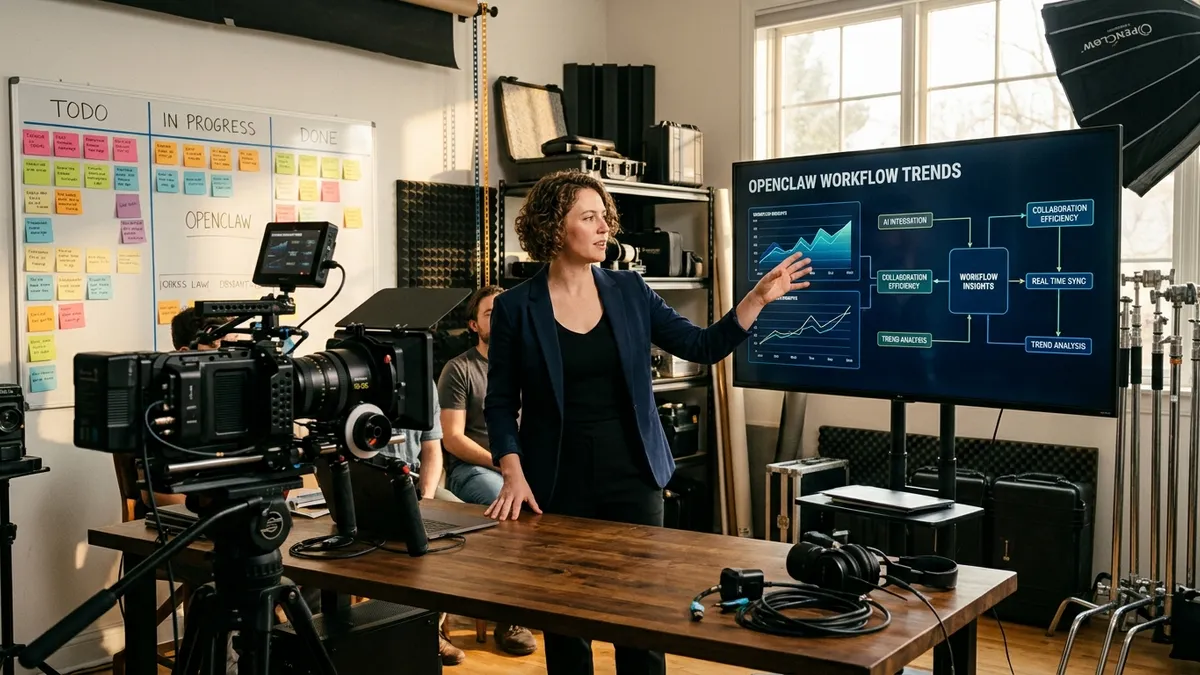
A practical OpenClaw trend on July 9, 2026 is that useful agent systems are being assembled as portable operator stacks instead of treated as one giant assistant session. The change is visible across current primary source documentation from OpenAI, Anthropic, Google, Microsoft, and the Model Context Protocol project. More tasks are designed to run in the background, more work is split across specialist workers, and more tool connections are being standardized so an operator can move a workflow from one surface to another without rebuilding everything from scratch.
For solo operators, creators, and small businesses, that matters because the highest-value AI work is rarely a one-off chat. It is recurring work such as inbox sweeps, client research, repo maintenance, browser-based reporting, content production, and dashboard checks. A portable stack is useful because those tasks often need the same basic ingredients across tools: asynchronous execution, bounded delegation, reusable procedures, stable connectors, and a clear review point before anything external happens.
Several current sources point in the same direction. OpenAI's Background mode guide says developers can run longer tasks asynchronously and resume streamed output later. OpenAI's May 21, 2025 post New tools and features in the Responses API adds remote MCP server support and background mode as first-class API features. Anthropic's subagents documentation describes specialist workers with their own context windows and tool access. Microsoft's June 12, 2025 post The Complete MCP Experience: Full Specification Support in VS Code says VS Code now supports the complete MCP specification. Google's May 19, 2026 update Transitioning Gemini CLI to Antigravity CLI says the new terminal tool keeps skills, hooks, subagents, and asynchronous workflows. The official MCP specification frames the underlying protocol as a standard way to connect language model applications to tools and data.
The stack is replacing the session as the unit of useful work
The clearest signal is that product teams are normalizing long-running execution. OpenAI's background mode guide is explicit that developers can create a response with background set to true, let it continue after the client disconnects, and later resume streaming from a stored cursor. That is not just an API convenience. It changes how an operator can design work. Instead of staying in a live session for every step, a founder can launch a morning reporting run, a creator can queue a source-gathering task overnight, and a small agency can let a browser routine collect numbers while the team does something else.
OpenClaw users have already been moving in that direction through cron jobs, heartbeats, and prior coverage of reviewable background runs. The difference now is that multiple major toolchains are converging on the same idea. Background execution is increasingly the default shape for recurring operator work, not an advanced edge case.
Subagents are making workflows easier to split, move, and review
Anthropic's subagents documentation matters because it turns specialization into an explicit workflow primitive. A subagent runs in its own context, can be given its own instructions and tool access, and returns a bounded result to the main thread. That makes it easier to package work by role rather than by prompt history. One worker can gather information, another can transform it, and a final one can check whether the result meets the run's criteria.
For SMB and creator workflows, that is more practical than the fantasy of one omniscient agent doing everything well. A newsletter operator can separate sourcing from drafting. A consultant can separate account research from summary writing. A developer can split code search, edit proposals, and test verification into narrower tasks. That same pattern is reflected in OpenClaw's guides on custom skills and browser control, where the goal is to make each worker legible, constrained, and easier to rerun.
Open protocols are lowering the rebuild cost for small operators
The portability part of the trend is just as important as the delegation part. The MCP specification says the protocol exists to let applications share context, expose tools, and build composable integrations and workflows. Microsoft's VS Code update shows that the ecosystem around the protocol is spreading into mainstream developer surfaces, including support for prompts, resources, tools, and authorization. OpenAI's Responses API update brings remote MCP servers into a general-purpose agent runtime, while Google's Antigravity migration preserves a similar operator vocabulary of skills, hooks, and subagents.
For a small operator, the benefit is not abstract standards compliance. It is cheaper iteration. If tool connections and reusable procedures are less tied to a single shell, IDE, or hosted surface, one good workflow becomes easier to adapt. A creator can reuse the same monitoring logic in a chat assistant, a terminal run, or a scheduled job. A small team can move a reporting loop from an experimental environment into a daily operating routine without rewriting the whole system. That directly supports the implementation habits described in founder daily ops and replayable operator workflows.
What operators should implement now
The practical move is to stop thinking in terms of a single agent and start thinking in terms of one portable stack. Choose one recurring task with a stable path. Decide what can run asynchronously, what should be handled by a specialist worker, which tool connections are actually required, and where the human checkpoint belongs. Then store the procedure in a reusable form so the system is not rebuilt from memory every time.
For OpenClaw users, the strongest July 2026 trend is not broader hype around autonomy. It is that useful operator systems are becoming more modular, more reviewable, and easier to move across runtimes. The winning build pattern is increasingly a portable stack: background runs for the boring middle, subagents for bounded specialist work, open tool connections for integration, and reusable instructions that keep the workflow stable over time.