
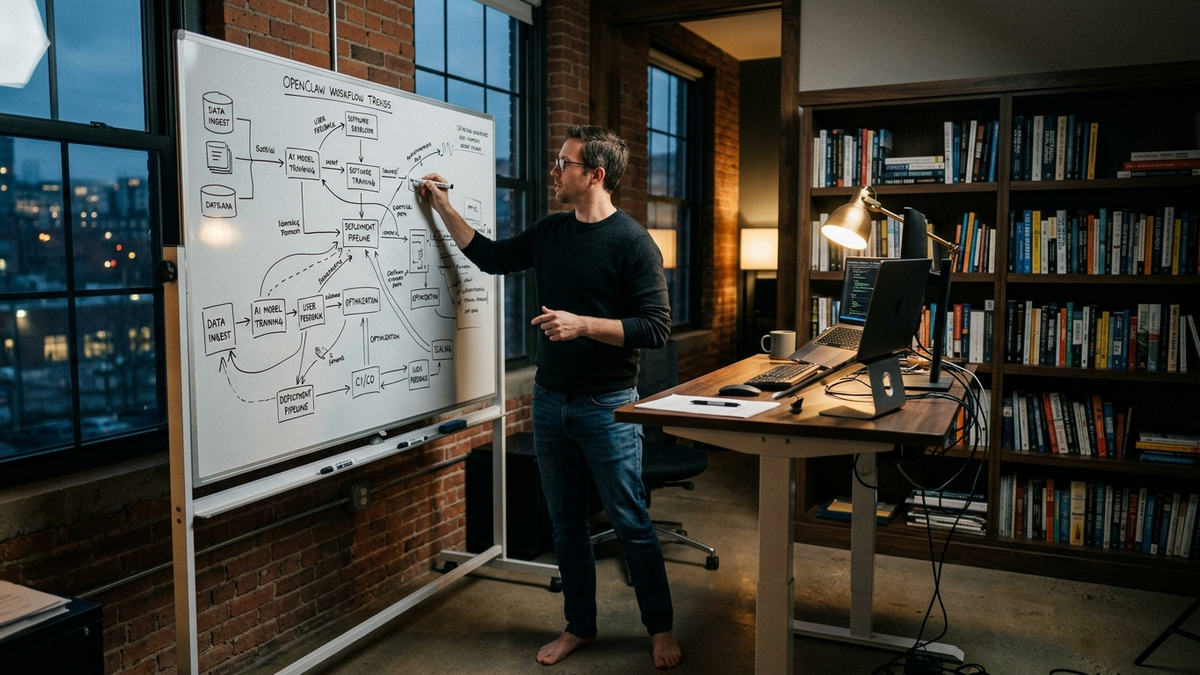
A practical OpenClaw trend on July 1, 2026 is that useful agent work is being turned into replayable operating procedures instead of repeated prompt sessions. The strongest signal is not just that models can do more. It is that major toolmakers now document clearer ways to capture a stable workflow, package it as a reusable unit, attach deterministic rules, and run it again with a human checkpoint at the right moment. For solo operators, creators, and small businesses, that shift matters because the most valuable AI work is usually recurring work: weekly research, content preparation, lead triage, repo cleanup, reporting, and publishing.
Several current primary sources point in the same direction. OpenAI's Record & Replay documentation says a user can demonstrate a workflow once and turn it into a reusable skill, with examples including filing an expense, publishing a video, and downloading a recurring report. OpenAI's Codex app automations guide describes running background automations with explicit sandbox and approval considerations. Anthropic's skills documentation says repeated checklists and procedures should move into SKILL.md rather than stay pasted in chat, while its hooks guide explains how shell commands can run automatically at key lifecycle moments. The Model Context Protocol specification adds the broader context by defining a standard way to connect language model applications with tools and data.
Recorded workflows are becoming a realistic on-ramp for non-developers
Record & Replay is notable because it lowers the translation cost between “I know how to do this” and “the agent can repeat this safely.” OpenAI's documentation is explicit that it works best when the steps are stable and the success criteria are clear. That sounds simple, but it maps closely to real SMB and creator operations. A founder might record how to gather and file weekly numbers. A creator might show how a video is uploaded and tagged. A small agency might demonstrate how to pull a recurring client report from a browser dashboard. Those tasks are not glamorous, but they are exactly the jobs that consume attention every week.
For OpenClaw users, this reinforces a broader implementation pattern already visible in browser control, custom skills, and packaged operator systems. The goal is not full autonomy for its own sake. The goal is to capture a stable path through a task so the operator stops re-explaining it from scratch.
Skills are replacing copied prompt choreography
Anthropic's skills documentation makes an important distinction: if a procedure keeps getting pasted into chat, it is probably a skill, not just a conversation. That is a useful framing for OpenClaw operators because many real workflows are half instruction set and half execution surface. Once a process is stored as a named skill, the operator can add support files, narrow the tool access, and keep long reference material out of the active context until it is needed.
That matters for smaller teams because it changes where consistency comes from. Instead of hoping every run starts with the same remembered prompt, the procedure lives in a file and loads on demand. An operator can build a research-monitoring skill, a newsletter-production skill, or a repo- maintenance skill and run each only when relevant. OpenClaw's practical guides on newsletter production and repo maintenance fit that model well.
Hooks and automations are turning preferences into runtime behavior
The next layer is determinism. Anthropic's hooks guide describes a direct mechanism for running commands automatically when Claude edits files, finishes tasks, or needs input. OpenAI's automations guidance similarly treats background execution as a first-class workflow surface rather than a side effect. Together, those documents show a practical trend: more agent systems are shipping ways to enforce follow-up actions and safety rules in the runtime itself.
That is especially useful for creators and SMB operators, because a good workflow usually has one or two moments that must not be left to memory. A hook can block a publish step unless sources are attached. A background automation can run overnight research and leave a summary waiting in the morning. A scheduled ops routine can gather diffs, metrics, or alerts and stop before anything external happens. In OpenClaw terms, that lines up with cron jobs, heartbeats, and the general habit of keeping review surfaces inspectable instead of hidden.
Standard tool connections make replayable workflows cheaper to assemble
The Model Context Protocol helps explain why this trend is accelerating. Its specification defines a standard protocol for connecting language-model applications to tools and data. In practice, that means operators are less dependent on one-off glue for every new workflow. If the workflow unit is becoming a recorded skill plus a small set of connected tools plus a human checkpoint, then standards matter because they reduce the assembly cost.
This is where the SMB framing is stronger than the old enterprise-first story. A solo founder does not need a giant transformation program to get value. They need one good morning ops routine, one solid content pipeline, and one dependable research monitor. A creator business needs a repeatable publishing path, not a slide deck about governance maturity. The current product direction from OpenAI, Anthropic, and MCP makes those narrower, operator-sized builds more realistic than they were a year ago.
What operators should do with this trend now
The strongest July 1 takeaway is that replayability is becoming a core design principle. Record or document the workflow once. Store it as a skill or procedure. Add deterministic hooks where a mistake would be expensive. Run the boring middle in the background when possible. Then put the human checkpoint at the external action or final review surface.
For OpenClaw users, the practical next step is to choose one recurring task that already has a stable path and convert it into a packaged workflow. That could be a client report pull, a daily content brief, a weekly competitor scan, or a code-maintenance sweep. The latest source material suggests that the winning operator stack is no longer just “pick a good model.” It is building a repeatable system that the operator can inspect, rerun, and improve over time.