
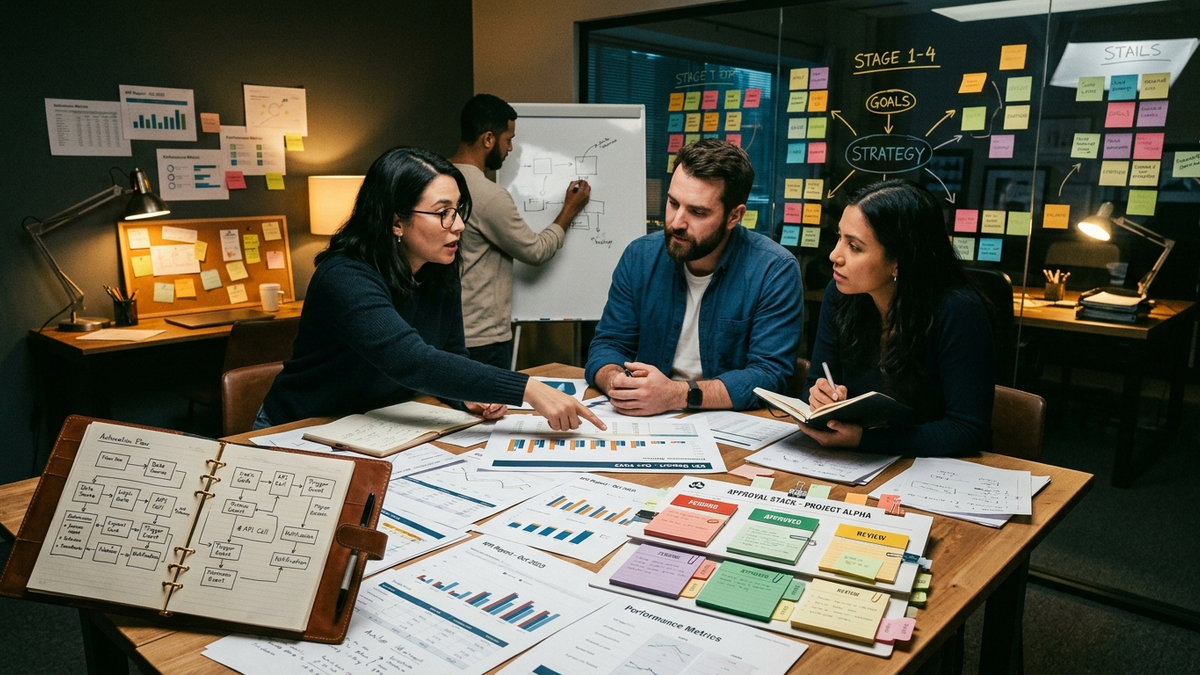
A practical OpenClaw trend on August 3, 2026 is that the strongest operator workflows are no longer being built as one giant autonomous agent. They are being assembled as portable approval stacks: a set of reusable tools, durable run state, and explicit human checkpoints that can travel across tasks without forcing the operator to rebuild context every time. For solo founders, creators, agencies, and small product teams, that matters because the real question is rarely whether a model can produce text. The real question is whether a workflow can gather information, pause safely, hand back something reviewable, and resume without turning into a brittle one-off.
The current source trail is unusually consistent. OpenAI's June 25, 2026 report How agents are transforming work says heavy users are delegating longer tasks and running multiple parallel workstreams. GitHub's July 23, 2026 update on agent automation controls in GitHub Issues adds approvals, rationale, and confidence controls directly inside the work surface. Google's May 12, 2026 post on pause-and-resume agents with ADK makes durable state a core production concern, and Google's July 1, 2026 explanation of why it built ADK 2.0 argues for blending deterministic workflow logic with agentic exploration. Anthropic's April 8, 2026 engineering post on managed agents describes separating orchestration from execution environments, while the July 28, 2026 Model Context Protocol introduction frames MCP as an open standard for connecting AI applications to tools, data, and workflows.
Put together, those sources describe a working pattern that fits OpenClaw unusually well. The system becomes more valuable when the operator can move the same workflow through chat, cron, browser tools, connectors, and handoff steps without rewriting everything for each new surface. That is why recent OpenClaw usage patterns keep clustering around custom skills, cron jobs, webhooks, and browser control.
Portable connections are becoming more important than bigger prompts
MCP's recent documentation matters because it describes tool access as a reusable interface rather than an app-specific hack. That sounds technical, but the operator implication is simple: if a workflow can reach the same tools and data sources from different AI clients or run contexts, it becomes easier to reuse and less expensive to maintain. Anthropic's managed-agents architecture points in the same direction. Its engineering team describes decoupling the "brain" from the execution "hands," which lets orchestration call into multiple environments only when needed instead of binding one session to one heavy container from the start.
For small operators, that shifts the design goal. Instead of asking for an all-purpose assistant, a founder can package a few narrow capabilities that travel well: a browser-check skill for competitive monitoring, a webhook-triggered intake flow for new leads, a scheduled morning brief, and a review step before anything is published or sent. That is much closer to the pattern described in earlier site coverage of portable skill packages and browser checkpoints with durable runs.
Approval surfaces are turning trust into a workflow feature
GitHub's July 23 controls are one of the clearest signals of the moment because review is not treated as a fallback. It is built into the automation interface itself through approvals, visible rationale, and confidence settings. That maps closely to how smaller teams actually want to use agents. They often want the system to sort, summarize, research, draft, and package work at speed. They do not want it silently altering production data, shipping customer messages, or taking live actions with no checkpoint.
In OpenClaw terms, the practical stack often looks like this: use webhooks or a cron trigger to start the routine, let tools gather the messy context, store artifacts in a stable place, then route the result back to a human-readable queue or session for approval. A creator can review captions and source links before posting. A small ecommerce shop can check competitor pricing and restock signals before updating a live listing. A software consultancy can let an agent inspect issues, reproduce a browser bug, and prepare a fix summary before anyone merges code. That review-first structure is why recent internal coverage of inspectable review queues and background subagents with review queues keeps feeling timely rather than transitional.
Durable execution matters because operator work is full of pauses
Google's ADK posts are useful here because they are focused less on glamour and more on runtime reality. Long-running work pauses. It waits on replies, external events, stock changes, human corrections, and scheduled windows. If the state disappears every time a process restarts or a workflow sleeps overnight, the operator is forced back into manual babysitting. OpenAI's June 25 report adds demand-side evidence: people are increasingly delegating longer and more parallel tasks, which makes pause, resume, and state management operationally central.
This is one reason OpenClaw-style workflows work well when they are broken into explicit stages rather than hidden inside a single session. A first stage can collect inputs. A second can normalize or enrich them. A third can generate a draft or recommendation. A fourth can wait for approval or a webhook event before continuing. That structure is easier to inspect, cheaper to rerun, and easier to debug when something drifts. It also aligns with prior site guidance around file-based operator playbooks and long-running agent routines.
What small operators can implement now
The near-term lesson is not that every workflow needs a complex agent platform. It is that even a lightweight OpenClaw setup benefits from three layers. First, package recurring instructions and tool access into reusable units, whether that means skills, connector patterns, or MCP reachable tools. Second, make the run durable enough to survive pauses and schedule boundaries. Third, define the approval point in advance so the human only reviews the work that actually carries consequence.
For a newsletter operator, that might mean a morning research sweep launched by cron, browser collection across several sources, a draft brief saved into the workspace, and a final editorial review in chat. For a local service business, it could mean webhook-driven lead intake, qualification against a rubric, a prepared response draft, and a human signoff before send. For a solo builder, it can mean a bug-report workflow that gathers repro steps and screenshots first, then packages a suggested fix instead of jumping straight to execution. In each case, the advantage is not maximal autonomy. It is a portable operator system that can be reused tomorrow with less setup than today.
That is why portable approval stacks look like the most practical OpenClaw trend right now. The market signals from June and July 2026 are converging around the same idea: useful agent systems are becoming easier to connect, easier to pause, and easier to supervise. For SMBs, creators, and solo operators, that combination is more valuable than a louder promise of full autonomy because it maps to the way real work already happens.
Sources
- OpenAI, How agents are transforming work
- GitHub, Agent automation controls in GitHub Issues in public preview
- Google Developers Blog, Build long-running AI agents that pause, resume, and never lose context with ADK
- Google Developers Blog, Why we built ADK 2.0
- Anthropic Engineering, Scaling Managed Agents: Decoupling the brain from the hands
- Model Context Protocol, What is the Model Context Protocol (MCP)?