
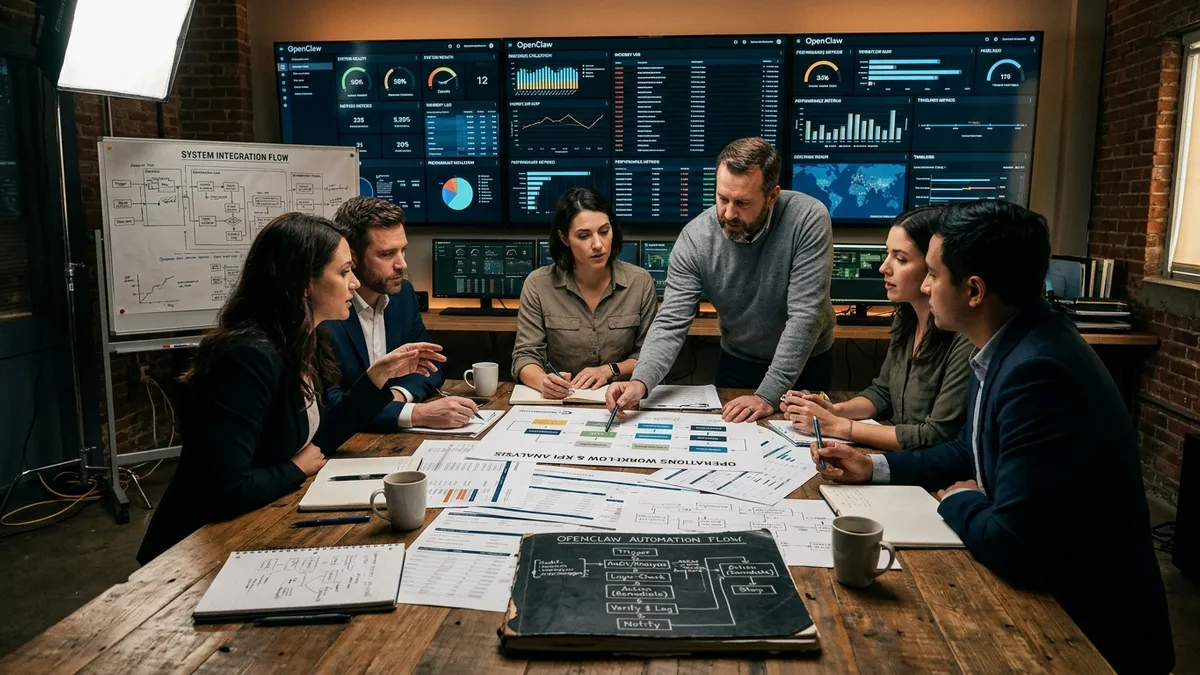
A practical OpenClaw trend on Wednesday, September 2, 2026 is that the reusable asset is no longer just a prompt. Across current primary sources, the repeatable unit is increasingly a workflow blueprint: a saved combination of task context, tool access, deterministic steps, approvals, and operator-facing instructions that can be rerun when the job comes back next week. That shift matters because most small teams do not need abstract autonomy. They need repeated work turned into something inspectable.
The supporting evidence is unusually broad. OpenAI's August 19, 2026 Codex platform post argues that the reusable part is the harness around the model and that builders should bring the agent into products and workflows people already use. OpenAI's August 25, 2026 post on repetitive work shows that those recurring jobs can be wrapped in notebooks that collect context, preserve review boundaries, and improve future runs. Anthropic's current hooks guide describes deterministic checks that run at key lifecycle moments. GitHub's June 9, 2026 custom agents post frames Markdown-defined agents as reusable, reviewable workflows. Google's July 1, 2026 ADK 2.0 post separates execution routing from language work, and the July 28, 2026 MCP documentation keeps workflows in the protocol vocabulary itself.
For OpenClaw operators, that ecosystem movement fits the product's native logic. A useful setup already tends to rely on custom skills, webhooks, cron jobs, and heartbeat routines. Coverage on workflow files, hooks, and background tasks and rerunnable operator scripts already pointed toward that direction. The new signal is that more of the leading ecosystem now treats the reusable workflow package, not the standalone chat, as the thing worth designing carefully.
Why workflow blueprints matter more than isolated prompts
Small operators often hit the same wall with AI: a prompt works once, but the second run needs remembered context, the third run needs a verification step, and the fourth run breaks because someone forgot a dependency or a formatting rule. OpenAI's Codex platform post gives a clean explanation for why. The hard part is not only generating text. It is gathering context, keeping state, using tools, staying inside boundaries, asking for approval, and carrying work forward. Those are workflow responsibilities.
In SMB and creator settings, that distinction is practical rather than academic. A newsletter operator needs a repeatable package for source gathering, citation checking, draft shaping, internal linking, and final review. A small agency needs a reusable client-report routine with data pulls, exception handling, and a signoff step before delivery. A founder running lean ops needs one saved blueprint for prospect research, another for issue triage, and another for publishing support. OpenClaw pages on founder daily operations and newsletter production map directly to that reality.
Deterministic steps are moving outside the model
One of the clearest 2026 patterns is that workflow builders are separating logic that should always happen from reasoning that benefits from a model. Google's ADK 2.0 post says workflows separate execution routing from language processing and can combine tool calls, human checkpoints, and open-ended steps. Anthropic's hooks documentation describes exactly where code can run automatically before or after important moments in an agent session. Both sources point toward the same implementation rule: if a step is mandatory, do not hide it in a prompt and hope the model remembers.
That rule is especially useful for OpenClaw operators because many repeated workflows involve public or consequential actions. A creator content pipeline may need a source-validation hook before publication. A local service business may need a human checkpoint before a quote or outreach message goes out. A repo-maintenance routine may need test and lint checks to run before any patch is proposed. The practical advantage comes from moving those steps into the workflow scaffold where they can be rerun consistently.
Versioned operator packets are becoming easier to maintain
GitHub's June 9 post on custom agents is useful because it shows this movement in plain operator terms. The reusable unit is a Markdown file that encodes tools, standards, and expected outputs so the workflow runs the same way each time. OpenAI's August 25 post on repetitive work adds the notebook angle: collect context around a workflow, wait for review at the right moment, and improve future runs using earlier ones. MCP reinforces the same direction at the protocol level by treating workflows and specialized prompts as shareable connection surfaces.
For solo operators and small teams, that means workflow maintenance is starting to look more like managing a runbook than hoarding magic prompts in scattered notes. The durable asset becomes a versioned packet with explicit inputs, access to the right tools, trigger conditions, and review boundaries. OpenClaw already supports that pattern through reusable instructions, schedules, and event-driven execution. The difference in late 2026 is that more surrounding tooling is converging on compatible assumptions, which makes these blueprints easier to port and reason about.
What operators can implement now
The most actionable reading of today's sources is simple. Pick one repeated job that already has a home in the business: weekly content production, lead research, support triage, repo upkeep, catalog cleanup, or reporting. Turn that job into a workflow blueprint instead of a saved prompt. Keep the prompt as one component, but add the real surrounding parts: source files, connector access, deterministic checks, approval pauses, and a place to store what the last run learned.
That approach is less dramatic than promises about fully autonomous coworkers, but it matches the verified product direction better. As of September 2, 2026, the practical trend is not that agents are escaping workflows. It is that useful agents are being packaged as workflows on purpose. For OpenClaw users, that is the important implementation pattern because it makes automation inspectable, rerunnable, and easier to fit inside the operating habits of SMBs, creators, and solo operators.
Sources
- OpenAI Developers, “Codex as a platform: build on the open agent harness,” August 19, 2026
- OpenAI Developers, “Automating repetitive work at OpenAI with Codex,” August 25, 2026
- Claude Code Docs, “Automate actions with hooks,” accessed September 2, 2026
- GitHub Blog, “From one-off prompts to workflows: How to use custom agents in GitHub Copilot CLI,” June 9, 2026
- Google Developers Blog, “Why we built ADK 2.0,” July 1, 2026
- Model Context Protocol Docs, “What is the Model Context Protocol (MCP)?” July 28, 2026 documentation