
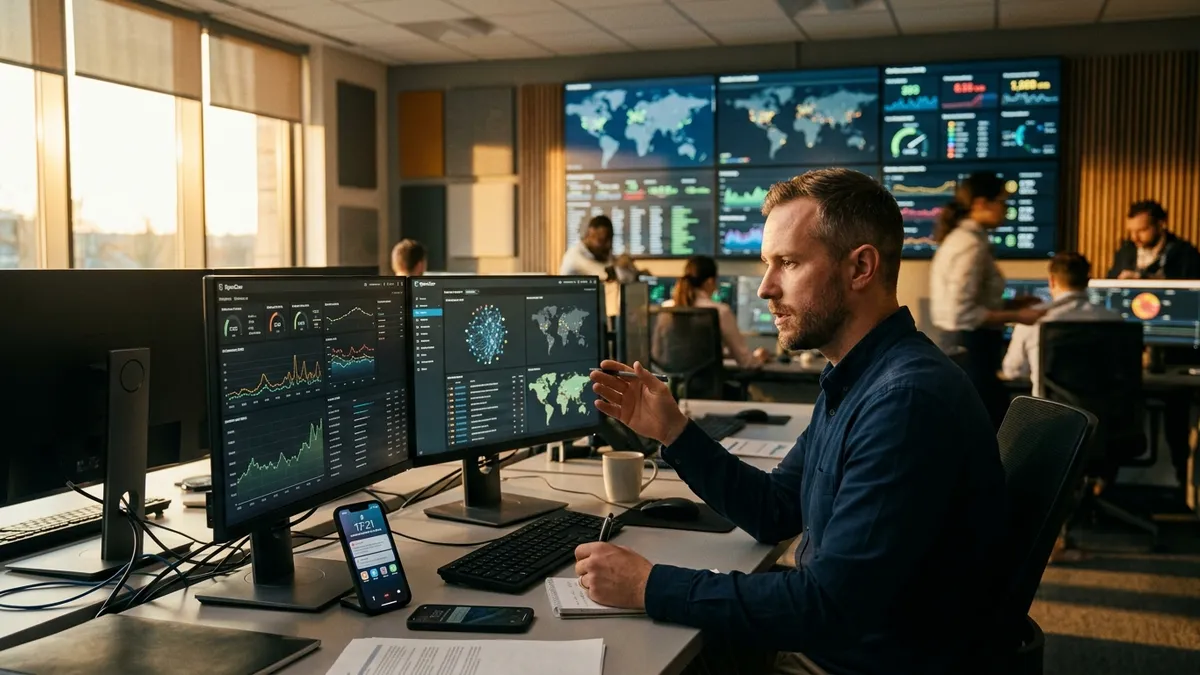
A clear OpenClaw trend on Tuesday, September 1, 2026 is that useful agent systems are moving closer to the actual place work happens. Instead of treating an AI session as a detached chat that produces a draft answer, current primary-source documentation increasingly frames the agent as a workflow component that sits beside a queue, a notebook, a repository, a dashboard, or a support console. The practical shift is not abstract autonomy. It is connected execution with bounded tools, durable context, and explicit review points.
The strongest evidence comes from official product and protocol materials published or maintained in 2026. OpenAI's August 19 and August 25 Codex posts describe the reusable part as the harness and the workflow itself, not only the prompt. Anthropic's current Claude Code documentation describes dynamic workflows as rerunnable scripts, specialist workers with bounded capabilities, and hooks as a way to make checks happen deterministically. GitHub's June 9 Copilot CLI guidance tells users to turn recurring terminal work into repeatable, reviewable agents. The latest Model Context Protocol specification defines prompts, workflows, tools, elicitation, and asynchronous tasks as standard building blocks rather than one-off product features.
For founders, creators, agencies, and small operations teams, that matters because most repeated work already lives in operating surfaces they know: content calendars, inboxes, CRMs, code repos, and browser tools. OpenClaw already maps well to that approach through custom skills, cron jobs, webhooks, and chat app connections. Recent site coverage of workflow files, hooks, and background tasks and rerunnable operator scripts showed adjacent pieces of the same movement. The newer signal is that agent value increasingly comes from staying attached to the system of record instead of forcing operators to keep pasting context into a blank window.
Why connected workflows are gaining ground
OpenAI's Codex platform post makes the case directly. It says the harness helps models gather context, use tools, operate within configured boundaries, request approval, and carry work forward. It also argues that developers can bring the agent into software designed around the actual job, including operations dashboards and customer support consoles. That is a meaningful implementation pattern for SMBs. A shipping broker, recruiter, local service company, or solo software founder typically does not need a fully new AI product. They need agent help inside the workflow they already run every day.
OpenAI's August 25 Codex workflow post pushes the idea further by focusing on recurring work. The article describes collecting context around a workflow, keeping review and approval boundaries in place, and improving future runs with what earlier runs learned. That logic fits small-team operations especially well because the repetitive tasks are usually practical and bounded: supplier checks, weekly publishing packages, audit scripts, prospect research packets, store catalog cleanup, and support summaries. OpenClaw guides for founder daily operations and sales prospecting already point toward the same model.
Narrow agents and connected tools beat one giant generalist
Anthropic's current Claude Code documentation suggests a practical design rule: the connected workflow should be broken into narrow workers with explicit capabilities. For a creator business, one worker might collect source material, another might shape a draft, and another might verify outbound formatting. For a small agency, separate workers can handle intake, production, and QA. For a repo-maintenance routine, one worker can gather evidence and another can prepare a patch under tighter rules.
GitHub's Copilot CLI article reinforces the same point from a terminal workflow angle. It frames custom agents as a way to move from one-off prompts toward repeatable, reviewable processes that understand a team's stack and standards. In practice, that is easier to maintain for smaller operators than trying to store every instruction inside one sprawling assistant persona. OpenClaw users can express the same idea through small reusable units connected by schedules, inbound events, or approval queues instead of depending on a single all-purpose worker.
Approvals and elicitation keep connected workflows usable
Connected execution becomes more valuable when it also stays safe to operate. Anthropic's hooks guide says hooks provide deterministic control because certain actions always happen instead of depending on the model to remember them. The current MCP specification adds a complementary protocol view, with tools for execution, prompts for templated workflows, elicitation for asking users for needed information, and optional tasks for long-running operations with polling, mid-flight input, and durable handles.
That combination is especially relevant for OpenClaw-style operator builds. A webhook can start the job, a narrow skill can perform the repeatable work, a hook can validate the output, and a human can be pulled back in only when the workflow reaches a consequential decision. That is a better fit for SMB and creator realities than the older idea of full autonomy. Most operators want speed on repetitive steps and judgment on expensive or public ones. The best implementation pattern is therefore not unlimited delegation, but connected routines with crisp pause points.
What small operators can implement now
As of September 1, 2026, the verified signal is that connected agent workflows are becoming a practical default across the leading tooling ecosystem. The most useful next step for an OpenClaw operator is to choose one workflow that already has a real home: a publishing checklist, support inbox, monitoring queue, GitHub maintenance loop, or sales research lane. Keep the agent attached to that surface. Limit the tools. Add one approval checkpoint. Save the routine so it can run again on demand or on schedule.
That approach is less dramatic than promises of fully autonomous digital coworkers, but it is much more clearly supported by today's primary sources. The trend is toward agents that work inside the operator's existing process, exchange live context with connected systems, and return reviewable outputs. For OpenClaw users, that is the implementation pattern worth watching because it turns AI from a separate assistant into a reusable layer inside day-to-day operations.
Sources
- OpenAI Developers, “Codex as a platform: build on the open agent harness,” August 19, 2026
- OpenAI Developers, “Automating repetitive work at OpenAI with Codex,” August 25, 2026
- Claude Code Docs, “Orchestrate subagents at scale with dynamic workflows,” accessed September 1, 2026
- Claude Code Docs, “Automate actions with hooks,” accessed September 1, 2026
- GitHub Blog, “From one-off prompts to workflows: How to use custom agents in GitHub Copilot CLI,” June 9, 2026
- Model Context Protocol, “Specification 2026-07-28,” July 28, 2026