
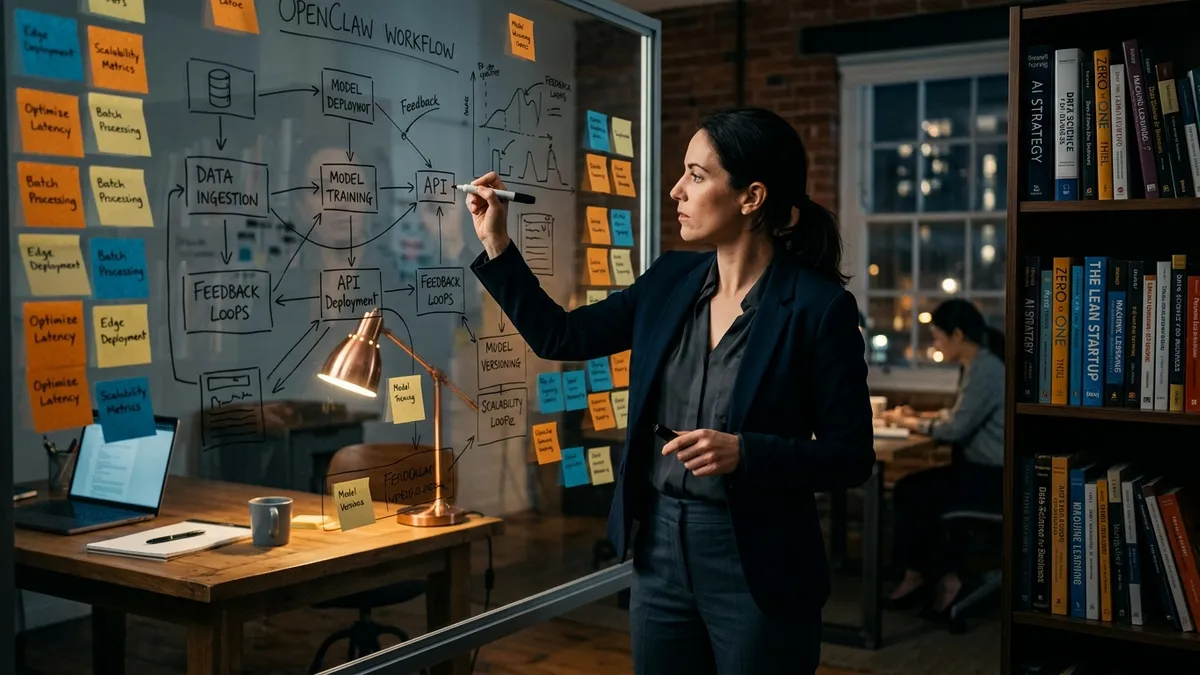
A practical trend in agent tooling on June 10, 2026 is that the most useful systems are becoming easier to define, inspect, and rerun. The shift is visible across several recent product releases: GitHub is turning custom agents into repository files, Microsoft is promoting deterministic orchestration for known multi-step work, and Google is packaging hosted runtime infrastructure behind a managed agent interface. Taken together, those releases point to a clearer implementation pattern for OpenClaw-style operators: agent behavior is moving out of one-off prompts and into reusable workflow assets.
That matters most for solo operators, creator businesses, and small teams that need repeatability more than spectacle. These users rarely need a system that improvises across every task. More often, they need a dependable loop for research, outreach prep, support triage, code review, or content production. In that environment, the winning stack is starting to look less like a single all-knowing chatbot and more like a combination of agent files, runtime boundaries, review checkpoints, and event-based automation.
Reusable agent files are becoming the new workflow specification
GitHub's June 10 post on custom agents in Copilot CLI describes agent profiles as repository files with role, scope, capabilities, and guardrails. GitHub's related documentation says those custom agents can live at user, repository, or organization scope and be invoked directly from the CLI. For operators, that means repeated AI work can now be stored the same way teams already store scripts, prompts, and playbooks: in versioned files that can be reviewed and improved over time.
This pattern closely matches how OpenClaw users already think about structured automation. Instead of leaving a reliable workflow buried in chat history, the logic can be pulled into durable instructions, much like the approach described in OpenClaw custom skills. For a small operator, that can mean a dedicated agent for weekly content research, a repo-maintenance agent tuned for a specific codebase, or a support-prep agent that always returns notes in the same format.
Review surfaces are replacing the myth of hands-free autonomy
GitHub's June 2 changelog for the Copilot app technical preview highlights canvases, isolated sessions, and work views that make agent output visible while the user stays in control. GitHub's framing is notable because it treats human work as output management: reviewing transcripts, checking diffs, and correcting course instead of constantly re-explaining the task.
That is a more realistic model for SMB and creator operations. A newsletter operator can review drafts before publication. A founder can check a pull request before merge. A sales assistant can inspect the research packet before sending the next step. The workflow still uses automation, but it keeps the final decision inside a visible checkpoint. That is consistent with earlier reporting on review-first workflows and with the approval patterns explained in OpenClaw heartbeats, where automation helps prepare work but does not have to publish or act unobserved.
Deterministic orchestration is gaining ground where task shape is known
Microsoft's May 14 announcement of Conductor is one of the clearest signals that many useful agent workflows do not need an LLM to decide every step dynamically. Microsoft describes Conductor as a YAML-first CLI where routing is deterministic, branching is explicit, and the orchestration layer consumes zero tokens. The company's rationale is direct: dynamic orchestration can add cost, latency, and unpredictability when the workflow structure is already known.
That matters for practical OpenClaw deployments because many operator tasks already have a stable shape. A daily trend article can follow a research, validate, draft, illustrate, build, and publish sequence. A lead-gen flow can scrape, normalize, score, and queue outreach. A maintenance routine can inspect issues, run checks, summarize failures, and prepare a fix. Those are better described as pipelines with agent steps than as open-ended autonomy. That logic also lines up with cron jobs and webhooks, which already treat triggers and handoffs as explicit workflow edges.
Managed runtimes are turning infrastructure into a service layer
Google's May 19 launch of Managed Agents in the Gemini API adds another piece to the stack. Google says a single API call can provision an agent that reasons, uses tools, and executes code inside an isolated Linux environment. The related environment documentation explains that these sandboxes can persist files across multiple interactions while remaining decoupled from the interaction context itself.
For smaller operators, this reduces one of the hardest parts of agent implementation: building secure runtime infrastructure before the workflow itself has even proven valuable. When sandboxing, state persistence, and tool execution are available as managed primitives, more effort can go toward the workflow definition and the human approval points. That same pattern is visible in OpenClaw's interest in workspace-native operations, covered recently in workspace-native automation.
What operators can implement now
The main takeaway from this week's tooling is that practical agent systems are converging on a repeatable architecture. One layer defines the agent in a durable file. Another layer routes the steps in a predictable sequence. A runtime layer executes code and tools inside a bounded environment. A review layer lets the human inspect outputs before anything consequential happens. For SMBs and creator-led operations, that design is more realistic than chasing fully autonomous behavior across messy real-world tasks.
In concrete terms, that means operators can start small: turn one repeated task into a file-backed agent, schedule it with a narrow trigger, keep the tool permissions tight, and add a review checkpoint before any public or destructive action. That pattern will not look as dramatic as fully autonomous demos, but the recent releases suggest it is where agent work is becoming more dependable. The trend is not simply that agents are getting smarter. It is that workflows are becoming legible enough for small teams to trust, audit, and run every week.