
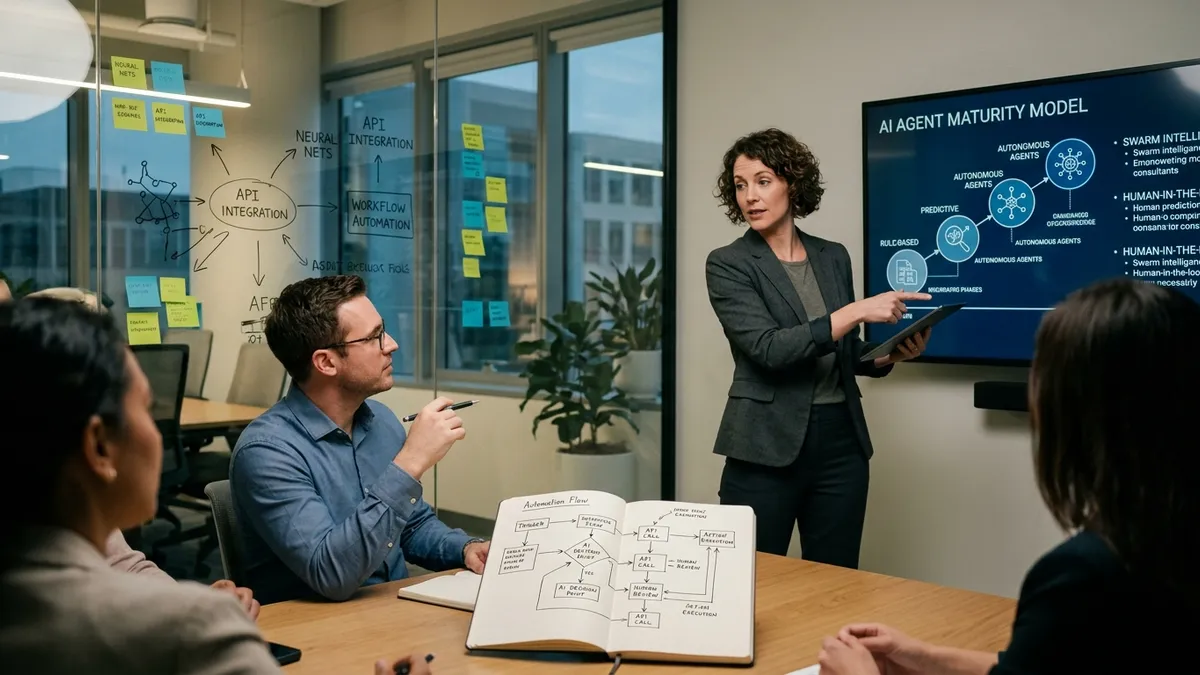
AI agent tooling is increasingly moving inside the work surfaces that small teams already use. That shift matters because most SMBs and creator businesses do not need another standalone demo. They need automations that can see the right context, call a few trusted tools, and hand work back to a human without forcing a large integration project first.
Several recent product updates point in that direction. On May 13, 2026, Notion introduced its Developer Platform with hosted Workers, an External Agent API, and native support for bringing outside agents into a shared workspace. On June 2, 2026, Microsoft announced Work IQ APIs, which become generally available on June 16, alongside a new admin surface for spending limits and usage monitoring. The common pattern is practical rather than theoretical: agent systems are being packaged closer to the documents, conversations, task queues, and approval loops where operators already spend their day.
Hosted runtimes are lowering the setup cost for operator automations
Notion's May 2026 platform launch is notable because it treats an agent workspace as a place where code, automations, and collaborators coexist. Workers run on Notion's hosted runtime, which means a small team can sync data, trigger webhooks, and build custom tools without first standing up its own long-running infrastructure. For small operators, that changes the starting point. Instead of wiring together a separate backend before testing a workflow, teams can begin closer to the actual work surface.
This makes agent adoption look more like workflow configuration and less like a bespoke software project. A creator operation could use a hosted worker to pull sponsorship leads into a workspace, enrich each record, and prepare a draft follow-up packet for review. A local service business could connect intake forms, route requests into a workspace database, and let an agent prepare summaries before a human approves outbound communication.
Context is becoming the real product, not just the model
Microsoft's June 2 Work IQ announcement makes the same point from a different angle. The company describes Work IQ as an intelligence layer built from mail, meetings, files, chats, people, and business systems, then exposed through APIs and protocols including MCP, A2A, and REST. For large organizations, that announcement is about internal productivity. For smaller teams, the more useful lesson is architectural: the best-performing agents are increasingly the ones attached to live workflow context instead of generic prompt windows.
In SMB environments, context-rich automation often produces more value than maximal autonomy. A three-person agency does not need an agent making every decision alone. It needs an agent that can see meeting notes, client status, deadlines, and recent messages, then assemble the next best action with enough evidence for a person to approve it quickly.
That is also why teams moving from prompts to production often end up building explicit connectors and data pathways, a pattern covered in our recent article on prompt-to-workflow transformations.
Open protocols are helping small teams avoid dead-end integrations
Another practical development is the continued spread of the Model Context Protocol. Anthropic said in December 2025 that it was donating MCP to the Linux Foundation's Agentic AI Foundation, and the protocol has since been adopted across multiple products and tool ecosystems. The SMB implication is straightforward: operators can expose a capability once, such as a CRM lookup, internal pricing sheet, or publishing action, and reuse that capability across different agent surfaces as support broadens.
That interoperability lowers switching costs. It also makes it easier to combine workspace-native tools with lightweight automation layers. Teams following this model often pair agent logic with inbound triggers and permission boundaries, similar to the webhook patterns outlined in our OpenClaw webhook guide and the modular packaging approaches described in our custom skills reference.
Workflow builders still matter because operators need bounded automation
The other side of the trend is visible in n8n's current AI documentation, where agent nodes sit inside ordinary workflows and can call tools, hand off to humans, or trigger sub-workflows. OpenAI's current Agents guidance similarly frames agent building as workflow design: models, tools, logic, knowledge, and evals are combined into a system rather than a single prompt.
For small teams, that design pattern is important because it keeps deterministic business logic in place. The recurring implementation pattern is hybrid automation: let the agent interpret messy inputs, summarize context, or choose among tools, but keep costs, destinations, approvals, and side effects inside explicit workflow nodes. That is what turns an interesting assistant into an operator system that can run every day.
What SMB and creator teams can implement now
Across the latest launches, four near-term deployment patterns stand out for smaller operators:
- Workspace triage: agents summarize inbound leads, support requests, or content ideas and route them into the right queue with a confidence score.
- Draft-first fulfillment: agents prepare proposals, briefs, reports, or replies, but a human approves final delivery.
- Context assembly: agents gather meeting notes, CRM history, and recent tasks so the operator starts from a complete brief instead of a blank page.
- Scoped action loops: agents can update records, trigger internal tasks, or request approvals, while sensitive external actions remain gated.
These are not abstract use cases. They align with the day-to-day loops that show up in founder operations, newsletter production, client delivery, and sales follow-up. Teams building those loops usually see the best results when they start with a narrow recurring task, instrument the handoff points, and only then expand tool access or parallel execution. That approach also maps well to the operator habits described in our founder daily operations guide and our coverage of production reliability for agent systems.
The near-term trend is implementation compression
The most important change is not that agents have become fully autonomous. It is that the distance between idea and implementation is shrinking. Hosted runtimes, workspace-native agent surfaces, workflow builders, and shared protocols are compressing the amount of custom setup required to ship a useful automation.
For SMBs and creators, that compression matters more than headline model benchmarks. It reduces the cost of experimentation, shortens feedback loops, and makes it easier to keep a human operator in control. If the last generation of agent tooling was about proving that agents could act, the June 2026 trend is about making those actions easier to scope, observe, and insert into ordinary work.
Sources
- Notion, "Introducing Notion's Developer Platform," May 13, 2026.
- Microsoft 365 Blog, "Announcing the new Work IQ APIs," June 2, 2026.
- Microsoft Foundry Blog, "Build agents you can trust across any framework with open evals and a control standard," June 2, 2026.
- Anthropic, "Donating the Model Context Protocol and establishing the Agentic AI Foundation," December 9, 2025.
- n8n Docs, "What's an agent in AI?"
- OpenAI Docs, "Agents."