
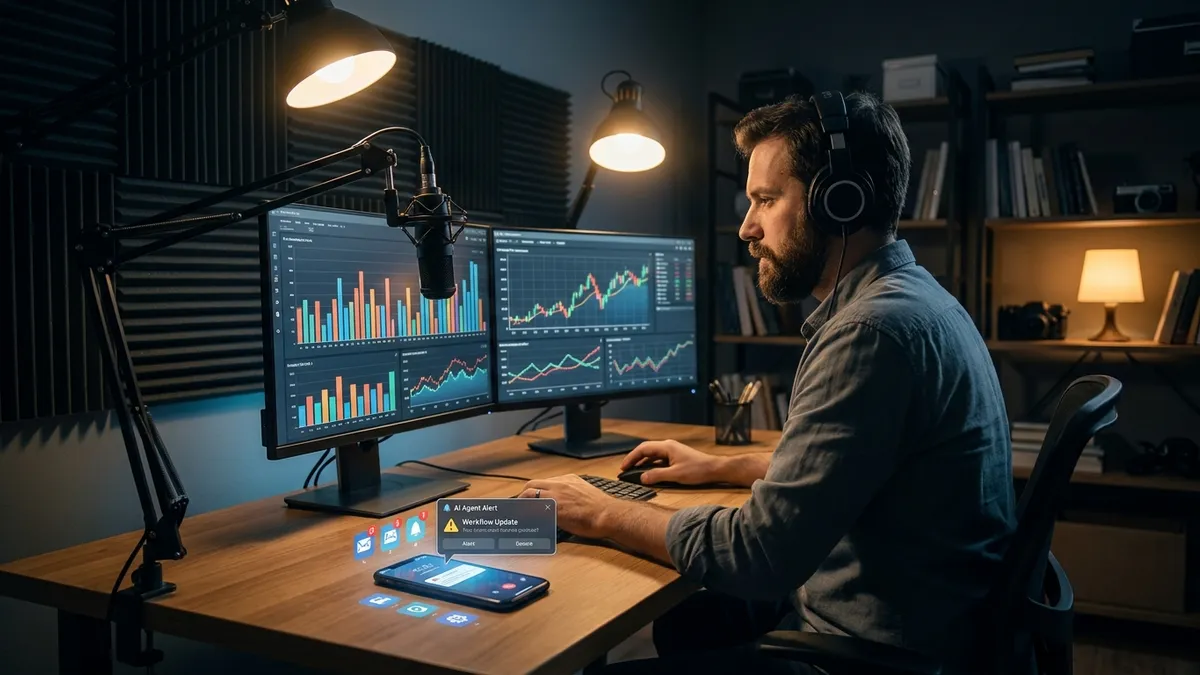
The "one-person company" is no longer theoretical. Individual operators are using AI agents to deliver the output of traditional 10-person teams, with some freelancers generating five- and six-figure monthly revenue streams without hiring employees. The shift represents a fundamental restructuring of how work gets done—where agents handle execution while humans focus on strategy, relationships, and creative direction.
The Solo Operator Landscape in 2026
A solo operator running AI-enhanced operations in 2026 looks different from traditional freelancing. These individuals orchestrate systems of autonomous agents that handle client intake, content production, customer support, and fulfillment workflows. According to Gusto's 2025 solopreneur research, 77% of solo founders turn profitable in year one—but many still work 50+ hour weeks, creating a time-for-money trap that agent workflows are designed to break.
One Vienna-based operator documented building a full-service agency delivering websites, SEO content, Google Ads management, and analytics setup—at 60-70% lower cost than traditional agencies—using a stack of AI agents that cost €220-450 monthly. The economic model is straightforward: eliminate payroll, office overhead, and project management layers while maintaining delivery quality through systematic automation.
Core Workflow Patterns for Solo Operations
1. Automated Client Intake and Qualification
Manual client intake consumes 8-12 hours per prospect when done traditionally. Solo operators now deploy agents that handle initial contact forms, schedule discovery calls, research prospect companies, and draft personalized proposals. The prompt-to-workflow transformation typically starts here—converting conversational requirements into structured data that feeds downstream automations.
Platforms like n8n enable visual workflow building where agents pull prospect data from forms, analyze company websites for context, generate tailored outreach emails, and score leads based on fit signals. The human reviews high-priority conversations; the agent handles qualification routing.
2. Content Production at Scale
Content businesses represent one of the highest-leverage solo operator models. Agents now handle research, first-draft generation, SEO optimization, and cross-platform repurposing. One documented case showed course creators generating substantial revenue within months by using agents to produce course outlines in under a minute—work that previously took weeks.
The workflow pattern: human defines topic strategy and quality standards, agent generates first drafts across formats (articles, social posts, email newsletters), human edits for voice and accuracy, agent handles formatting and distribution. This division of labor maintains quality while multiplying output 5-10x.
3. Customer Support Automation
Solo operators can't staff 24/7 support—but agents can. Modern implementations go beyond simple FAQ bots to handle actual transactions. Support agents now process refunds via Stripe, update order status in Shopify, check delivery tracking, and escalate only when confidence thresholds aren't met.
The infrastructure requires connecting support channels (email, chat, Discord) to an AI agent with tool access to payment processors, order management systems, and knowledge bases. Platforms like OpenClaw support custom skill development for connecting proprietary systems and building domain-specific automation.
4. Operations and Inventory Management
Ecommerce solo operators face inventory challenges that traditionally required dedicated staff. AI agents now monitor stock levels, predict demand patterns based on sales velocity, trigger reorder workflows with suppliers, and send low-stock alerts before shortages impact sales.
One implementation documented by n8n shows agents syncing inventory data across Shopify and WooCommerce, analyzing historical sales patterns, and automatically creating purchase orders when thresholds are breached—turning a manual daily task into a fully autonomous workflow.
The Practical Stack: What Solo Operators Actually Use
Development and Coding Agents
Claude Code and similar coding agents enable non-developers to build and maintain software products. One operator built a 23-district real estate analytics platform—including maps, charts, bilingual content, and a Chrome extension—solo, at approximately €150/month for the AI tooling.
The workflow: human describes architecture requirements and feature specs, agent writes components and implements logic, human reviews for correctness and business requirements, agent refactors and deploys. For operators interested in this pattern, vibe coding best practices provide implementation guidance.
Research and Analysis Agents
Tools like Perplexity replace research analysts by providing real-time data with citations. Solo operators use these agents for competitive analysis, market research, keyword discovery, and statistical validation—work that previously required dedicated research staff or expensive consulting reports.
Cost comparison: a single market research report from a consulting firm costs $5,000-15,000. A Perplexity Pro subscription costs approximately €20/month and provides unlimited research queries with verifiable sources.
No-Code Workflow Platforms
Non-technical operators rely on visual workflow builders like Make.com, n8n, and Zapier to connect agents across systems. These platforms enable complex multi-step automations—trigger on form submission, research prospect company, generate proposal, schedule follow-up, update CRM—without writing code.
For teams requiring more sophisticated orchestration, OpenClaw workflow patterns demonstrate how operators build custom automation that integrates multiple AI services and business systems.
Cost Structure and Economics
The total AI stack for a productive solo operation ranges from $200-500 monthly in 2026. A typical breakdown:
- Development/coding agent: $150-200 (Claude Code, Cursor, or similar)
- Research agent: $20-40 (Perplexity Pro, SearchGPT)
- Design tools: $15-30 (Canva Pro with AI features)
- Workflow automation: $0-100 (free tiers or low-cost plans for Make/n8n)
- Content generation: $20-60 (ChatGPT Plus, Claude Pro)
Compare this to hiring a single junior employee at $3,000-5,000 monthly (including benefits and overhead). The 10-20x cost advantage is why solo operators can undercut traditional agencies on price while maintaining higher profit margins.
However, as documented by payment infrastructure providers, heavy API usage can spike costs unpredictably. Operators who rely on API-based models report monthly bills ranging from $300-1,200 when running intensive workflows. Smart routing—using subscription models for daily work and API calls for batch processing—helps manage these costs.
Common Implementation Patterns
Start Small, Automate Incrementally
Successful solo operators don't attempt to automate everything simultaneously. The pattern: identify the most time-consuming manual task, build an agent workflow to handle it, validate reliability, then move to the next bottleneck.
One common sequence: automate email triage first (saves 1-2 hours daily), then client intake (saves 8-12 hours per prospect), then content production (multiplies output 5x), then support (enables 24/7 availability). Each step compounds the previous efficiency gains.
Human-in-the-Loop for Quality Control
Fully autonomous agents introduce reliability risks. Most successful implementations use human-in-the-loop patterns where agents handle execution but humans review before final delivery. Reliability testing for production agents shows how operators build validation steps into workflows to catch errors before they reach customers.
Typical checkpoints: agent drafts proposal → human reviews and approves → agent sends; agent generates content → human edits for voice → agent publishes; agent qualifies lead → human conducts discovery call.
Tool Integration Over Custom Development
Solo operators lack engineering teams to build custom infrastructure. The winning pattern: use existing platforms with pre-built integrations rather than coding from scratch. Platforms like OpenClaw provide integration frameworks that connect multiple AI services, business tools, and communication channels without requiring deep technical expertise.
Revenue Models That Work for Solo Operations
Not every business model scales effectively with AI agents. The patterns generating consistent revenue for solo operators:
Service-Based Businesses with Repeatable Deliverables
SEO content production, social media management, ad creative generation, and analytics reporting—services with defined scopes that agents can execute reliably. One operator running AI-automated ad creation for 10-15 local clients at $2,000 monthly generates $20,000-30,000 revenue with minimal human intervention.
Digital Products and Courses
Agents handle course outline creation, content drafting, video scripting, and student support. Creators maintain focus on subject matter expertise and community engagement while agents automate production and delivery workflows.
Niche SaaS and Micro-Tools
Small software products targeting specific workflows or industries. Development agents build features, support agents handle tickets, marketing agents drive growth. Revenue typically starts at $5,000-15,000 MRR before requiring additional team members.
Challenges and Limitations
Agent-powered solo operations face real constraints. According to Simon-Kucher's 2025 research, while 76% of companies launched AI features, most reported revenue uplifts below 10%—indicating a monetization gap between building agents and generating sustainable income.
Additional limitations:
- Relationship-heavy work doesn't automate well: Enterprise sales, strategic consulting, and complex negotiations still require human presence and judgment.
- Quality variance remains: Agents produce inconsistent output that requires human review, limiting the promise of full automation.
- Cost unpredictability: API-based models introduce variable expenses that can spike unexpectedly during high-volume periods.
- Scaling past $100K/month is rare: Most solo operations plateau because one person can only manage so many client relationships and strategic decisions, even with agent support.
Implementation Next Steps
For operators starting to build agent workflows:
- Audit time usage: Track where hours go for one week. Identify repetitive tasks consuming 5+ hours weekly.
- Start with one workflow: Pick the highest-time-consumption task and build an agent to handle it. Validate reliability before expanding.
- Use existing platforms: Leverage no-code tools and pre-built integrations rather than custom development.
- Build human review steps: Implement quality checkpoints before agent output reaches customers.
- Monitor costs closely: Track AI spending weekly to avoid surprise bills from API usage spikes.
- Document your system: As workflows grow complex, documentation becomes critical for maintenance and troubleshooting.
The solo operator model powered by AI agents is not speculative—it's operational today across content production, client services, ecommerce operations, and software development. The economics favor individual operators who can orchestrate these systems effectively, and the barrier to entry continues to drop as platforms mature and pricing becomes more accessible. The primary constraint is no longer capital or team size—it's the operator's ability to design systems that balance automation with human judgment.