
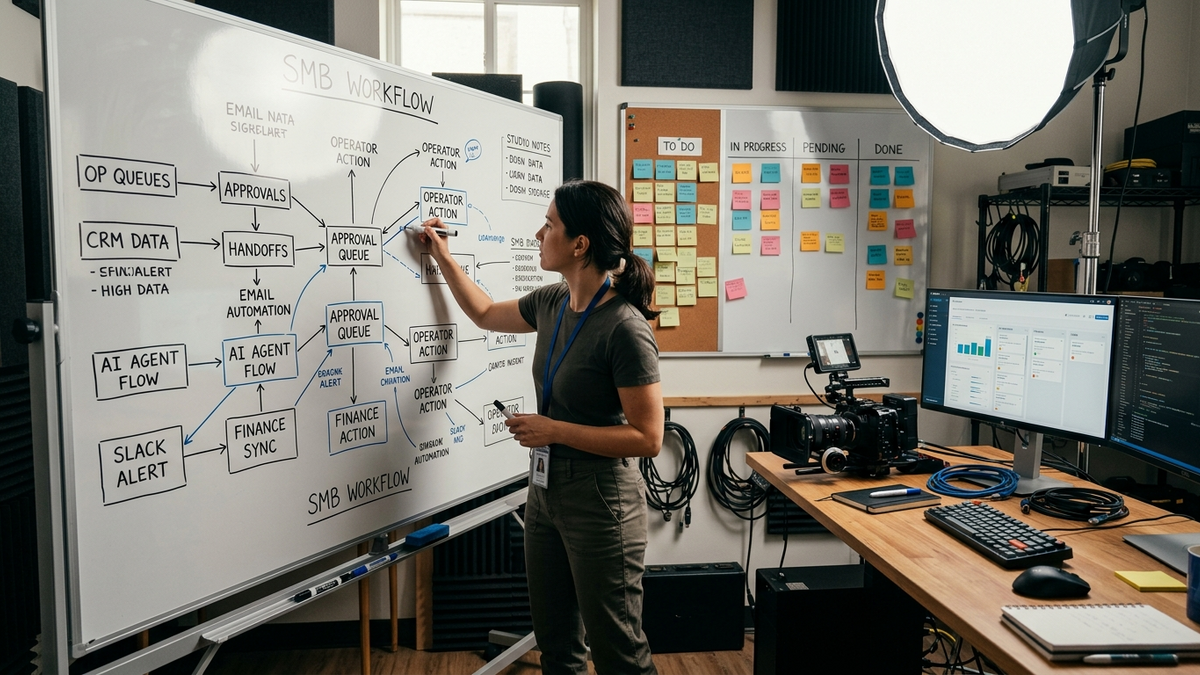
A practical AI agent trend on Wednesday, August 5, 2026 is that small teams are moving away from the idea of one all-purpose autonomous bot and toward narrower agents that hand work from one system to another. The pattern shows up across official product releases and docs from OpenAI, Anthropic, Zapier, n8n, and the Model Context Protocol ecosystem. Instead of asking one model session to research, decide, edit, file, notify, and publish in a single loop, builders are separating those jobs into tool-connected stages with explicit approvals, queue boundaries, and repeatable handoffs.
That matters because it fits how SMBs and creator operators actually work. Most do not need a free-roaming agent that improvises across the whole business. They need something closer to a dependable digital operator: research goes into a brief, the brief becomes a draft, the draft goes to review, and only the approved output touches the live system. Readers who have followed this site's coverage of prompt-to-workflow assets, approval-based automation, and cron jobs will recognize the same underlying lesson: the win comes from packaging judgment and routing, not from pretending every workflow should run as a single uninterrupted conversation.
Platform launches are now pushing builders toward connected tool use
OpenAI's new tools for building agents post made that shift explicit by centering the Responses API and built-in tools such as web search, file search, and computer use. Later, OpenAI's ChatGPT agent launch described a product that can research and act across sites, but it also emphasized connectors, browser takeover, and risk controls. The useful signal for smaller operators is not “let the model do everything.” It is that leading platforms now assume agent work will cross multiple tools and that the handoff points matter.
Anthropic is pointing in the same direction. Its tool-use overview explains how models call external tools rather than relying only on text generation, while the computer use tool shows the model operating through a controlled desktop environment. Those capabilities are important, but the deeper trend is architectural: reasoning is being paired with bounded action surfaces. For a small team, that makes it easier to decide which step should stay manual, which should be automated, and which should only run after review.
The connector layer is becoming the real implementation battleground
Once agent builders accept that work will move across apps, the connector layer starts to matter as much as the model. Anthropic's introduction of the Model Context Protocol framed the problem directly: developers were repeatedly rebuilding custom integrations between models, data sources, and tools. The protocol's current docs describe MCP as a standard way for AI applications to connect to data, tools, and workflows. That is a very practical trend for operators because standard connectors lower the cost of building narrow agents around existing systems instead of rebuilding the stack every time a new model shows up.
The same shift is visible in workflow products built for smaller teams. Zapier's guide to Zapier Agents positions agents as workers that can operate across thousands of apps, and its 2025 product redesign post highlighted monitoring, organization, and launch controls for autonomous workflows. n8n's AI agents page makes a similar promise from the builder side: visual workflows, code when needed, and traceable logic rather than invisible orchestration. Across these products, the trend is consistent. The valuable unit is no longer a chat box. It is a connected workflow with visible steps.
What this looks like in small-team production
In practice, this handoff model fits high-frequency SMB jobs better than full autonomy does. A local service business can use one agent to read inbound email and classify whether it is a lead, support request, or vendor issue, then pass the result into a structured queue. A second step can pull policy or pricing data from a connected source. A third step can draft a reply for human approval before anything is sent. That is a more grounded version of the ideas already covered in AI automated email and AI social media workflows: let the agent do the repetitive preparation, but keep live publishing and customer-facing commitments inside a review loop.
Creator operators can use the same structure. One agent can research links and transcripts, another can convert them into a house-style brief, and a final step can package approved content for channel variants. Small ecommerce teams can route catalog enrichment, customer FAQ drafting, and inventory summaries through separate lanes instead of one giant prompt. The measurable outcome is usually not a dramatic headline metric. It is steadier throughput, fewer broken runs, and less time spent restarting half-finished automation.
The next practical move is to design around handoffs, not hero runs
For operators shipping agent workflows now, the most useful next step is to redraw one repeated process as a series of narrow decisions. Mark where the model needs fresh judgment, where a tool should fetch or write data, where a human should approve, and where the result should wait in a queue instead of continuing automatically. That approach also lines up with custom skills and founder daily ops: durable systems improve when each stage has a clear role.
The broader trend is straightforward. Agent progress is still being driven by better models, but the operator advantage is increasingly coming from workflow shape. Small teams are getting more reliable value when they treat agents as components in a connected production system, not as magic workers that should improvise from start to finish.