
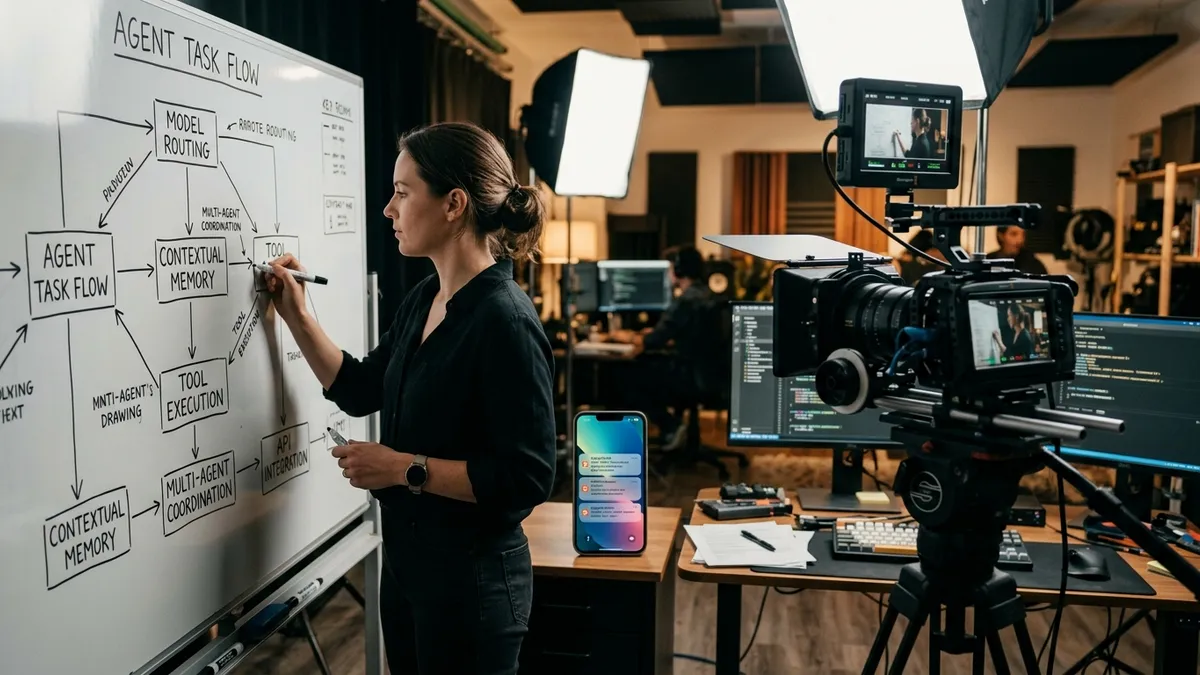
One practical AI agent trend on July 8, 2026 is the shift from open-ended chat assistance toward approval-based automations that small businesses can actually operate. The strongest recent signals are not centered on giant, fully autonomous systems. They come from workflow products and engineering guidance that package repeatable jobs into saved instructions, scheduled triggers, narrow tool access, and explicit review steps. That matters for smaller operators because the real constraint is rarely model intelligence alone. It is whether a recurring task can run without forcing one person to restate the process every time.
The market backdrop is already moving in that direction. QuickBooks said in its June 25, 2025 small-business survey of more than 2,200 US companies with up to 100 employees that 68% were using AI regularly, 74% of AI users said it was improving productivity, and the top reported uses were marketing, customer service, administrative work, data processing, and bookkeeping. Those are not speculative “moonshot” categories. They are repetitive operating jobs, which helps explain why the latest agent tooling is being shaped around workflows rather than one giant assistant.
OpenAI's April 22, 2026 launch of workspace agents in ChatGPT was a clear example. The company said teams can create shared agents for complex tasks and long-running workflows. OpenAI's related developer cookbook on building workspace agents goes further, showing an agent that runs on a schedule, gathers meeting context from connected tools, writes a briefing document, and shares output with teammates. That is a practical template for SMB work: one saved workflow, one clear destination, and less re-explaining between runs.
Approval gates are becoming part of the workflow, not an afterthought
The more revealing signal came on June 18, 2026, when OpenAI published its Workspace Agent API trigger pattern. The guide describes saved workflows as a package of instructions, connected context, app actions, approvals, and output format, then shows how another system can start that workflow when work begins outside ChatGPT. OpenAI's production checklist also tells builders to keep sensitive writes approval-gated until the workflow is reviewed. For small teams, that matters more than abstract autonomy claims. The useful design pattern is not “let the agent do everything.” It is “let the agent do the repeatable prep, then pause where a human judgment still matters.”
That pattern fits operator jobs already described across this site, from scheduled runs and webhook triggers to founder daily operations. A weekly reporting agent can collect records, draft the summary, and stop before sending. A support workflow can classify incoming requests, assemble a reply draft, and wait for review. A content pipeline can gather sources, prepare a brief, and hand off before publication. The measurable gain is not mystical reasoning. It is fewer manual handoffs and less duplicated setup work.
File-based workflow definitions are making agent behavior easier to share
GitHub has reinforced the same direction from the software side. On June 9, 2026, the company published guidance for custom agents in GitHub Copilot CLI, describing repository-based Markdown files that define the agent's role, tools, guardrails, and outputs. Two days later, GitHub said Agentic Workflows entered public preview and can compile natural-language Markdown into standard Actions YAML for tasks like issue triage, CI failure analysis, and documentation updates. Even though those examples come from software, the underlying pattern is broadly useful: if the workflow lives in a file, a team can review it, version it, and improve it without relying on one operator's memory.
That is especially relevant to creators and SMBs because reviewability is usually what separates a clever prompt from a dependable system. A solo operator can store how a lead-intake process should run. A tiny agency can standardize campaign research or client reporting. A two-person product team can turn bug triage into a saved workflow. That same progression is already visible in internal coverage of reusable workflow specs and workspace-native automation.
Implementation guidance still favors narrow scope over agent sprawl
The newest product releases also line up with older but still relevant engineering advice. Anthropic's December 19, 2024 post Building effective agents argues that the most successful teams use simple, composable patterns rather than complex frameworks, and distinguishes predefined workflows from more autonomous agents. OpenAI's practical guide to building agents makes a similar operational point: start by establishing a performance baseline, meet the accuracy target first, then optimize for cost and latency. It also recommends reusable tool definitions and notes that prompt templates can reduce maintenance complexity.
For smaller operators, those recommendations translate into a straightforward build order. First, choose one bounded workflow with a clear finish line. Second, connect only the systems needed for that job. Third, define the output format and the exact point where approval is required. Fourth, run the workflow often enough to notice failures and improve it. That approach is less glamorous than the “AI employee” narrative, but it is closer to what real operators can sustain on a budget. Teams making that shift can also borrow from custom skills and newsletter production patterns to keep procedures portable.
The July 8 signal, then, is not that small businesses suddenly need a large agent platform. It is that the most practical tools are converging on the same operating model: saved workflow files, external triggers, narrow tool access, and approval gates around higher-risk actions. That gives SMBs and creators something more useful than a flashy demo. It gives them a way to turn recurring work into automations that can be reviewed, shared, and measured.