
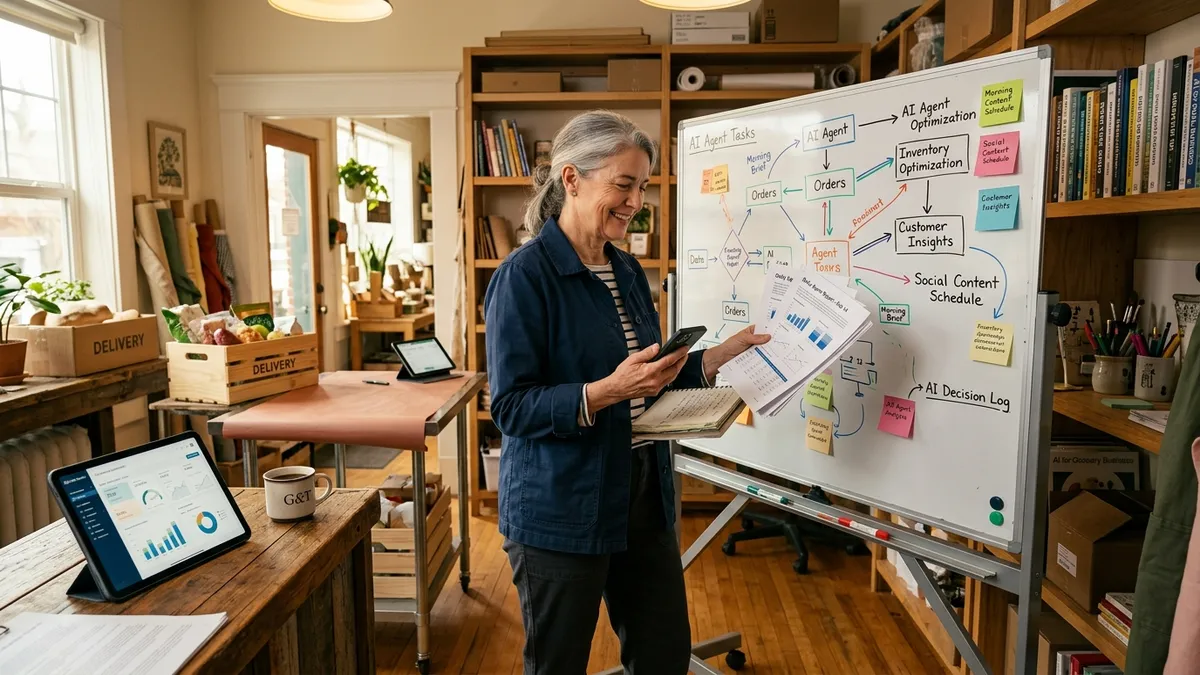
On October 21, 2026, Anthropic opened a research preview of Claude Duet, a standalone app where Claude works as a proactive agent rather than waiting to be prompted. It sends a morning brief, checks connected accounts in the background, keeps working after the app closes, and asks for approval before it sends a message, makes a payment, signs a document, or deletes anything. Anthropic built Duet for professionals and small business owners with more on their plates than they can track.
Duet is the fourth major front end in a wave that opened in early September. Meta expanded Muse with skills and connectors aimed at small businesses in late September. OpenAI introduced its personal agent, Dots, in September. Google announced the Gemini agent at Gemini at Work on October 8. For solo operators and small studios the interesting part is not that these products exist. It is that the constraint holding back larger organizations is the one resource a one-person business already owns: a human allowed to approve things.
What actually shipped
Claude Duet runs as a standalone iOS and Android app and on claude.ai, included in Pro and Max plans with a waitlist, starting with US subscribers. It runs tasks on its own cloud VM with its own browser, so work continues when the laptop closes. Anthropic says it can use more than 6,000 connectors and plugins in the Claude Marketplace, including ones that find missed Gmail and Slack messages, check QuickBooks or Stripe for unpaid invoices, and turn a product launch into a Canva campaign.
The guardrails matter most. Anthropic ships a dedicated classifier and safety-system prompt that rejects requests to share credit card numbers or government identification; health and personal-finance details pass only on explicit instruction. Two actions are off-limits even with approval: trading securities and moving money between accounts. Background checks and the morning brief count against the plan's five-hour and weekly limits, so users hit caps sooner than with chat alone. Anthropic is candid that Duet can misread a thread or misjudge what is urgent.
Muse for Small Business adds business skills and connectors to the personal agent Meta introduced in early September. The SBE Council lists connectors for Intuit QuickBooks, Shopify, Stripe, Canva, Slack, Asana, Notion and Zoom, plus Instagram analytics, Facebook Pages and Meta ad accounts. Meta says nothing publishes, sends or spends without the owner's approval. Tom Mulholland, owner of Mulholland Grocery in Malvern, Iowa, put the pitch plainly: “I work about 65 hours a week, and there are so many things where I'm the only one who can do them.”
The numbers are adoption, not outcomes
The most-quoted statistic in this wave is the least useful on its own. The SBE Council's Small Business Check Up Survey, published in late September, found that 58% of small employers already use AI agents regularly or occasionally and another 14% are considering them, meaning 72% are using them or planning to. The council's earlier 2026 technology survey found 82% of small business employers have adopted AI tools, the typical business using five, and 93% planning to keep investing.
None of that measures a result: reported revenue gains tied to AI are self-reported and not causal. Menlo Ventures' 2026 State of Consumer AI, based on a survey of 5,067 US adults, puts the agency question more precisely: 41% of AI users have tried an agent, 24% use one regularly, and 32% have let AI act on their behalf without final approval. Among agent users, 92% pay for AI and 63% use it daily.
The distance between 24% regular use and 72% intent is the real story, and it is the distance an operator closes with a scorecard, not a survey.
Why the approval gate is cheaper for a small shop
The most quoted line in the current coverage comes from Paul Baier, CEO of GAI Insights, in AI Business on October 22: no company over 1,000 people is clamoring to roll out Dots, Muse or Duet in the fourth quarter. His reasoning is that personal agents automate processes that handle confidential information and connect to internal systems, which is not a decision a security group makes quickly. Read the same finding from the other side and it becomes an advantage: the approval gate that stalls a 1,000-person company is a policy, a security review and a queue, while in a two-person shop the gate is the owner and costs minutes rather than quarters.
William McKeon-White of Forrester Research told AI Business that Duet has nothing super unique about it except the restraint in which it is being introduced. For a small operator, that restraint is the product.
The operator workflow
Pick a decision, not a workflow. These agents surface and prepare decisions. Start with one recurring decision: which invoices are unpaid, which replies need a human, which campaign is working. A personal agent is a triage layer, not a chain-automation engine.
Connect read-mostly, and start with two apps. Anthropic checks accounts at intervals so background polling does not burn through plan limits. Pick the two systems where a wrong read is cheapest to absorb.
Write the approval policy before the first approval request arrives. Decide in advance what the agent may never do, even with your approval. Anthropic already refuses to trade securities or move money between accounts; your own list should cover refunds, payroll, deletions and anything customer-facing.
Keep a decision log. One line per agent-initiated item: what it proposed, what you approved, changed or rejected, and how long it took. Without that log a personal agent is a stream of notifications and nothing else. It is the raw material for the scorecard pattern in the SMB measurement scorecard piece, and it maps onto the approval-first pattern in small-team approval loops.
Measure four numbers weekly. Signal rate: of surfaced items, what share are actionable. Decision latency: median hours from surfacing to closure. Approval precision: approvals you changed or rejected per ten. And owner time returned, where approvals count as time consumed against time saved. Approval precision is the reliability number, and belongs in the same loop as the eval discipline in the eval-loop piece for solo operators.
Watch the limits, not just the price. Background checks count against plan limits, and Anthropic warns that larger tasks such as financial models need more model turns. Budget for the meter the way cheap-versus-frontier routing budgets for the model call.
Know what does not come back. Anthropic's support documentation states that disconnecting an app stops Duet accessing it from that point on, but memory of past information from earlier conversations is kept. Treat every connected account as a durable record, not a temporary permission.
Where this lands
Personal agents are the first agent surface designed for a business with no agent team or governance committee. For a solo operator or three-person studio the sequence is straightforward: one recurring decision, two read-mostly connectors, a written approval policy, a decision log, and four numbers reviewed every Friday. If you are still assembling it yourself, the agent fundamentals and scheduled background checks cover the same loop without a vendor decision.
Sources
- Anthropic, “Introducing Claude Duet” — research preview, guardrails, connector list, and usage-limit behaviour (October 21, 2026)
- Anthropic Support, “Get started with Claude Duet” — access, task tracking, limitations, and what persists after an app is disconnected (October 22, 2026)
- Meta, “The Future Is for Everyone: Muse for Small Business” — business skills, connectors, custom connectors, and small-operator use cases
- SBE Council, “AI Agents Are Moving into the Small Business Mainstream” — Small Business Check Up Survey findings and the Muse connector set (September 30, 2026)
- AI Business, “Anthropic rolls out Claude Duet” — analyst commentary from Forrester and GAI Insights (October 22, 2026)
- Menlo Ventures, “2026: The State of Consumer AI” — agent trial, regular use, delegated-action and income figures from a survey of 5,067 US adults