
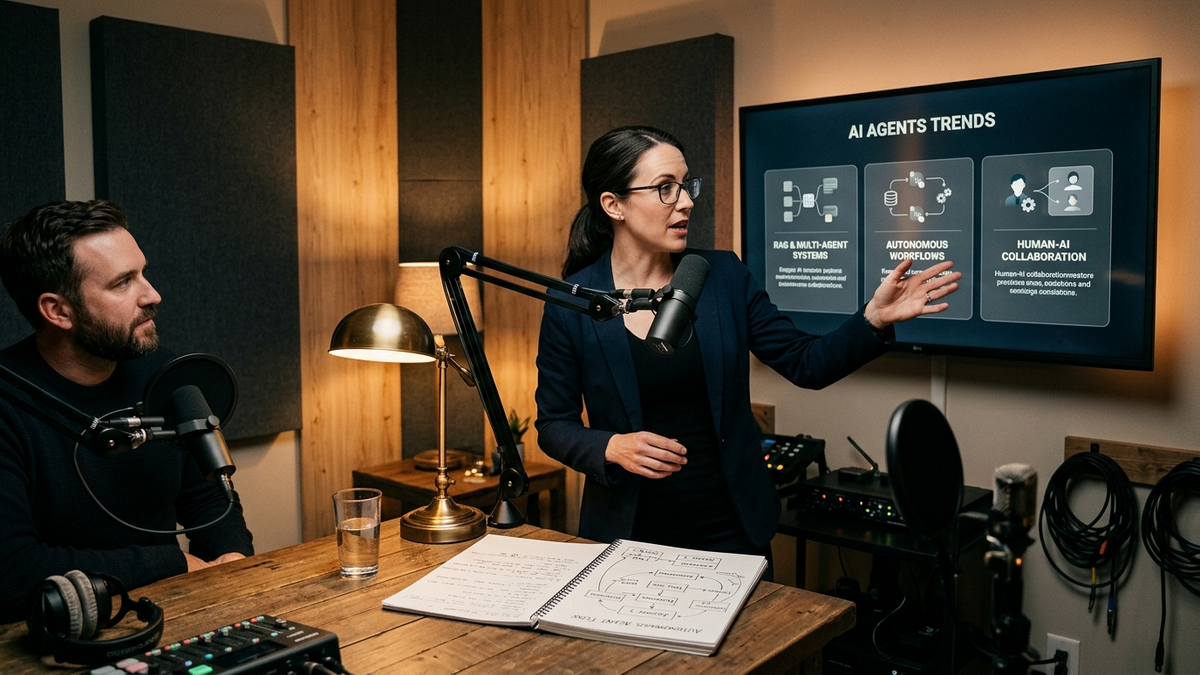
A practical AI agent trend on Monday, August 24, 2026 is that smaller operators are becoming less interested in fully autonomous assistants and more interested in workflows that stop for review before anything important happens. The shift is visible across current platform documentation rather than in a single splashy launch. OpenAI's recent Codex platform post frames agents as systems that gather context, use tools, request approval, and carry work forward inside existing applications. Anthropic's current Claude Code documentation treats subagents and hooks as normal building blocks, not edge features. Workflow tooling from n8n is also leaning into controls that run inside the workflow itself.
For founders, creators, agencies, and other hands-on operators, that matters because most of their useful automations are not abstract. They are concrete jobs with visible risk: qualifying leads, checking a site, preparing a client summary, packaging research, or drafting outreach. A small team usually wants the speed of agent execution without giving an LLM open-ended authority over the final action. That is the same pattern behind this site's recent coverage of prompt-to-workflow transformations, trace and regression loops, and specialist agent stacks. What looks clearer today is that the approval step is turning into the default operating pattern.
OpenAI's current guidance points to reviewable workflows, not one giant bot
OpenAI's August 19, 2026 post on Codex as a platform describes an open agent harness that helps models reason through tasks, use tools, operate within boundaries, request approval, and keep work moving. That wording matters because it shifts the idea of an agent away from a chat-only assistant and toward a workflow engine with checkpoints. A second OpenAI signal comes from the current scheduled tasks documentation, which treats recurring work as something operators can define, run in the background, and route back to a chat or workspace for review.
That is a strong fit for SMB use cases because recurring operations are where time is usually lost. A creator can schedule morning research collection and review the packet before publishing. A small service firm can let an agent gather lead context, but require a human to approve the actual outreach. A software shop can let an agent run repo checks and draft fixes while a maintainer still signs off on the patch. The internal playbooks on scheduled jobs, founder daily operations, and repository maintenance all map cleanly to that approach.
Anthropic's subagents and hooks make the review layer more concrete
Anthropic's subagents documentation says builders can create specialized workers for task-specific workflows and improved context management. Each subagent gets its own prompt, tool scope, and context window. That is useful for small teams because it discourages the all-in-one assistant pattern. One worker can gather sources, another can draft a summary, and a third can check formatting or citations. Separating those roles makes it easier to see where human review should happen.
The hooks guide adds the enforcement layer. Anthropic documents hooks as a way to run code at key lifecycle points, including before or after tool use and when a session stops. In practical operator terms, that means a workflow can verify files, block risky commands, send a notification, or insist on a final check before the run is considered complete. For SMBs, this is less about formal governance and more about keeping real-world actions legible. It complements internal guidance on custom skills, browser control, and debugging with AI: narrower workers become more trustworthy when the operator knows where the guardrail lives.
Workflow platforms are pushing the same pattern for real operations
n8n's July 24, 2026 article on AI agent governance is written for production controls, but its most useful takeaway for smaller operators is architectural rather than organizational. The company argues that controls should run where the agent actually runs, inside the workflow, not in a separate policy deck. That translates well to SMB automation: validate a lead before enrichment, confirm a budget before a paid API action, check the output schema before sending a client deliverable, or route uncertain cases to a human queue. The practical point is that the check should be embedded in the same flow as the action.
OpenAI's current use-cases page reinforces that direction by showing recurring knowledge work, inbox cleanup, computer use, and long-running objectives as structured workflows rather than standalone chat moments. When those examples are read together with Codex automations and Anthropic hooks, a clear pattern emerges: the winning agent systems for smaller operators are the ones that can be scheduled, decomposed, and interrupted before something expensive or public happens.
What small teams can copy from this trend now
The practical lesson is not that every SMB needs a heavy orchestration stack. It is that agent workflows work better when the operator defines three things up front. First, what the agent is allowed to do without help. Second, what must stop for approval. Third, what evidence should be attached to that approval. For a creator, the evidence may be source links and a draft. For a sales operator, it may be lead data and a proposed email. For a developer, it may be logs, diffs, and test output. That is a much more practical pattern than asking one general assistant to “handle everything.”
This also helps with cost and reliability. Specialist workers keep context smaller, which usually makes reruns cheaper. Approval gates reduce the blast radius when a workflow goes off track. Scheduled runs turn repeated work into routines instead of one-off prompts. Those benefits line up with the site's recent articles on cost routing for small teams and session handoffs and operator memory. The approval-first workflow is not flashy, but it is exactly the kind of structure that lets a two-person company use agents every day without turning operations into a guessing game.
On August 24, 2026, that is the clearer direction in agent operations: smaller teams are not waiting for a perfect autonomous worker. They are assembling reviewable flows that can gather context, do the boring middle steps, and stop with enough evidence for a human to make the final call.
Sources
- OpenAI Developers, “Codex as a platform: build on the open agent harness,” August 19, 2026
- OpenAI, “Scheduled tasks,” accessed August 24, 2026
- OpenAI Developers, “Use cases,” accessed August 24, 2026
- Anthropic, Claude Code Docs, “Create custom subagents,” accessed August 24, 2026
- Anthropic, Claude Code Docs, “Automate actions with hooks,” accessed August 24, 2026
- n8n, “AI Agent Governance: Controls for Production Systems,” July 24, 2026