
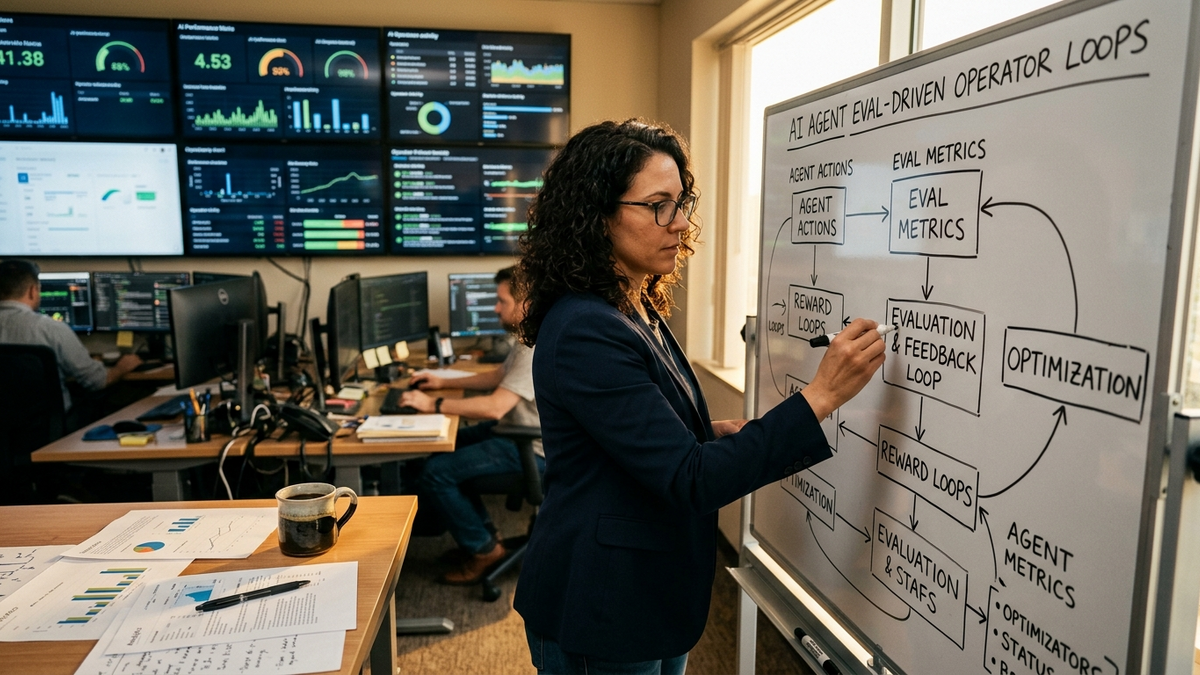
A practical AI agent trend on June 24, 2026 is that operators are no longer treating reliability as a vague future requirement. The strongest current shift is toward eval-driven loops: agents are being judged not only by the final answer they produce, but by the traces, tool choices, latency, token use, and review steps they create along the way. That change matters most for small businesses, creator teams, and solo operators because those users cannot afford workflows that look impressive in a demo and then fail quietly during a live client handoff, a support queue, or a publishing deadline.
Recent official documentation from OpenAI, Anthropic, LangChain, and Google points in the same direction. The common message is that practical agent adoption is moving away from one-shot prompting and toward repeatable operating loops: inspect what the agent did, score the behavior, refine the tool surface, and rerun the workflow. That framing lines up with the site's earlier coverage of production reliability and the knowledge base guidance on scheduled agent runs, where consistent execution matters more than conversational flair.
Trace review is becoming the first step, not the cleanup step
OpenAI's current Evaluate agent workflows guide puts traces at the center of the workflow. Its recommended sequence is to inspect representative traces first, then run graders against them, and only after that move toward repeatable datasets and eval runs. That is a practical signal for operators: before scaling an agent, first verify how it routed work, whether it picked the right tool, and whether a handoff happened when it should have.
For a lean agency or online business, this changes what “testing an agent” actually means. The operator does not need a heavyweight research lab. It needs a trace that answers concrete questions: Did the lead triage agent hit the CRM lookup before drafting a reply? Did the publishing agent stop for approval before scheduling the post? Did the research agent cite source material or improvise? Those are workflow questions, not abstract model questions, and they are the same kinds of checks that make founder daily ops safer to automate.
Deterministic checks are giving small teams a low-cost eval baseline
OpenAI's recent developer post, Testing Agent Skills Systematically with Evals, describes a lightweight pattern that is especially useful for smaller teams: capture structured execution output, save it as JSONL, and score what actually happened with deterministic checks before adding model-based grading. The post's examples are software-oriented, but the implementation pattern generalizes well. A content workflow can check whether source files were created. A support workflow can check whether required tools were called. A research workflow can check whether the expected search or retrieval step happened before synthesis.
That matters because many SMB workflows fail in predictable ways. An agent loops too long, skips a required tool, or produces a usable-looking answer without completing the underlying task. Deterministic checks catch that cheaply. They also pair naturally with the workflow-first ideas already covered in prompt-to-workflow patterns and custom skills, because once a good prompt becomes a reusable workflow, it can also become a reusable test target.
Rubric grading is filling the gap between “it ran” and “it was good”
Deterministic checks alone are not enough for open-ended tasks, and that is where rubric-style evaluation is becoming a standard operating layer. OpenAI's evals post recommends adding structured qualitative grading after the basic checks pass. Anthropic's Demystifying evals for AI agents makes a similar point from another angle, showing agent evaluations that mix multiple grader types, including tool-call requirements, state checks, transcript constraints, and communication-quality rubrics.
This is a practical shift for operators because many real workflows are only partly objective. A client-update drafter might need the right facts, the right tone, and the right approval path. A research summary might need grounded claims, adequate coverage, and clean source use. Anthropic's research-agent discussion explicitly points to groundedness and coverage as evaluation problems, which maps closely to article drafting, market scanning, and creator research pipelines. In other words, operator teams are learning to score both task completion and task quality instead of pretending one number can stand in for both.
Trajectory scoring is moving agent evaluation below the surface
Another clear trend is that builders increasingly want to score the path an agent took, not just the final output. LangChain's Evaluate a complex agent tutorial breaks evaluation into three layers: final response, trajectory, and single-step evaluation. Google's Vertex agent evaluation guidance uses the same distinction, separating final response from trajectory evaluation and then measuring whether the agent followed the needed sequence of actions in exact, in-order, or any-order ways.
For small teams, trajectory scoring is valuable because it turns hidden failure modes into visible workflow defects. If an outreach agent reaches the correct final draft but wastes time with redundant tool calls, that still affects cost and latency. If a support agent resolves the ticket but skips identity verification, that is a process failure even when the answer looks fine. This is the same operational logic behind trigger-based SMB workflows: the agent sits inside a business process, so the process path matters.
Tool metrics are becoming implementation work, not observability theater
Anthropic's Writing effective tools for AI agents pushes the trend one step further by treating tool design itself as an eval surface. The company recommends tracking runtime, total number of tool calls, token consumption, and tool errors, then using those signals to spot confusing schemas, wasteful pagination, or brittle descriptions. That is a strong signal that practical agent work is maturing around implementation discipline rather than around general claims of autonomy.
That advice fits the needs of creators and operators better than enterprise-first narratives usually do. A newsletter team, course business, or micro-agency often wants the same thing a developer wants: fewer redundant steps, cleaner tool handoffs, lower token burn, and obvious recovery paths when something breaks. The winning playbook is not “deploy one agent everywhere.” It is “tighten one workflow until it behaves predictably, then expand from there.”
The operator takeaway for June 2026
The practical lesson from current primary sources is that reliable agent adoption now looks more like operating a workflow than prompting a chatbot. Teams start with a bounded task, log traces, add deterministic checks, layer in rubric grading, inspect trajectory quality, and keep refining tools. For small businesses and creators, that approach is more realistic than chasing full autonomy because it makes failure explainable and improvement measurable.
The next useful move for an operator is simple: pick one recurring process, decide what “done” looks like, record the agent's path, and score it. That could be intake triage, weekly research, repurposing content, or repository maintenance. The broader trend is clear. AI agents are becoming more useful when they are embedded in eval-driven loops that humans can inspect, rerun, and trust.
Sources
- OpenAI API Docs, "Evaluate agent workflows"
- OpenAI Developers, "Testing Agent Skills Systematically with Evals"
- Anthropic Engineering, "Demystifying evals for AI agents"
- Anthropic Engineering, "Writing effective tools for AI agents"
- LangChain Docs, "Evaluate a complex agent"
- Google Cloud Blog, "Evaluate your AI agents with Vertex Gen AI evaluation service"