
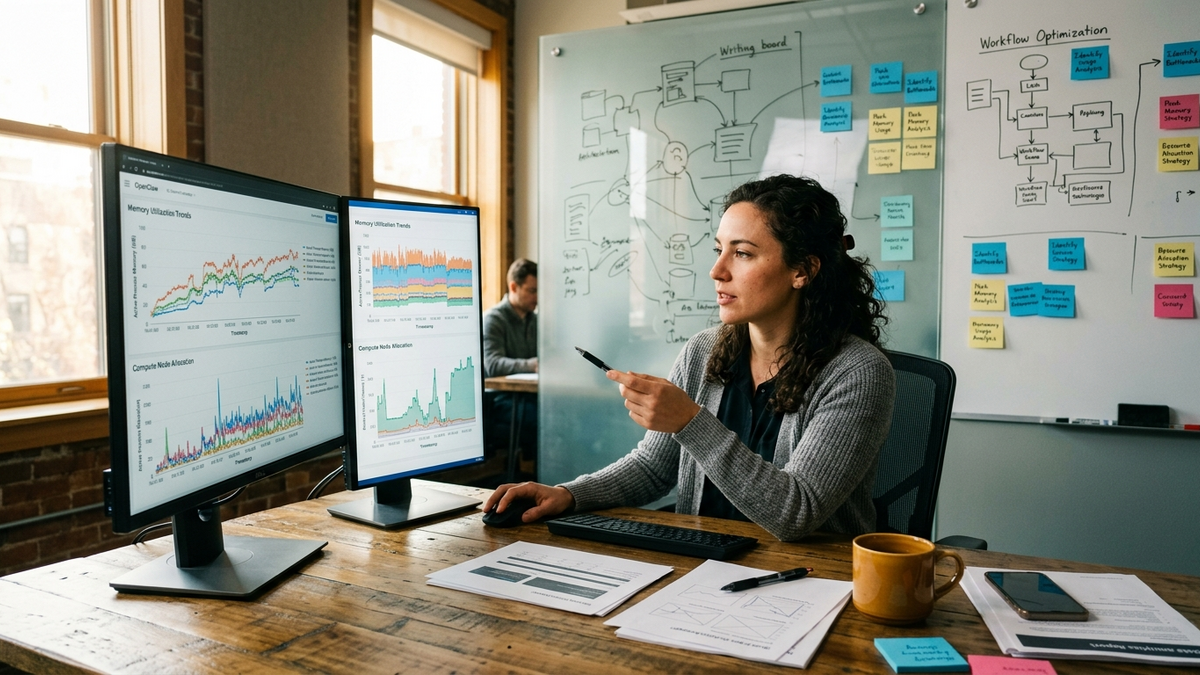
A practical OpenClaw trend on June 15, 2026 is that memory is becoming part of the workflow surface itself, not just a hidden side effect of a long chat. Recent updates from GitHub, OpenAI, Google, and Anthropic all point toward the same implementation pattern: useful agents now keep reusable context in explicit places such as versioned files, session histories, persistent environments, or deliberate check-in loops. For operators running small businesses, creator systems, or solo software shops, that matters because repeatable memory is what turns one good run into a durable operating process.
The shift is easy to understand from the operator’s side. A founder does not simply want an agent that once wrote a strong support draft or once assembled a useful research brief. The stronger requirement is continuity. The next run should remember the house style, the last known constraints, the right files, and the review points that matter. That is increasingly how major vendors are designing agent tooling, even though they describe it with different product terms.
GitHub is turning session history into a reusable operating layer
GitHub’s June 2, 2026 launch of /chronicle is one of the clearest examples. GitHub says each Copilot session builds a private history that can be queried later, and the updated feature now pulls together sessions across GitHub, the Copilot app, VS Code, JetBrains, and cloud-agent surfaces. In practical terms, that turns session history into a searchable source of standup summaries, tips, and reusable instructions instead of leaving it trapped in whichever window happened to be open.
That model lines up closely with how OpenClaw operators already work when they rely on workspace instructions, saved files, and recurring runs rather than one-off chat threads. The durable value lives in the stored operating context around the run, which is why guides on heartbeats and founder daily ops matter so much in practice. They give memory a place to live between runs.
Custom agent files make memory portable instead of personal
GitHub reinforced the same trend again on June 9, 2026 in its post on custom agents in Copilot CLI. GitHub describes those agents as Markdown-defined profiles stored directly in the repository, where the file can specify role, scope, capabilities, and guardrails. The significance is not just customization. It is portability. The memory of how the agent should behave moves out of one operator’s head and into a reusable asset that can be versioned, reviewed, and shared.
For OpenClaw users, that is the same basic logic behind skills, prompt scaffolds, and workflow specs. A content-production agent can remember output structure because the structure lives in a file. A repo-maintenance agent can remember triage standards because the standards are stored with the project. That approach fits earlier site coverage of skill files as governed workflow assets and workflow specs as durable operator tools.
OpenAI is making memory and harness behavior explicit design choices
OpenAI’s API changelog adds another concrete signal. On April 15, 2026, OpenAI said the updated Agents SDK now supports controlled sandboxes, inspection and customization of the open-source harness, and direct control over when memories are created and where they are stored. That matters because it treats memory as a configuration decision rather than a vague expectation that the model will “just remember” what matters.
For SMB and creator workflows, that distinction has immediate value. A daily research agent may need short-lived memory that resets after each run. A support assistant may need reusable customer-handling rules but not persistent access to every previous draft. A publishing workflow may need long-lived style guidance yet still require a human signoff before anything goes out. Explicit memory controls make those tradeoffs easier to design, test, and document than improvising them inside one endless prompt.
Google is separating interaction history from the working environment
Google’s current Gemini managed-agent documentation shows a similar move from another angle. In the environment guide, Google says environments are managed Linux sandboxes that are decoupled from interaction context, allowing developers to reuse the same environment across multiple interactions or start fresh as needed. Installed packages and files persist when that environment is reused.
That is an important implementation pattern for OpenClaw-style operators. Memory is not only about chat recall. It is also about the state of the workspace: which files exist, which tools were installed, which artifacts are available for the next step, and whether the operator wants continuity or a clean reset. The practical result is a more predictable split between temporary thinking and durable working state, which also supports patterns like scheduled runs and parallel operator workflows.
Anthropic is framing memory around check-ins, not blind persistence
Anthropic’s April 9, 2026 research note Trustworthy agents in practice adds an equally useful caution. The company says that on complex tasks, Claude’s own rate of checking in with users roughly doubles, which Anthropic presents as evidence that agents need to be calibrated on when to act and when to hand a decision back. That makes workflow memory less about storing everything forever and more about knowing when the system should pause, summarize, and return control to the operator.
This is especially relevant for solo operators, because their strongest AI workflows usually blend persistence with interruption points. A lead-gen agent can gather targets automatically, but a human still chooses who gets the outreach. A newsletter pipeline can assemble research and structure, but a human still approves the final framing. An operations assistant can maintain a running state file, but it should still escalate when the context becomes ambiguous. In that sense, good workflow memory is not passive storage. It is an organized handoff system.
The operator takeaway is to design memory as infrastructure
Taken together, these releases suggest a clear practical direction for OpenClaw users. Useful memory should be designed on purpose. Some context belongs in files such as skills, workflow specs, and checklists. Some belongs in saved session history that can be searched later. Some belongs in the persistent working environment so the next run has the right tools and artifacts. And some belongs in summaries that deliberately hand decisions back to the human at the right moment.
That framing is more grounded than the older idea that better models alone would solve continuity. The stronger market signal in June 2026 is that continuity is increasingly a workflow design problem. For SMBs, creators, and solo builders using OpenClaw, that is good news. It means memory can be shaped into something reviewable, teachable, and dependable enough to support real daily operations.