
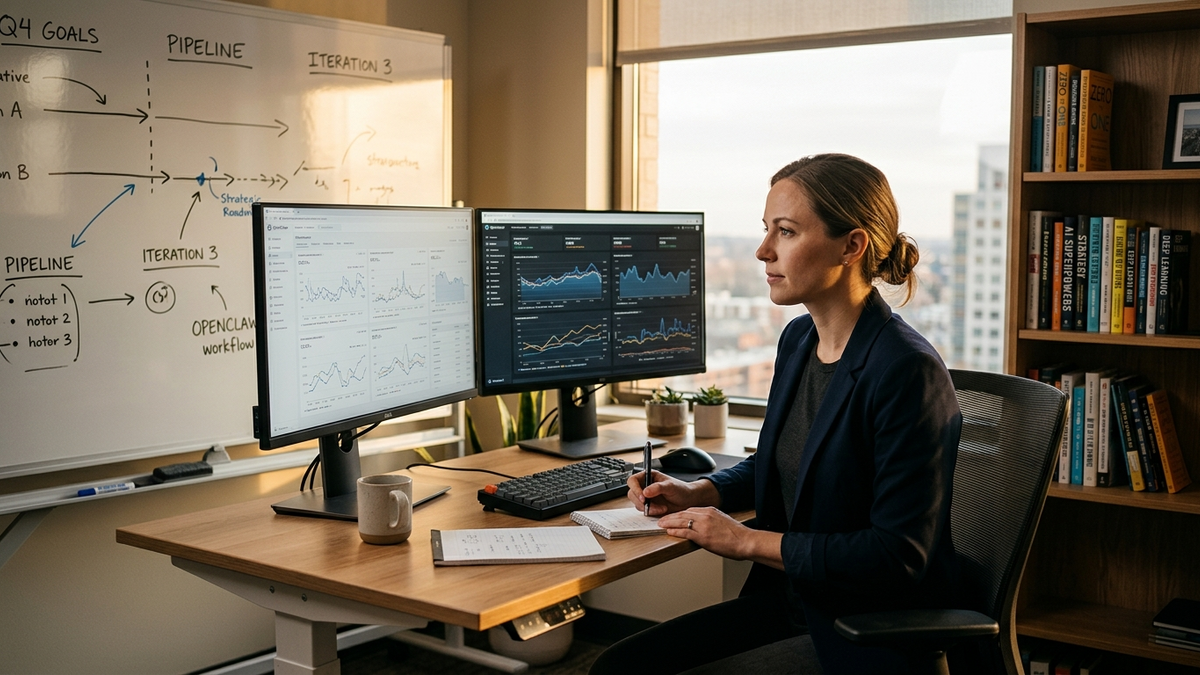
The landscape of business automation is fundamentally shifting in 2026. For small and medium-sized businesses (SMBs) and independent creators, the conversation has moved away from simple generative prompt engineering toward deploying comprehensive autonomous workflows. At the center of this transition is OpenClaw, an open-source framework that allows solo operators to construct reliable, local, and agentic business operations.
Unlike highly complex orchestration platforms designed primarily for massive corporations with rigid IT oversight, OpenClaw has discovered its true product-market fit among leaner teams. By allowing users to orchestrate tasks across browsers, local files, and third-party APIs without requiring extensive coding backgrounds, the framework has leveled the operational playing field.
The Transition from Zero-Code to Local Agents
Early AI automation relied heavily on SaaS connectors and structured cloud environments. While effective, these solutions often priced out creators or created data privacy concerns for local SMBs. The trend in mid-2026 is moving rapidly toward frameworks that run locally or directly within secure cloud instances controlled by the user.
According to recent insights on zero-code workflow adoption, SMB operators are increasingly blending zero-code automation principles with autonomous OpenClaw skills. This hybrid approach enables non-developers to trigger highly complex, multi-step operations using natural language. A creator can now schedule a daily pipeline that fetches news, drafts an email newsletter, generates accompanying graphics, and stages the post—all through localized agents.
This shift is also detailed in our internal analysis of OpenClaw zero-code workflows, which highlights how lowering the barrier to entry has created a surge of grass-roots process optimization.
Real-World Workflows: Email, Docs, and Media
The most tangible impact of OpenClaw in 2026 is found in routine operational tasks. Handling customer inquiries, drafting vendor emails, and organizing documentation historically consumed a disproportionate amount of time for small teams. By integrating agents directly into these bottlenecks, operators are reclaiming hours every week.
Industry reports highlight that SMBs are rapidly accelerating their adoption of AI email and document agents. In the OpenClaw ecosystem, this translates to specific operator setups: an agent monitoring a support inbox, referencing a local knowledge base (like `MEMORY.md`), and drafting contextual, highly personalized responses that wait in a draft folder for human approval.
For digital creators, the application leans heavily toward content pipelines. The use of specialized agents for content creation has evolved. Rather than merely writing copy, modern OpenClaw agents handle the meta-work: researching topics overnight using background processes, summarizing trending news from specific RSS feeds, and formatting the output into platform-native formats.
Scheduled Autonomy and Background Operations
A critical trend driving OpenClaw's utility for operators is the widespread use of scheduled autonomy. Instead of waiting for a human prompt, agents are being deployed as persistent background workers.
By utilizing features like OpenClaw cron jobs, SMBs can set up routine data extraction or daily system checks. As outlined in comprehensive analyses of the AI agent workforce in 2026, the real value lies in asynchronous execution. An e-commerce operator, for example, can schedule an OpenClaw instance to run every four hours, check inventory levels across multiple platforms, cross-reference them with supplier APIs, and automatically generate restock alerts.
This capability is transforming how small retail operations and digital storefronts function. Recent industry discussions around AI agents in standard business operations suggest that nearly 66% of organizations utilizing such autonomous workflows are reporting immediate and highly measurable productivity gains. The key to these gains is that the AI operates while the human is focused on strategic growth.
The Operator Pattern: Supervision over Generation
Perhaps the most important workflow trend of 2026 is the psychological shift from "AI as a tool" to "AI as a junior operator." In the context of the transformation from prompts to workflows, humans are taking on the role of supervisors.
Instead of micromanaging the generation of a specific asset, creators and SMB founders are managing the parameters of the agent's environment. They define the tools, set the boundaries (e.g., "never send an email without my approval," or "only query these three databases"), and provide the long-term context through local memory files.
This supervisory pattern reduces the cognitive load on the human operator. When an agent encounters an edge case it cannot resolve, it pauses and pages the operator. This "human-in-the-loop" default ensures reliability without sacrificing the speed of autonomous execution.
Conclusion
As 2026 progresses, the narrative surrounding AI agents is solidifying around practical, everyday utility for smaller operations. OpenClaw is proving that you do not need massive infrastructure or an internal engineering team to deploy a highly capable agentic workforce.
By focusing on local control, scheduled background tasks, and seamless integration with existing tools, OpenClaw is empowering creators and SMBs to punch far above their weight. The era of manual data entry and repetitive operational bottlenecks is rapidly closing, replaced by a new standard of accessible, operator-driven automation.