
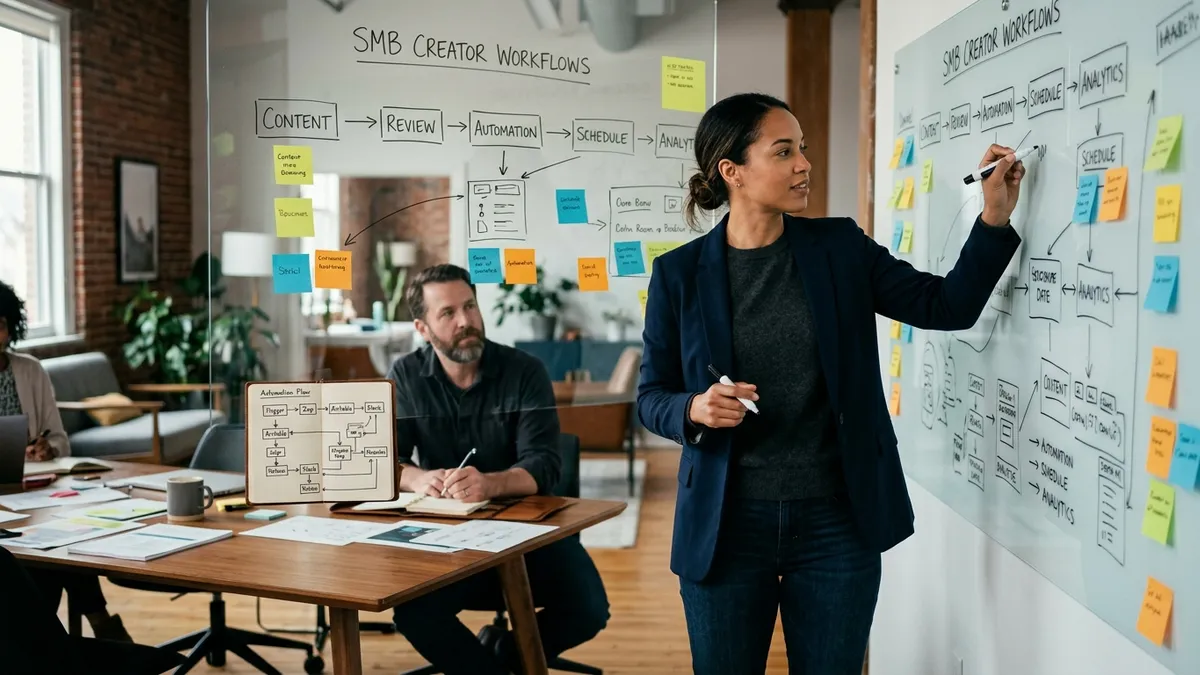
The conversation around artificial intelligence has decisively shifted away from isolated prompts toward persistent, autonomous operations. For small and medium-sized businesses (SMBs) and solo creators, 2026 marks the year where operating digital assembly lines became accessible, affordable, and practically mandatory for competitive parity.
The End of Prompt Engineering, The Era of Workflow Design
Just a few years ago, the primary interface with AI involved typing highly specific instructions into a chat box and waiting for a text response. Today, small businesses have moved beyond the chat interface. According to an April 2026 report by Insights Reinventing AI, the critical skill for operators is no longer prompt engineering, but workflow design.
This transition fundamentally alters how work gets done. Instead of treating an AI agent as an oracle, operators treat it as a node in a broader system. A solo creator does not ask an AI to write a newsletter; they orchestrate a pipeline where an agent autonomously scrapes news sources, filters for relevance, drafts summaries, formats them according to brand guidelines, and queues them in an email platform. You can read more about setting up these pipelines in our guide to OpenClaw newsletter production.
The Core Stack for Solo Operators
The tooling landscape has matured rapidly to support these autonomous operations. Communities like r/AI_Agents regularly highlight the demand for flawless execution in sales, marketing, and productivity over experimental chatter.
A typical 2026 workflow stack for a small agency or solo creator often includes:
- An Orchestration Engine: Platforms like n8n or Make serve as the nervous system, routing data between applications. See how this works in practice with our breakdown of n8n workflow deployments.
- A Local/Persistent Agent Harness: Tools like OpenClaw allow creators to run customized agents that have access to local filespaces, maintaining memory across sessions without relying entirely on cloud providers.
- Specialized Endpoints: Agents are no longer generalists. Operators deploy specialized models for specific tasks—one for coding, one for writing, one for data extraction.
Real-World Implementations: Going Beyond the Hype
The theoretical benefits of AI have finally given way to practical, measurable outcomes. In the SaaS space, platforms are leveraging agents to drastically reduce operational overhead. A recent analysis by NoimosAI explores how agents are scaling content and operations, effectively acting as the new engine for growth.
For content creators, this looks like automated repurposing pipelines. A single long-form video is handed off to an autonomous workflow that extracts clips, generates platform-specific captions, creates thumbnails, and schedules posts across six different networks. This is not a future concept; it is the baseline expectation for AI social media management today.
"Companies are using AI agents to run full workflows—start to finish," notes a recent trend overview shared by popular tech commentators on Instagram. The gap between belief and action is closing rapidly as the barriers to entry lower. Operators do not need a computer science degree to build these systems; they need a clear understanding of their own business logic.
The Financial Reality of Autonomous Operations
Perhaps the most significant shift in 2026 is the economics of these workflows. Early multi-agent systems were notoriously expensive, burning through API credits in infinite loops. Today, the focus is squarely on cost-performance and reliability. Small businesses cannot afford an agent that hallucinates an email to a client or gets stuck in a recursive loop.
To manage costs, operators are employing hybrid automation. Simple, deterministic tasks are handled by traditional APIs or scripts, while large language models (LLMs) are reserved only for steps requiring cognitive routing, summarization, or creative generation. This hybrid approach keeps API costs manageable while maintaining the flexibility of an AI-driven system. We have documented these optimization strategies extensively in our cost performance benchmarks.
The Future is Specialized
As highlighted by writers on Medium, the agents that define workflows in 2026 are the ones seamlessly integrating into existing human processes. The "human-in-the-loop" model has evolved into the "human-supervisor" model. Operators step in to approve exceptions, monitor quality, and design new pathways, rather than doing the rote work themselves.
For solo founders and small business owners, this means their day-to-day work is transitioning from execution to management. They manage digital employees that never sleep, never take vacations, and execute flawlessly according to the workflow diagrams sketched out in their workshops.
If you are looking to build your first autonomous workflow, start small. Map out your most repetitive task on a whiteboard, identify the manual steps, and begin replacing them one by one. Our guide to founder daily operations offers a practical starting point for those ready to build their own digital assembly lines.