
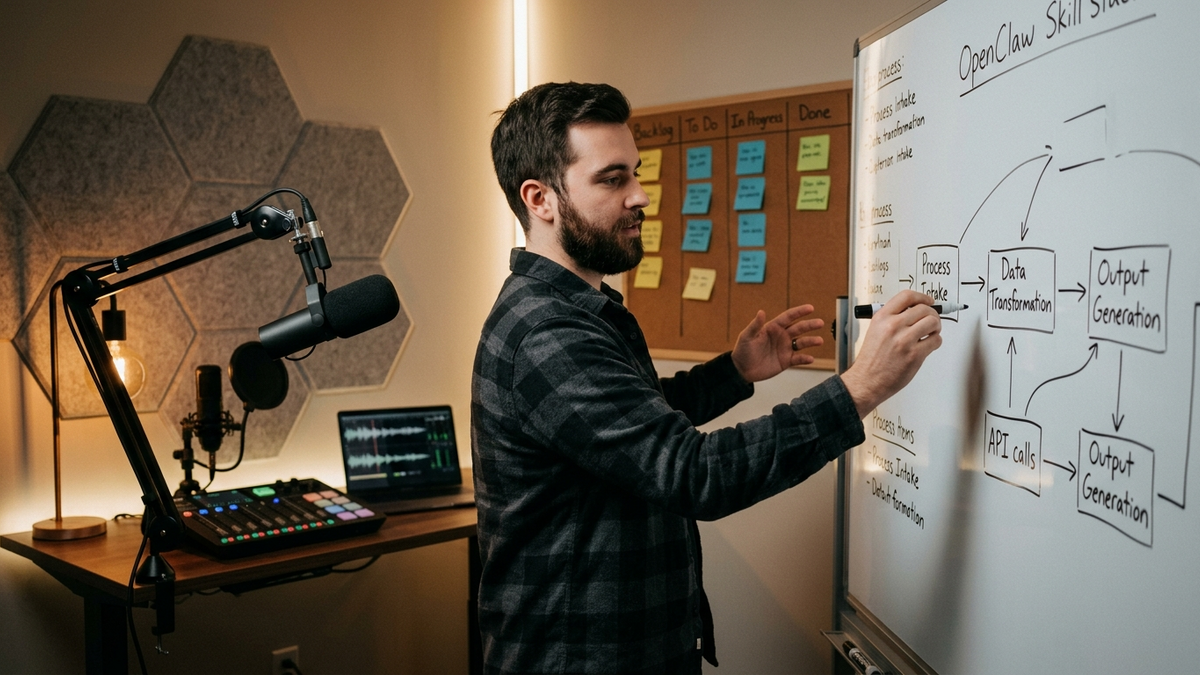
A practical OpenClaw trend on Thursday, August 20, 2026 is that useful agent workflows are increasingly being packaged as portable skill stacks instead of staying trapped inside one chat session. The signal is visible in current primary documentation, not just marketing language. The draft Model Context Protocol specification now names Skills over MCP as rich, structured instructions for agent workflows that can be discovered and consumed through MCP. Anthropic's Claude Code documentation says skills live in SKILL.md files and only load when they are actually used. GitHub's Copilot CLI guidance says custom agents can live as Markdown files in a repository and be reviewed, updated, and shared. OpenAI's MCP documentation frames the protocol as a common way to extend models with tools and knowledge.
For operators, creators, and small businesses, that matters because repeatable work rarely fits inside one perfect prompt. A newsletter pipeline needs source gathering, formatting rules, and a final review. A services business needs a repeatable client-research packet. A solo dev needs code review habits, release checklists, and browser steps that can be invoked on demand. In OpenClaw, that logic already maps to custom skills, cron jobs, and browser control. The broader tooling market is now making the same pattern look normal: write the workflow down, keep it portable, and connect it to the tools that do the real work.
The workflow file is becoming the reusable unit
Anthropic's current skills documentation is explicit about the shift. It says a skill is created by adding a SKILL.md file with instructions, and that the body loads only when the skill is used. That matters operationally because long procedures stop being permanent prompt overhead. They become callable assets. The same page also says skills follow the Agent Skills open standard and can be shared across multiple AI tools, which makes the file more portable than a platform- specific chat transcript.
GitHub's June 9, 2026 post on custom agents in Copilot CLI reaches a similar conclusion from the repository side. The company says an agent profile lives in the .github/agents directory as a Markdown file with YAML frontmatter describing role, scope, capabilities, and guardrails. Because that file lives in the repo, the workflow can be reviewed and updated like any other project asset. For small operators, this is a strong implementation pattern: the reusable unit is no longer a saved prompt in one vendor UI. It is a versioned instruction artifact that can travel with the work.
MCP is turning portable skills into a cross-tool pattern
The MCP project is an important part of why this trend feels more durable than a single vendor feature. The draft specification lists Skills over MCP alongside Tasks and MCP Apps, signaling that workflow instructions are being treated as a first-class integration surface. The Skills Over MCP Working Group charter goes further, saying the group defines how agent skills are discovered, distributed, and consumed through MCP because native skills support in host applications already demonstrates strong demand.
OpenAI's MCP guide reinforces that direction from the platform side. The company says MCP is becoming the industry standard for extending AI models with additional tools and knowledge, and documents how remote MCP servers can expose capabilities over the internet. For an OpenClaw operator, the practical implication is straightforward. A workflow can stay small and specific while still reaching outside the chat window to search documents, query a system, or trigger a narrow external action. That is exactly the sort of architecture reflected in earlier internal coverage of file-based operator playbooks and session logs, hooks, and workflow files.
Portable does not mean giant
One useful nuance in the current documentation is that portability is not pushing teams toward giant do-everything agents. Anthropic's hooks guide separates skills, subagents, and plugins into different extension layers, which is a reminder that reusable behavior works best when it stays bounded. GitHub's custom-agent examples also start with repeated terminal-heavy tasks rather than broad autonomous systems. The consistent theme is not maximal authority. It is giving a narrow worker a stable procedure and a clean handoff format.
That makes the trend especially useful for SMB and creator workflows. A podcast team can keep one research skill, one outline-formatting skill, and one publishing checklist instead of one overloaded media agent. A consultant can keep a lead-research procedure separate from a client-delivery QA procedure. A solo founder can package a daily market scan as a scheduled routine and call a different skill only when it is time to draft a brief. OpenClaw's own guidance on founder daily ops and newsletter production fits that same structure.
What operators should actually build
The most practical move is to pick one repeated workflow and package it as a stack instead of a message. Start with the instruction file. Add the smallest tool surface needed for evidence gathering or execution. Keep outputs structured enough that the next stage can consume them. Then attach a trigger, whether that is a manual call, a scheduled run, or a browser-assisted handoff. This is the same logic behind internal pieces on installable open-source workflows and specialized subagents for small teams: package the repeatable thinking, keep the worker narrow, and make the workflow easy to invoke again tomorrow.
As of August 20, 2026, the credible market signal is not that agents are becoming magically self-sufficient. It is that their useful parts are being broken into portable, reviewable workflow modules. For OpenClaw operators, that is good news. It favors practical builders who want durable procedures for research, publishing, maintenance, and client work, rather than teams chasing one oversized prompt that can never quite be trusted twice.