
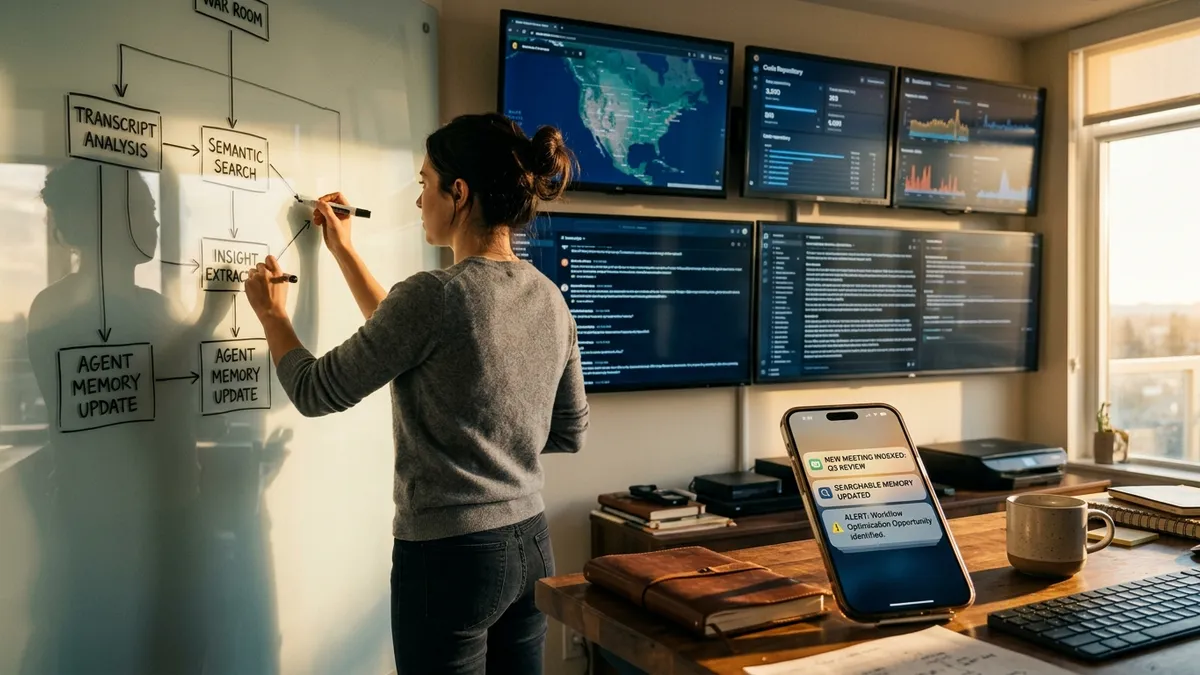
A practical OpenClaw trend on Wednesday, September 9, 2026 is that meetings are quietly turning into a kind of long-term agent memory. The v2026.9.3 release, published September 8, 2026 at 14:15 UTC, adds searchable saved meeting transcripts and tightens memory search across notes, sessions and shared projects in the same release. For a one-person business, a creator with weekly brand-deal calls, or a freelance consultant running monthly retainer check-ins, the change is small in interface and large in workflow. The agent can now answer questions about what was said in a specific meeting, who promised what, and what was decided three weeks ago, without an operator re-reading a transcript.
The change builds on memory work that has shipped across August and September. The Skill Workshop blog post described how the harness turns repeated lessons into reviewable skills; the v2026.9.3 release notes add a Memory section that preserves recency weighting across keyword, hybrid and vector recall and indexes memory notes even when optional embedding providers are unavailable. Searchable transcripts sit on top of that foundation, which is why a small operation can rely on it without configuring a separate vector backend.
Why a saved transcript is different from a saved note
Most operators already know how to save a meeting. The typical stack is a Zoom or Meet recording, an Otter or Granola transcript, and a Notion page with a manual summary. The problem is that the transcript usually stops being searchable the moment the call ends. A month later, when a client asks "did we agree to include a second revision round," the operator scrolls through Notion, then a Slack thread, then the original calendar event. Each layer is separate from the agent doing the rest of the work.
The v2026.9.3 release treats the transcript itself as first-class content. The release summary describes saved meeting transcripts as a searchable surface that sits alongside notes and sessions. That means the same agent that already retrieves yesterday’s standup notes can also pull the exact line from a client call on March 14, with attribution to the saved file. Memory and meetings share one retrieval vocabulary.
For a solo founder running ten client calls a week, the practical effect is that the agent becomes the place where "what did we decide" lives. The transcript is no longer an artifact that has to be opened by hand; it is indexable material the operator can query with the same recall flow used for founder daily ops notes and sales-prospecting follow-ups.
What changed in the memory plumbing under the hood
The Memory section of the v2026.9.3 release notes lists roughly twenty changes, and three of them matter most for small-team operators. The first is that memory search now indexes notes even when embedding providers are unavailable, which removes the silent failure mode operators used to hit when a Voyage or OpenAI key went missing. The second is that keyword recall survives in project sessions, including older dated notes, which is the behavior most operators assume memory has had all along. The third is that session recency weighting is restored across keyword, hybrid, and vector fallback recall, including short CJK queries, so the agent no longer forgets last week’s notes the moment the embedding path degrades.
These are not headline features on their own. Together they mean a one-person business can run memory search on a vanilla install without configuring a paid embedding provider, and the agent still returns the right session when the operator asks "what did I tell the Westlake team about deliverables." That is the precondition that makes searchable transcripts useful: the operator has to trust the recall before trusting a recap.
Reporting on the broader ecosystem has been tracking the same shift. Anthropic’s Claude Code hooks documentation describes deterministic actions at lifecycle checkpoints, and a September 2026 post on building reliable OpenClaw cron workflows describes cron-driven attachment of evidence to recurring jobs. The trajectory across the operator stack is the same: artifacts that used to live in separate tools are becoming queryable through the same agent surface.
The meeting recap workflow an SMB can run today
The simplest version uses no third-party transcription tool. During a call, the operator runs the OpenClaw desktop app and lets the harness record through meeting capture. When the call ends, OpenClaw saves the transcript and the operator asks the agent, in the same session, to write a recap. The recap is stored as a memory note, the transcript becomes searchable, and a cron job can remind the operator to re-read it next week before the next call. Earlier newsletter production coverage describes a similar shape of work for content, and the pattern translates directly to recurring client calls.
A more ambitious version splits the work. A weekly cron job runs every Sunday evening, finds the saved transcripts from the past seven days, asks the agent to summarize the top three commitments per call, and writes those commitments back into the project’s memory file. When the operator opens the project on Monday, the agent already knows what was promised and who owns it. The recap is a memory object, not a doc the operator has to remember to open.
The OpenClaw playbook describes the same cron pattern with a Slack announcement target. For a one-person operation, the announcement channel can be a private Telegram group, a Notion page, or simply a file in the workspace that the operator reviews on Monday morning. The point is not the destination; the point is that the recap is automatic and the search is shared.
How to keep the memory bank reviewable
Searchable transcripts only help if the operator trusts what the agent returns. The heartbeat monitoring guide describes how to run periodic checks on agent health; the same idea applies to memory. A weekly job that asks the agent to list its three most recent saved transcripts, the top decision in each, and the last owner of each decision is a cheap way to keep the memory bank honest. The operator reads the list, confirms it matches reality, and the agent has implicitly audited itself.
The Skill Workshop documentation adds a second review layer. Once a recurring recap pattern proves useful, the operator can ask the agent to promote it to a Skill Workshop proposal, which goes through the same review path the September 7, 2026 swarm-default article described. The result is that a meeting-recap workflow used informally in week one becomes an approved skill in week three, with the same governance the operator would apply to any other production behavior.
A third guardrail is privacy. A transcript may include personal information about clients, employees, or third parties. The v2026.9.3 release does not change what gets saved; it changes what gets searched. Operators should review the same setup and consent choices they apply to session memory, especially when meeting capture is enabled on a shared device. A small operation can keep transcripts scoped to a single workspace, redact sensitive lines before asking the agent to summarize, and treat the search index as part of the client’s data footprint.
What this means for a one-person business this week
The practical takeaway from v2026.9.3 is not a new model or a new dashboard. It is that a meeting can now behave like a memory object. A solo founder, creator, or small-team operator who already runs daily-ops notes through the harness can add meeting transcripts to the same recall flow with no new infrastructure. The same cron job that runs a weekly review can include meeting recaps; the same Skill Workshop proposal that turns repeated lessons into approved skills can now turn repeated meeting patterns into approved behavior.
The setup work is small. The release notes flag the same Node 24.16+ or Node 26.1+ requirement that has applied since v2026.9.x, and the new memory search paths fall back gracefully when optional embedding providers are unavailable. A SMB owner who upgraded to v2026.9.3 last week already has the index; the change is the operator’s habit, not a new install step.
The shift is small in code and large in workflow. A one-person business used to lose the substance of its client calls the moment the calendar event closed. With v2026.9.3, the meeting becomes part of the same long-term memory the operator already trusts for notes, sessions, and project files. The next time a client asks "did we agree to that," the answer is a recall query rather than a scroll through old docs.