
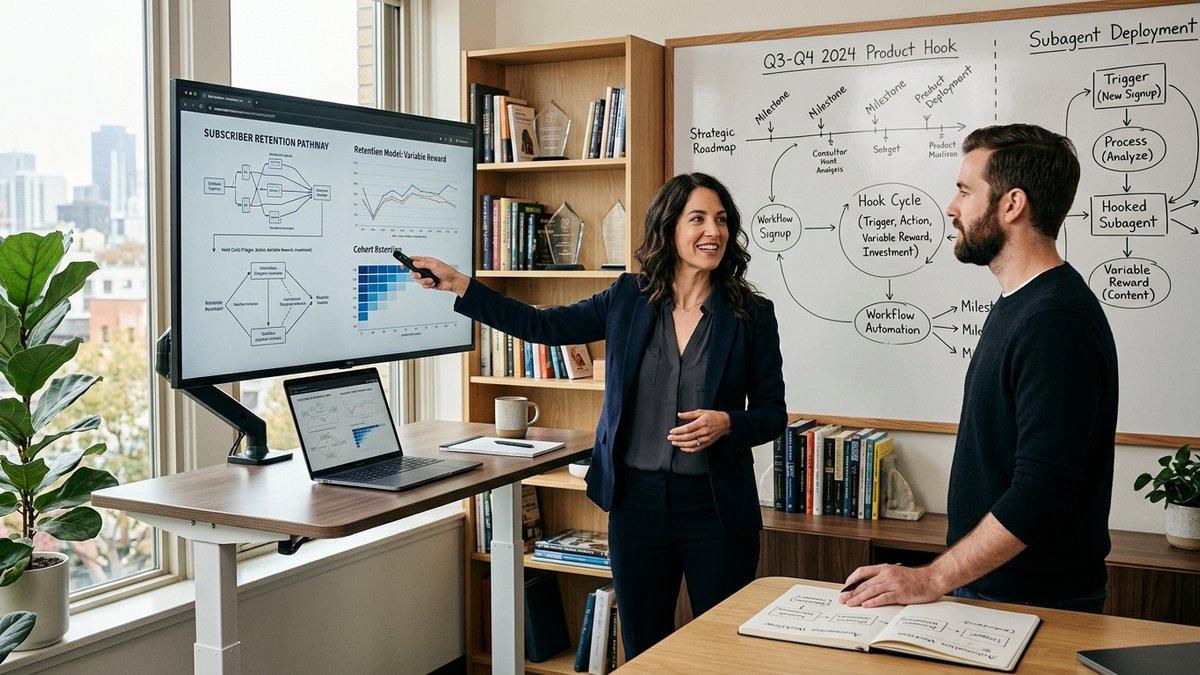
A practical OpenClaw trend on June 24, 2026 is that agent builders are moving away from the idea that one broad assistant should improvise every step of a workflow from a single prompt. The stronger current pattern is more modular. A narrow worker handles one kind of task, a deterministic hook enforces a rule or runs a follow-up action, a human approval step pauses anything sensitive, and the whole flow lives in a reusable runtime surface that can be called again tomorrow. For solo operators, creators, and small businesses, that pattern is easier to inspect and cheaper to maintain than all-purpose conversational automation.
Several primary sources now point in the same direction. Anthropic's hooks guide says hooks run shell commands automatically at specific points in Claude Code's lifecycle and provide deterministic control rather than relying on the model to remember. Anthropic's subagents documentation describes specialized workers that can be chained in sequence for multi-step workflows. OpenAI's April 2026 post on the next evolution of the Agents SDK frames the shift as a more capable harness for long-horizon work with native sandbox execution. OpenAI's guide to guardrails and human review adds the explicit pause-and-approve layer. Google's launch post for Gemini CLI shows the same direction from the terminal side, and the Model Context Protocol introduction explains why these stacks are easier to assemble now that tools and data sources increasingly share a standard connection layer.
The workflow unit is getting smaller and more reusable
Anthropic's subagent documentation is useful because it describes a concrete design move rather than a marketing slogan. The platform now treats specialized workers as a normal building block and explicitly supports chaining them in sequence. That matters because many operator jobs are already naturally segmented: one worker collects source material, one summarizes it, one drafts an update, and one checks whether the output is ready for a human. OpenAI's SDK guidance makes a similar point from another angle by recommending focused agents, separate tool surfaces, and explicit orchestration instead of one overloaded prompt.
OpenClaw setups already fit that direction well. A recurring content or operations task can live inside a skill, run on a schedule, and call only the tools needed for that narrow job. Internal guidance on custom skills, cron jobs, and inspectable delegation all support the same operating idea: package a repeatable workflow, then keep each worker's scope legible.
Hooks are turning project rules into runtime behavior
The hooks guidance matters because it converts operator preferences into something closer to infrastructure. Anthropic documents examples such as formatting files after edits, blocking edits to protected files, re-injecting context after compaction, and sending notifications when the agent needs input. Those are not abstract capabilities. They are visible runtime interventions that reduce drift. For a creator workflow, a hook can stop a publish step unless source links are present. For a support queue, it can block a reply until the CRM lookup happened. For a finance task, it can force a review before any outbound action.
That is one reason this trend matters for smaller operators more than for abstract platform comparisons. A lean team rarely needs a giant autonomous agent. It needs a reliable rule at the exact moment a mistake would become expensive. OpenClaw's own patterns around heartbeats and session logs, hooks, and workflow files point toward the same conclusion: the winning workflow is usually the one that leaves a visible trail and stops at the right checkpoint.
Approval layers are becoming part of the workflow, not an afterthought
OpenAI's current guidance is unusually direct on this point. The company says guardrails perform automatic validation while human review pauses a run so a person or policy can approve or reject a sensitive action. That pause is important because practical operator workflows often involve external consequences: sending an email, updating a customer record, touching a production repository, or publishing an article. The current trend is not toward removing the operator. It is toward making the handoff cleaner and more deliberate.
For SMB and creator use cases, that can be implemented without much ceremony. A newsletter pipeline can stop after source collection and outline generation. A lead-triage flow can prepare a draft follow-up and wait for approval. A repo-maintenance workflow can gather diffs, run checks, and surface a summary before anything ships. The point is to make the most expensive action the most reviewable action.
Standard tool surfaces are lowering the assembly cost
The broader infrastructure layer helps explain why this pattern is growing now. Google's Gemini CLI pitch presents the terminal as a place for coding, deep research, content generation, and task management, not just ad hoc prompting. The MCP project defines a standard way for AI applications to connect to external systems, including data sources, tools, and workflows. When that connection layer becomes more shared, operators do not need to rebuild every integration idea from scratch. They can spend more time designing the sequence of work and less time wiring the plumbing.
That implementation pattern is especially relevant for agencies, solo founders, and creator businesses. The practical stack is no longer just a model plus a prompt. It is a stack of narrow workers, tool access, review pauses, and lightweight memory or logs. In OpenClaw terms, that often means combining a skill, a scheduled trigger, a small set of approved tools, and a human checkpoint into one repeatable operating surface.
What this trend changes for OpenClaw operators
The near-term lesson is straightforward. Instead of asking one agent to “handle marketing” or “manage support,” operators are getting better results by defining one repeatable unit of work at a time. Build the source collector. Build the review step. Build the follow-up action. Then connect them with the smallest set of tools and rules that can complete the job. The June 2026 trend is not maximal autonomy. It is practical workflow packaging: specialized workers, deterministic hooks, standard connections, and visible approvals assembled into operator-grade systems that smaller teams can actually trust.