
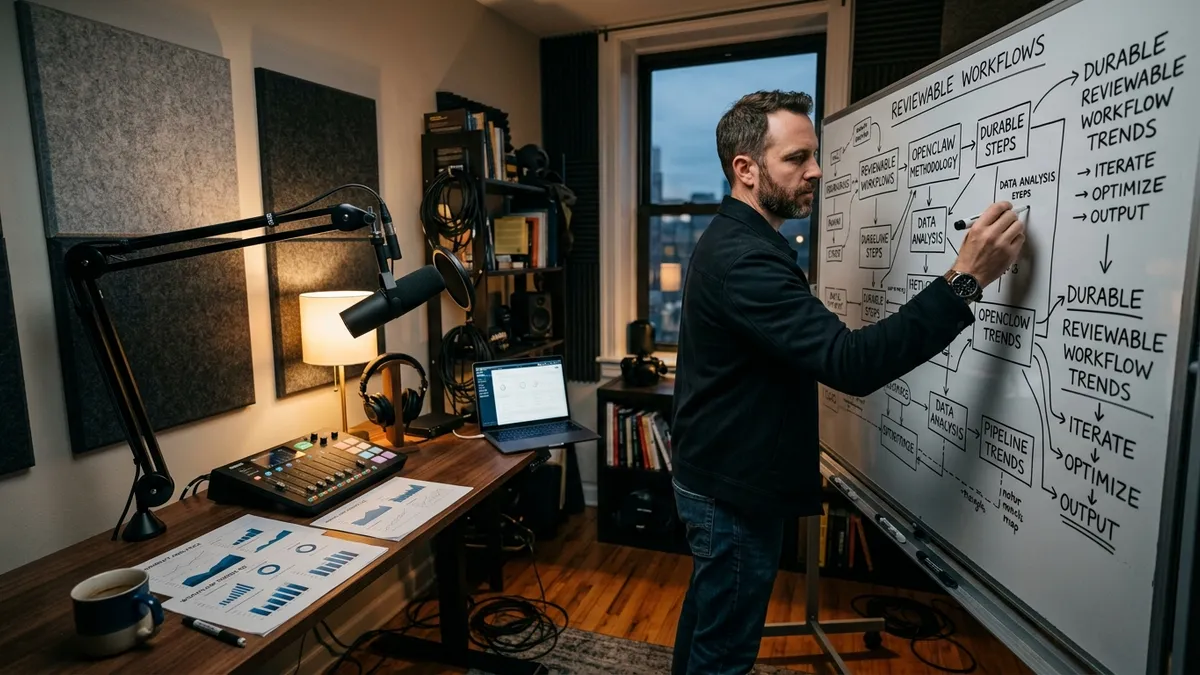
A practical OpenClaw trend on July 16, 2026 is that useful agent systems are increasingly being designed as durable, reviewable workflows rather than as one-shot chat sessions. The strongest evidence is not marketing language about autonomy. It is the way leading toolmakers now document long-running jobs, resumable browser sessions, open tool connections, and human checkpoints that pause execution at the moment a task becomes sensitive. For operators, creators, and small businesses, that matters because the highest-value AI work rarely ends in a single answer. It usually spans research, tooling, approvals, and follow-up.
Several current primary sources point in the same direction. OpenAI's Background mode documentation says long-running tasks can be executed asynchronously and polled over time, which moves agent work beyond the timeout limits of a normal request. Anthropic's Model Context Protocol announcement describes an open standard for connecting AI systems to data sources and tools. LangGraph's interrupts documentation explains how a workflow can pause and wait for external input before continuing. Cloudflare's browser tools docs say an agent can pause for approval and resume with its browser session intact. Cloudflare's recent Workflows update adds another infrastructure signal by describing a control plane rebuilt for higher concurrency and creation rates. Taken together, those sources show a market moving toward agent runs that behave more like real operations than like polished demos.
Durable background runs are becoming the normal unit of work
OpenAI's current guidance is important because it makes duration explicit. The Background mode docs say developers can execute long-running tasks reliably in the background and poll for status while a job sits in queued or in-progress states. That sounds like an implementation detail, but it changes workflow design. If an agent can research, summarize, transform, or validate work across minutes instead of seconds, then the natural container stops being the live chat window and starts becoming the job itself.
That maps neatly onto existing OpenClaw practice. A founder's morning brief is more dependable when it runs as a scheduled job through cron jobs instead of relying on a manual prompt every day. A recurring monitoring or outreach routine becomes more useful when it can keep state across checks through heartbeats. The operator benefit is simple: durable execution reduces the amount of context that has to be re-explained before the system can do useful work.
Open tool connections are replacing copy-paste workflows
Anthropic's description of MCP as a universal, open standard for connecting AI systems with data sources matters for small operators because most useful work lives in scattered surfaces. It may start in inboxes, dashboards, documents, storefronts, repos, or spreadsheets. When those sources are accessible through a common connection model, the agent does not need to be treated like a disconnected assistant waiting for pasted context. It can be placed closer to the systems where the work already lives.
In OpenClaw terms, that reinforces the value of reusable operating instructions rather than ad hoc chat behavior. Internal guidance on custom skills and connector-ready background workflows already pointed toward a stack where context, tools, and procedures travel together. The external MCP push makes that direction look less like a niche architecture choice and more like a default integration pattern.
Approval checkpoints are winning because trust is still local
LangGraph's interrupts docs describe a direct human-in-the-loop pattern: pause execution, save state, wait indefinitely for external input, then resume. Cloudflare's browser tools docs describe a similar operational principle from another angle. Instead of treating browser automation as a blind macro, the run can pause for approval and continue with the same live browser session still intact. These details matter because they turn review from a social policy into a runtime feature.
That is especially relevant for SMB and creator workflows. A small agency might want an agent to assemble client research but not send the final message. A solo founder may want an agent to collect product metrics and draft a weekly update, while keeping the final publish or send step manual. A shop owner may want browser automation to gather catalog or order data without letting the system change account settings on its own. This is why OpenClaw usage keeps converging on patterns such as browser control, reviewable background runs, and browser handoffs with approval gates. The most practical workflows are the ones that move fast up to the edge of risk, then stop clearly.
Browser sessions are becoming part of the workflow, not a separate tool
Cloudflare's current browser tooling docs are notable because they treat the browser as a durable runtime surface. The model writes code against a live browser session, and the platform records connector calls in a durable log so a paused run can resume without losing its place. That is a useful signal for operators far beyond Cloudflare itself. Browser work is no longer being framed as a fragile bolt-on. It is being treated as a first-class part of the workflow stack.
That shift fits common OpenClaw use-cases. Many practical jobs still happen in interfaces that do not expose clean APIs: partner portals, ad managers, analytics tools, support consoles, and publishing dashboards. Once the browser becomes a resumable step inside a broader workflow, an operator can let the agent do the repetitive legwork without pretending every task should be fully autonomous. The result is closer to assisted execution than to autopilot, which is usually the better fit for a small team.
Infrastructure signals suggest this pattern is scaling up
Cloudflare's Workflows control-plane update adds one more clue about where the market is going. The company said it rebuilt the system so it could scale to higher concurrency and creation rate limits for workloads where many instances start and end at the same time. That is not a consumer-facing feature, but it matters because it reflects the same underlying reality: agent workflows are increasingly expected to run as background operations, not just as interactive experiments.
For OpenClaw-style operators, the practical conclusion is straightforward. The winning stack is not the most theatrical one. It is the one that connects to the right tools, runs long enough to complete real work, pauses for review when needed, and resumes without losing state. That is a much better fit for founders, creators, and small teams than enterprise-heavy governance talk because it addresses the day-to-day question they actually face: how to let agents do more work without creating more cleanup.