
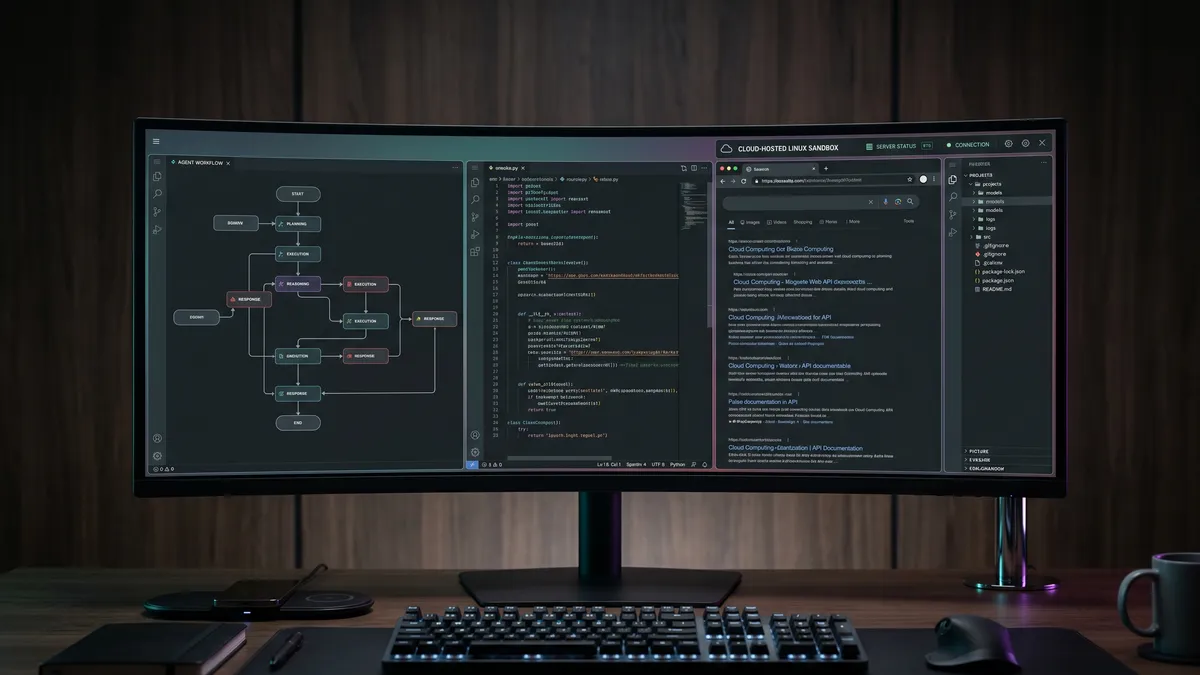
Google's new managed agents launch in the Gemini API is one of the more important builder releases from I/O, not because it introduces yet another chat endpoint, but because it packages a meaningful chunk of agent infrastructure behind a single API call.
The core promise is simple. Call the Antigravity managed agent through the Interactions API, and Google provisions an isolated Linux environment where the agent can reason, execute code, manage files, and browse the web. For builders, that is a bigger deal than it sounds. It means a lot of the annoying runtime scaffolding moves from your app layer into the platform layer.
If you have been building with OpenClaw, Claude Code, or other agent-oriented workflows already, this launch is especially interesting because Google is converging on a structure that feels familiar: instructions in AGENTS.md, capabilities in SKILL.md, and execution in a managed sandbox. That makes the release feel less like a one-off demo and more like a signal that file-native agent configuration is becoming a real pattern.
What Google Actually Launched
According to Google's official announcement, Managed Agents in the Gemini API let developers spin up an agent with a single call in an ephemeral, isolated Linux environment. The initial public entry point is Antigravity, a general-purpose managed agent powered by Gemini 3.5 Flash and exposed in preview through the Gemini API and Google AI Studio.
The docs make the mechanics pretty clear:
- A single interaction can provision a secure Linux sandbox with code execution and filesystem access.
- Default tools include code execution, Google Search, and URL context, with filesystem capabilities enabled when an environment is present.
- Files persist across interactions when you reuse an environment ID, which lets you continue longer-running work instead of starting from zero every turn.
- Agent behavior can be customized with AGENTS.md and SKILL.md files mounted into the sandbox.
- You can save a custom configuration as a managed agent and invoke it by ID later, instead of rebuilding the setup every time.
That matters because Google is not only offering model access here. It is exposing a hosted agent runtime. That runtime includes planning loops, tools, files, state, and environment lifecycle. Those are the pieces that usually turn a quick prototype into an operations headache.
Why This Is More Interesting Than a Normal API Upgrade
Most AI API launches still leave builders doing a lot of invisible work: standing up sandboxes, wiring tool execution, deciding how to persist artifacts, and building safe session boundaries between users. Managed agents compress a lot of that into a cleaner default stack.
1. It lowers the infrastructure tax
A lot of agent products die in the gap between “the model can do the task” and “the system can do the task reliably for real users.” Sandboxed execution, state persistence, tool-use loops, and file handling are usually where complexity explodes. Google is taking on more of that burden directly.
2. It gives builders a more product-shaped primitive
A normal text generation endpoint gives you tokens. A managed agent endpoint gives you a worker that can actually go do something. That shifts the builder question from “how do I orchestrate the runtime?” to “what experience and workflow should I productize?”
3. It makes multi-step work first-class
The quickstart explicitly separates interaction.id from environment_id. That is useful. It means builders can decide whether to continue the same conversation, reuse the same working directory, or start fresh on one side while keeping the other. That is a very practical abstraction for research, reporting, coding, audit, and operations workflows.
4. It matches how serious agent builders already work
The filesystem-native setup is one of the most underrated parts of the launch. Google's custom agent docs recommend organizing agent behavior in a structured directory with .agents/AGENTS.md and skill folders containing SKILL.md. For anyone already using agent frameworks with instruction files and reusable skills, that is a strong sign that the ecosystem is maturing around more portable conventions.
Builder takeaway
The value is not “Google made another model endpoint.”
The value is that Google is productizing the layer between a capable model and a usable agent application. If that layer gets easier, more solo builders and small teams can ship agent-backed products without becoming infrastructure companies.
The Near-Term Opportunities for Builders
I think the best opportunities here are not abstract AGI fantasies. They are focused products where a managed runtime lets one person or a very small team ship something useful much faster.
Research and briefing agents
This is the obvious first category, and Google is clearly leaning into it. An agent that can search, gather sources, generate working files, and return a finished briefing or PDF is much easier to build when the browsing and filesystem stack already exists. Vertical research products for finance, recruiting, sales, policy, healthcare, or real estate feel especially viable.
Internal operator tools
A lot of good agent products do not need to be consumer apps. They can be internal tools for a marketing team, operations lead, analyst, recruiter, or founder. Managed agents make it easier to build “do the work for me” utilities that investigate a topic, process files, write outputs, and hand back structured artifacts to a human reviewer.
Agent-backed micro-SaaS products
This is where the commercial angle gets more interesting. Builders can put a thin application layer in front of a managed agent and sell a workflow outcome instead of a chatbot. Think competitive teardowns, account research dossiers, SEO opportunity reports, supplier comparison memos, or client onboarding packs.
Code and content production pipelines
Because the environment can run code and persist files, the platform is also attractive for build steps that are harder to fake in plain chat, such as generating spreadsheets, PDFs, markdown reports, code patches, data transforms, or packaged deliverables. That can turn agent output into something much closer to finished work.
Agencies and productized services
There is also a strong opportunity for agencies and technical consultants. Instead of selling bespoke “AI strategy,” they can build repeatable managed-agent workflows for niche client outcomes, then wrap those workflows in dashboards, intake forms, and QA layers. In other words, this is not only a developer feature. It is a service-productization feature.
Why This Matters for the OpenClaw and Agent-Workflow Crowd
One reason this launch stands out is that it rhymes with how serious practitioners are already working elsewhere. OpenClaw builders are used to instruction files, skills, tools, and real execution surfaces. Google is now validating a similar mental model in its own hosted stack.
That does not mean the systems are identical. OpenClaw gives you a self-hosted, highly customizable operator environment, while Gemini managed agents give you a Google-hosted runtime with tighter platform control. But for builders, the overlap is the important part. Skills, instructions, environments, and tool-using agents are starting to look less like framework quirks and more like durable primitives.
If you are building reusable agent workflows today, I would pay attention to that convergence. It increases the odds that skills, operating patterns, and product ideas can travel across ecosystems more easily over time.
The Tradeoffs Are Real
I like this launch, but I would not oversell it. The docs are explicit that the feature is in preview, which means schemas and capabilities can change. Google also notes that managed-agent runs can consume a lot of tokens because each request may trigger multiple reasoning loops, tool calls, code execution steps, and file operations.
- Token costs can climb fast if the agent takes too many steps.
- Structured outputs are not currently supported in Antigravity, which matters for some production use cases.
- Preview pricing is favorable right now, including environment compute not being billed during preview, but that will not be the forever economics.
- You still need product judgment. A hosted sandbox does not automatically create demand, positioning, or retention.
So the practical stance is not blind hype. It is: this significantly reduces the friction to prototype and ship agentic software, but the real winners will still be the builders who pick narrow, valuable workflows and wrap them in a credible product experience.
What Smart Builders Should Do Next
- Pick one multi-step workflow that currently feels annoying to orchestrate yourself.
- Prototype it with the Antigravity managed agent using a remote environment.
- Mount an
AGENTS.mdfile and one or two narrowly scoped skills instead of overengineering the first version. - Measure how many steps, files, and tokens the workflow actually consumes.
- Only then decide whether the product should stay on a hosted managed-agent stack, move to a more custom runtime, or become a hybrid.
That last point matters. Managed agents are probably best understood as an acceleration layer. For some products, that will be enough long term. For others, it will be the fastest route to proving demand before you harden the architecture.
Final Take
Google's managed agents endpoint is important because it makes agent infrastructure feel closer to an application primitive. Instead of forcing every builder to reimplement sandboxes, tool loops, and working directories, it offers a more complete runtime from day one.
That opens a real window for builders. Not because it magically creates businesses, but because it shortens the path from workflow idea to shippable agent product. For anyone building research tools, operator copilots, agent-backed SaaS, or productized service workflows, that is a serious opportunity worth testing now.
Read the official launch post, the Antigravity docs, and the guide to building managed agents with AGENTS.md and SKILL.md if you want the implementation details.