
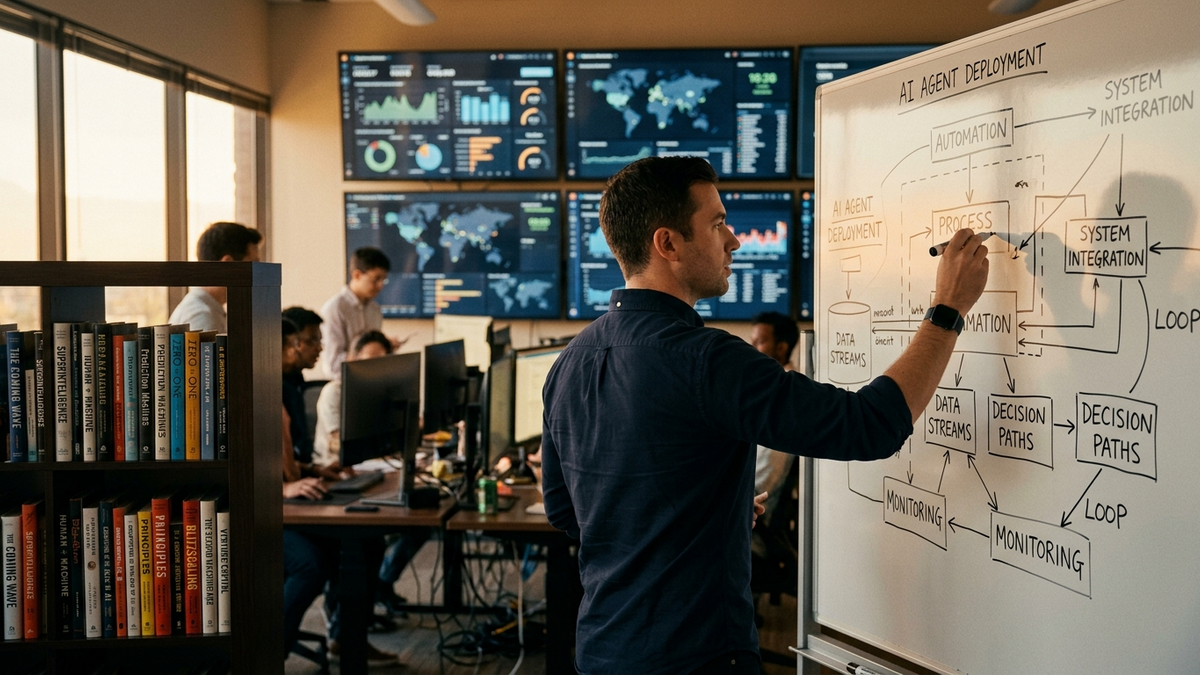
A practical AI agent trend on June 23, 2026 is that major toolmakers are converging on the same implementation pattern for real work. Instead of treating one big assistant as the whole product, they are shipping a workflow system where a main agent plans the job, specialist subagents take narrower tasks, hooks shape what happens inside the loop, and review or evaluation layers catch mistakes before the output is reused. That matters more to a solo operator, agency team, or creator business than another abstract promise about full autonomy.
The reason is simple. Small operators usually do not need an agent that can do everything. They need an agent stack that can repeat the same high-value jobs without becoming brittle: content research, code cleanup, inbox triage, document extraction, client reporting, or lead follow-up packaging. The latest product moves from OpenAI, Google, Anthropic, and GitHub suggest the market is settling on a more practical answer: break the work into roles, keep execution observable, and harden the loop around the model.
OpenAI is pushing the harness, not just the model
OpenAI's April 15 post on the next evolution of the Agents SDK said the updated SDK helps developers build agents that inspect files, run commands, edit code, and handle long-horizon tasks inside controlled sandbox environments. The company also described configurable memory, sandbox-aware orchestration, and a manifest system for predictable workspaces. That is important because it frames the useful product as the harness around the agent loop, not as a single prompt template.
For a small team, that means recurring work can live in a bounded runtime instead of an improvised chat session. A founder can give an agent a folder of invoices, a writer can hand off source files for a repackaging pass, or a developer can ask for a scoped documentation cleanup inside a reviewable workspace. That maps closely to this site's earlier coverage of trigger-based SMB workflows and the knowledge base on scheduled runs, where the value comes from repeatable execution rather than one-off prompting.
Eval loops are becoming part of the workflow itself
OpenAI's May 2026 cookbook example on building an agent improvement loop with traces, evals, and Codex goes a step further. It shows a workflow where teams collect traces from runs, add human or model feedback, convert those failures into tests, and use the resulting evals to improve later runs. For operators, that is a more useful pattern than a generic benchmark score because it links reliability work directly to real tasks that already matter.
In practice, a creator team can turn a bad briefing run into a new rubric, a reseller can turn a broken extraction step into a validation check, and a small software shop can turn a missed file edit into a regression test. That is why the current agent conversation is shifting from prompt cleverness toward operational memory. The workflow gets smarter because the team writes down what failed and teaches the stack not to repeat it, much like the systems described in prompt-to-workflow patterns and custom skills.
Google is making delegation and middleware first-class
Google's April 15 post announcing subagents in Gemini CLI described a setup where complex or repetitive work can be delegated to specialized agents that run in separate context windows with their own tools and instructions. The company said this keeps the main session focused on the big picture while allowing parallel research, code exploration, tests, or analysis. That is a practical pattern for small teams because it lets one operator manage multiple bounded tasks without flooding a single session.
Google paired that with January guidance on hooks in Gemini CLI, which it described as a way to control and customize the agentic loop with scripts that add context, validate actions, enforce policies, log tool use, or send notifications. For SMB and creator operators, that is less about formal governance than about making small automations trustworthy. A hook can stop a risky file action, inject today's campaign brief, or require a specific output format before a run continues. That fits cleanly with local operator patterns like webhooks and review-first automation surfaces.
Anthropic and GitHub are reinforcing the same stack shape
Anthropic's May 28 announcement for Claude Opus 4.8 said Claude Code now has a research-preview dynamic workflows feature that can plan work, run hundreds of parallel subagents in a session, and verify outputs before reporting back. That launch is partly about raw capability, but the more practical signal is structural: parallel delegation plus self-checking is becoming a default product pattern rather than an advanced custom build.
GitHub made a similar point in its June post on custom agents in GitHub Copilot CLI, where agent behavior is stored in Markdown files that define role, tools, standards, and guardrails. That file-based approach matters for lean teams because it turns agent behavior into an asset that can be versioned, reused, and improved. The winning pattern is not a secret prompt. It is a workflow package: instructions, tools, approval points, and post-run checks bundled together in a form another person can inspect.
What this means for operators right now
The short-term lesson is that practical AI agents are looking more like lightweight production systems and less like magical chat boxes. A solo operator can start with one main agent that receives the task, two or three specialists for narrow subtasks, a hook layer for local rules, and a simple eval loop for failure review. That same structure can handle affiliate research, storefront QA, short-form content packaging, repository cleanup, or repetitive client operations without forcing a small team to buy a large platform or build its own orchestration stack from scratch.
The broader trend is not that all agent tools now work perfectly. It is that the implementation patterns are getting more concrete. Planning agent, specialist workers, local middleware, and feedback-driven improvement are showing up across vendors at the same time. For small businesses and creator operators, that convergence is useful because it makes the next build step clearer: stop chasing a universal super-agent and start packaging repeated work into supervised, testable workflows.