
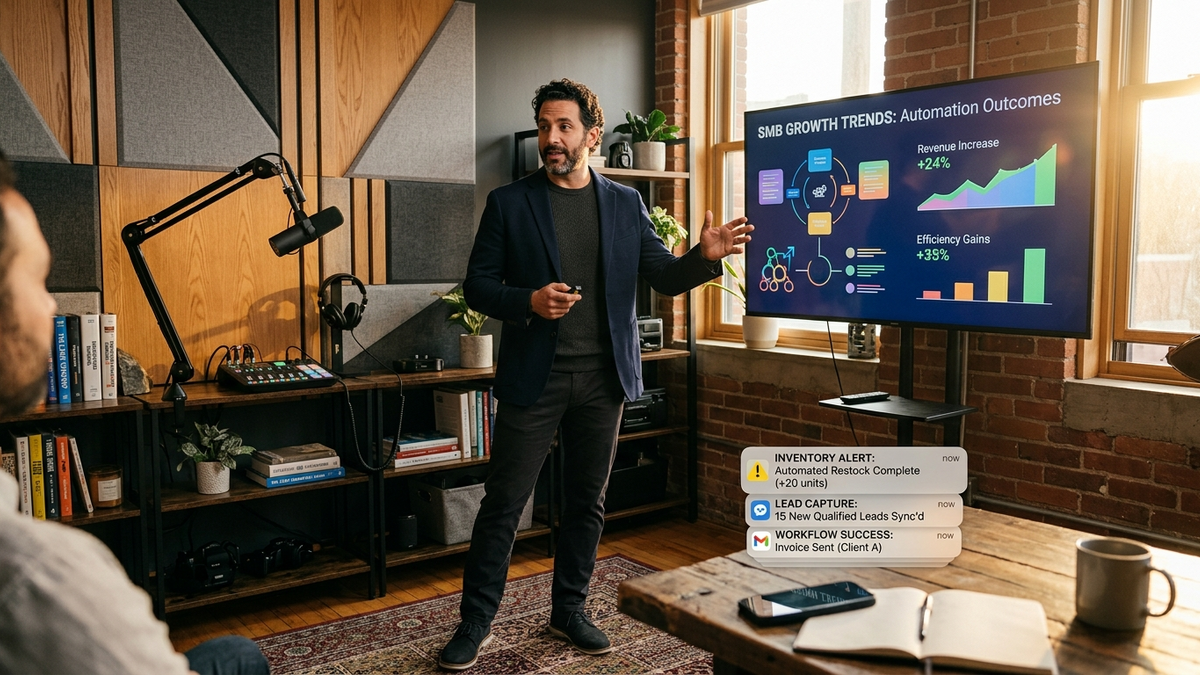
The conversation surrounding AI agents has evolved dramatically in 2026. While the previous year was defined by experimentation, the current landscape for Small and Medium-sized Businesses (SMBs) is laser-focused on one metric: measurable outcomes. From streamlining lead generation to managing autonomous customer support pipelines, agentic AI is no longer a futuristic concept—it is standard operating infrastructure for growth-focused SMBs.
The Rise of Production-Ready AI Agents in SMBs
According to recent data from Digital Applied's 2026 AI Agent Adoption report, SMBs (defined as having 200-999 employees) have seen a significant leap in adoption, with 22% now utilizing AI agents in active production and an additional 54% currently running pilot programs. This marks a critical transition. Unlike the open-ended generative AI assistants of 2023 and 2024, today’s agents are scoped strictly to bounded, repeatable, rule-driven workflows.
For smaller teams, the value proposition is simple: predictable, unflagging execution of operational tasks. Whether it is a multi-agent system managing a sales pipeline or an autonomous script handling first-tier IT support, the focus is squarely on cost-performance efficiency and direct ROI.
Core Automations Driving Measurable Outcomes
The shift toward outcome-driven AI agents is most visible in the specific workflows SMBs are choosing to automate. HatHawk’s analysis of the top AI automations in 2026 underscores that agentic AI is now fully embedded in sales and customer operations. The days of simply drafting emails with AI are over; today's agents are managing the entire lifecycle of specific processes.
1. Autonomous Lead Qualification and Follow-up
One of the highest ROI workflows for SMBs is lead generation and qualification. Instead of relying on static web forms and manual SDR follow-ups, companies are deploying agents that engage inbound leads, qualify them against business criteria, and automatically schedule meetings with human closers. This AI lead generation pipeline typically yields measurable improvements in response times, dropping the latency from hours to seconds and significantly increasing conversion rates.
2. Data-Driven Customer Support
Customer support is another area where AI agents are delivering immediate, quantifiable value. By tapping into internal company knowledge bases, these agents can resolve 60-80% of Tier 1 support tickets without human intervention. Crucially, they are designed with fallback protocols, automatically escalating complex issues to human agents with a complete summary of the interaction so far. This hybrid approach ensures high customer satisfaction while drastically reducing the operational load on small support teams.
3. Financial and IT Operations
Beyond sales and support, operational efficiency is a massive driver for SMB agent adoption. The Markaaz report on the SMB AI Revolution highlights the deployment of AI agents across finance and IT sectors. From automated invoice reconciliation to intelligent monitoring of IT infrastructure, agents are taking over the repetitive data-heavy tasks that previously bogged down small teams.
The Importance of Structured Workflows
The success of these implementations lies in understanding where AI agents excel. As noted by Dynamics Smartz in their analysis of AI agents in Business Central, agents are most effective for repeatable, rule-driven, and data-heavy processes. They thrive on clear boundaries and structured environments.
SMBs that see the best results are those that invest time in prompt-to-workflow transformations. This means moving away from ad-hoc prompting and toward rigorously defined standard operating procedures (SOPs) that the agent can execute reliably. When a workflow is clearly documented, the AI agent becomes a predictable execution engine, turning a previously manual operational cost into a measurable, optimized process.
Evaluating and Validating ROI
With the initial hype cycle long past, SMB leaders in 2026 are demanding proof of value. The evaluation metrics have shifted from "lines of code generated" or "hours saved" to hard operational metrics: cost per lead, ticket resolution time, customer churn rate, and error reduction in data entry.
This pragmatic approach aligns with the insights shared by industry experts on platforms like LinkedIn, where the focus has definitively moved toward automations that prove their worth immediately. For an SMB, an AI agent must justify its subscription or compute cost within the first quarter of deployment. If an agentic workflow cannot demonstrate measurable ROI in a sandbox environment, it rarely makes it to production.
Implementing Your First AI Agent Workflow
For solo operators and SMBs looking to implement their first high-ROI agent, the recommended path is iterative:
- Audit Existing Processes: Identify tasks that are high-volume, repeatable, and currently act as a bottleneck for human staff.
- Define the SOP: Document the exact steps, rules, and edge cases for the task. An AI agent cannot automate a process that your team cannot clearly explain.
- Select the Right Tooling: Choose tools tailored for SMBs, avoiding overly complex orchestration platforms unless absolutely necessary. Look for solutions that integrate cleanly with your existing tech stack (e.g., CRM, ticketing systems).
- Implement Human-in-the-Loop (HITL): Start with an agent that drafts responses or prepares data for a human to review. Once the agent proves its reliability, you can gradually increase its autonomy.
- Measure and Refine: Establish baseline metrics before deployment. Track the agent's performance against these baselines and refine its instructions based on real-world outcomes.
The shift toward measurable outcomes in 2026 represents a maturing of the AI agent ecosystem. By focusing on practical, bounded automations, SMBs are leveling the playing field, unlocking levels of operational efficiency that were previously out of reach. The future belongs not to the companies with the most AI, but to the companies that use AI to drive the most reliable, quantifiable results.