
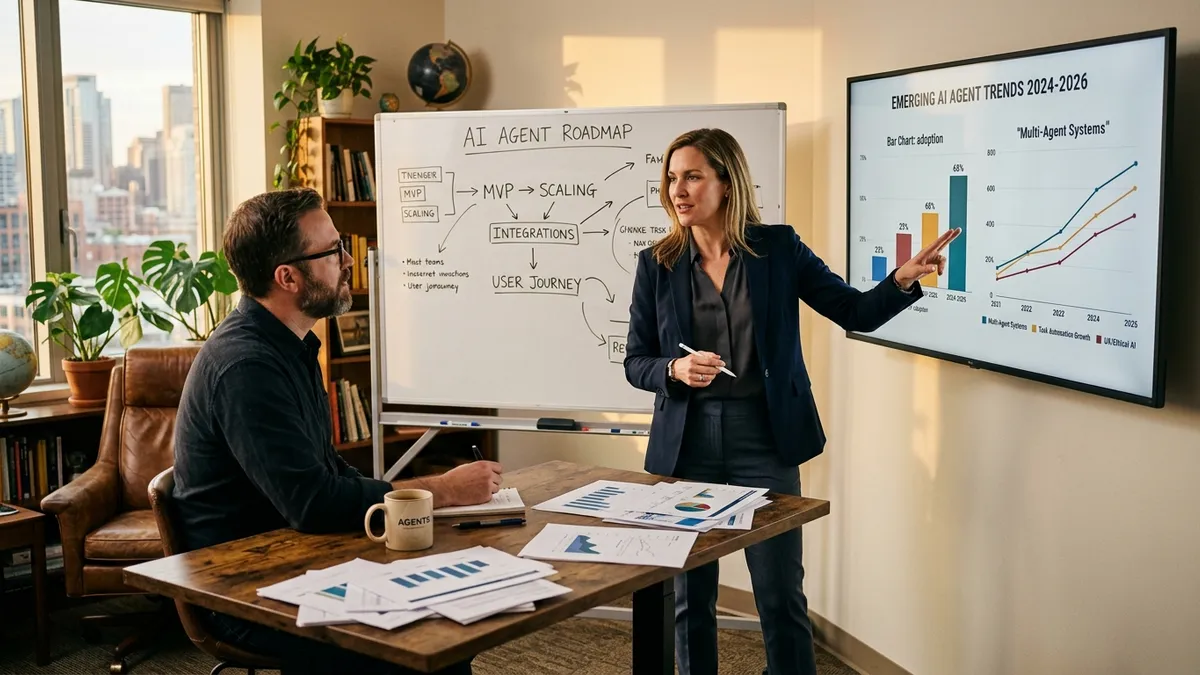
A practical AI agent trend on July 13, 2026 is the steady move from prompt-only experimentation to workflow-first implementation. The signal is visible across current product documentation and recent platform examples: agents are increasingly being packaged as recurring tasks, specialized workers, and auditable automations instead of single chat turns. That shift matters most for solo operators, creators, and small teams because they usually do not need a giant autonomous system. They need one dependable workflow that can gather information, perform bounded work, and stop at the right review point.
OpenAI's current scheduled tasks documentation says tasks can run in the background, combine with skills, and use separate worktrees when the work should stay isolated from unfinished local changes. Its background mode guide makes a related point at the API layer by treating long-running execution as normal for reasoning-heavy tasks. Anthropic's Claude Code documentation describes subagents as specialized assistants with their own context, permissions, and tool access, while its hooks system lets operators attach automatic behavior to lifecycle events. GitHub's June 2026 public preview for Agentic Workflows adds another implementation clue: automation can now be defined in natural-language Markdown and compiled into standard Actions YAML. Taken together, these sources suggest that the market is standardizing around reviewable workflow artifacts, not just better prompts.
Why prompt-only usage is giving way to workflow packaging
Prompt-only use is still useful for ideation, quick drafting, and one-off analysis. The problem appears when an operator wants the same result every day or every week. A founder who needs a morning brief, a creator who runs a recurring research sweep, or a small agency that checks dashboards and drafts client updates all run into the same issue: a good prompt is not yet an operating system. It does not define where context comes from, which tool should be used, how failures should be handled, or when a human needs to approve the result.
That is why workflow packaging is becoming more important than prompt cleverness. In OpenAI's scheduled task model, the prompt becomes durable work that can be tested, monitored, and rerun. In Anthropic's model, the prompt becomes one layer inside a specialist agent definition or a hook policy. In GitHub's model, the prompt becomes a versioned automation file. The implementation pattern is different in each product, but the direction is consistent: move repeated instructions out of conversational memory and into reusable operational structures.
What this looks like for operators in practice
For small teams, the workflow-first pattern is less about abstract orchestration and more about narrowing failure. A recurring content system might start with a scheduled research run, pass findings to a drafting worker, and stop before publication so an editor can review. A founder's daily operations loop might collect calendar events, email changes, and follow-ups into a short source-backed brief. A lightweight support workflow might classify messages, draft replies, and pause before anything is sent. Those are concrete operating patterns, not theoretical agent demos.
The same design logic already appears in internal coverage of scheduled jobs, custom skills, and browser control. It also aligns with recent reporting on reusable workflow specs and reliability loops for small teams. The practical lesson is that useful agents tend to look less like magic assistants and more like managed routines.
Three implementation patterns are standing out
The first pattern is scheduled execution for stable recurring work. OpenAI explicitly recommends reviewing the first few runs of a scheduled task, then adjusting the prompt, tools, or cadence. That is a strong sign that workflow design is becoming iterative and observable. For an SMB, it means the initial version can be narrow: one task, one cadence, one inbox for findings.
The second pattern is specialist delegation. Anthropic's subagents model describes separate workers that keep noisy search results, logs, or file contents out of the main thread. That structure is especially useful for small teams because it encourages clean handoffs. One worker researches, one transforms, and one validates. When each role is bounded, it becomes easier to locate where cost, latency, or quality breaks down.
The third pattern is deterministic guardrails around the workflow. Hooks in Claude Code can fire on session events, turn events, and tool calls, which makes them useful for automatic formatting, validation, notifications, or command blocking. GitHub's Agentic Workflows adds the repository-native version of the same idea: the process is encoded in files, run under known policies, and reviewed like other operational changes. For smaller operators, that is valuable because it reduces the need to trust memory or manual discipline.
Recent GitHub evidence shows the small-team case clearly
The most practical recent example comes from GitHub's July 8 case study on the Aspire team. GitHub describes a 10-person team using Agentic Workflows to turn merged product changes into SME-reviewed documentation pull requests. The article reports 82 documentation pull requests merged at a median of 44.8 hours after the product pull request, with the engineer who shipped the feature reviewing each draft. The point is not that every team should automate documentation. The point is that a small team used an agentic workflow to create a bounded draft, keep a human reviewer in place, and reduce backlog without inventing a brand-new process.
That is exactly the kind of evidence smaller operators need. It shows a workflow where the agent does not own the final action, the review surface is explicit, and the gains come from consistent execution rather than from removing humans from the loop. This is a stronger adoption signal than broad claims about transformation because it describes a concrete procedure that other small teams can copy and adapt.
What operators should do next
The clearest takeaway is to stop treating a strong prompt as the finished deliverable. Instead, operators should identify one recurring task with a clear end condition, define where the inputs come from, separate research from transformation, add one review checkpoint, and store the procedure in a reusable format. The immediate goal is not full autonomy. It is a repeatable routine that can survive handoffs, interruptions, and light iteration.
The July 2026 trend line is becoming easier to read. AI agents are not replacing workflow design. They are making workflow design the real product. For creators, founders, and small teams, that is good news because reviewable workflows are cheaper to maintain, easier to improve, and far more useful than one more clever prompt.