
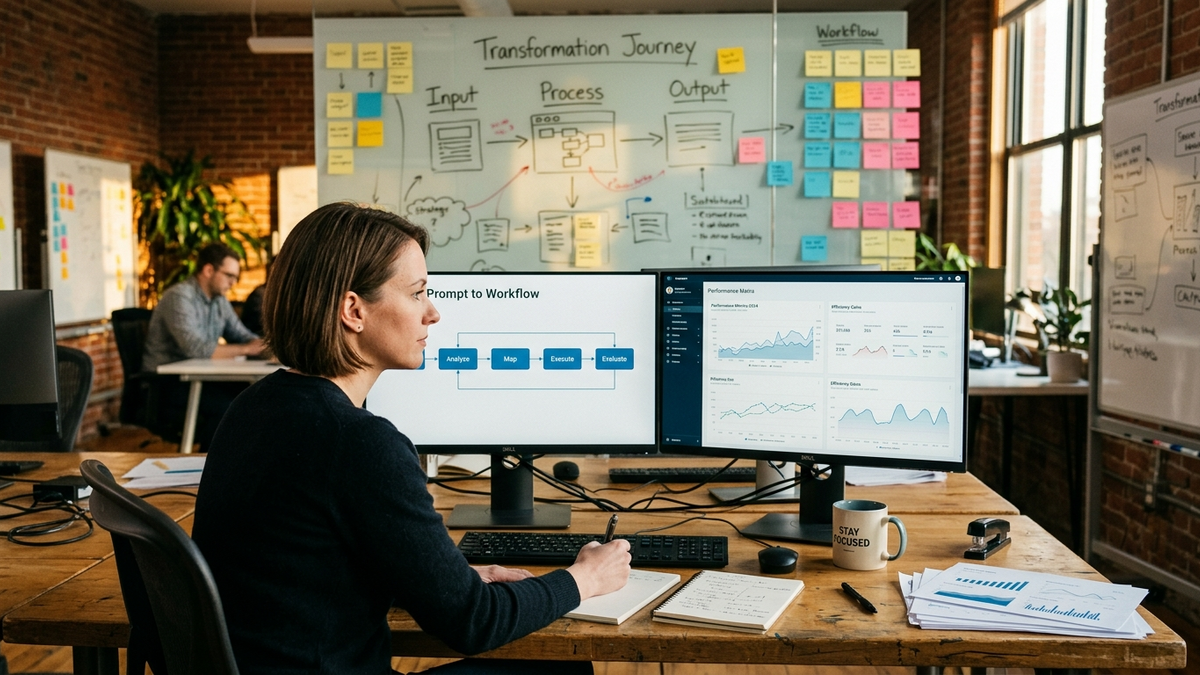
The AI agent conversation has moved past a familiar phase: typing a prompt, receiving a response, and manually doing the rest of the work. In 2026, the more important shift for solo operators and small teams is operational. Prompts are increasingly being used as workflow triggers, not just text inputs. The result is a practical transition from one-shot assistance to repeatable automation pipelines.
This trend is visible across major model providers and open-source tooling, but it is especially relevant for small businesses because it lowers orchestration overhead. Teams no longer need to wire every step manually before they can test a useful workflow. Instead, they can define intent in natural language, then map, inspect, and harden the generated process.
Why prompt-to-workflow is moving faster now
OpenAI’s product direction has made this transition easier to see in concrete terms. In its launch post for new agent-building tools, OpenAI positioned the Responses API, built-in tools, and Agents SDK as building blocks for multi-step task execution rather than single-turn chat behavior. That framing matters because it reflects a platform-level move toward tool use, orchestration, and observability in one stack.
The same pattern shows up in protocol-level infrastructure. Anthropic’s announcement of the Model Context Protocol (MCP) described a standard approach for connecting AI systems to external tools and data sources. For operators, MCP’s practical value is not conceptual. It is implementation speed. Standardized connectors reduce custom glue code, which is usually where small teams lose time when trying to productionize automations.
How operators are implementing this in practice
A recurring implementation pattern for SMBs is to treat an agent workflow like a small production system with five explicit stages: trigger, retrieval, reasoning, action, and review. This avoids the common mistake of relying on one long prompt and hoping for consistent results.
- Trigger: A user prompt, inbound webhook, form submission, or scheduled run starts the flow.
- Retrieval: The agent collects context from docs, CRM entries, spreadsheets, or prior messages.
- Reasoning: The model plans the next steps and chooses tools.
- Action: The system writes records, sends messages, opens tickets, or updates task boards.
- Review: A human or policy checkpoint validates risky outputs before final execution.
For teams already experimenting with reusable execution surfaces, this pattern aligns with workflows described in our coverage of prompt-to-workflow transformation and practical reliability checks covered in SMB reliability testing.
Tooling signals from the current stack
The tooling ecosystem now emphasizes structured flow control more than prompt cleverness. n8n’s AI Agent node documentation, for example, explicitly anchors agent execution around connected tools and workflow nodes, including practical constraints like requiring at least one tool sub-node. That is a useful signal for operators. The tooling assumes real actions, not just generated prose.
LangGraph documentation makes a similarly practical point with durable execution. State persistence and resumability are central for long-running tasks and human-in-the-loop pauses. For small teams, this is critical because failed runs are expensive if they require full restarts or manual reconstruction.
CrewAI’s Flows documentation reinforces another implementation pattern: event-driven multi-step control with state sharing and conditional branches. In operational terms, that means a team can route the same initial prompt into different downstream actions based on confidence scores, customer tier, SLA rules, or approval status.
What this means for SMB and creator operations
The immediate impact is process compression. A creator business can turn “publish this week’s product update” into an orchestrated sequence that drafts copy, checks internal references, creates social variants, and schedules publication with review gates. A service business can route “new lead from intake form” through enrichment, scoring, CRM update, and follow-up drafting in one managed pipeline.
The crucial shift is that operators are defining workflows in plain language first, then hardening behavior with controls. This is different from older automation setups that required deep pre-configuration before any value appeared. It is also why prompt design is increasingly inseparable from workflow design.
Teams implementing this model usually converge on three safeguards:
- Scoped autonomy: Agents can execute only pre-approved actions.
- Checkpointing: High-impact actions require explicit approval.
- Run logs: Every tool call is traceable for debugging and postmortems.
Those safeguards map closely to the hands-on practices in our scheduled automation guide and custom skills implementation guide, where repeatability and traceability are treated as first-order requirements.
The implementation pattern likely to persist
The strongest signal from today’s ecosystem is that prompt-only interaction is becoming the entry point, not the operating model. The durable model for SMBs appears to be prompt-to-workflow pipelines with explicit state, tool boundaries, and review checkpoints.
In practical terms, small teams do not need to “adopt agents” as a single decision. They can start by converting one repeated task into a structured flow, measure reliability, then expand from there. That sequence, narrow scope first and broader orchestration second, is proving more effective than broad autonomous deployments.
As platform vendors continue to ship orchestration primitives and as open standards reduce integration friction, the teams that benefit most are likely to be operators who think in systems: defining clear triggers, clear outputs, and clear fallback behavior. In that environment, the prompt is still important, but the workflow is where operational value is created.