
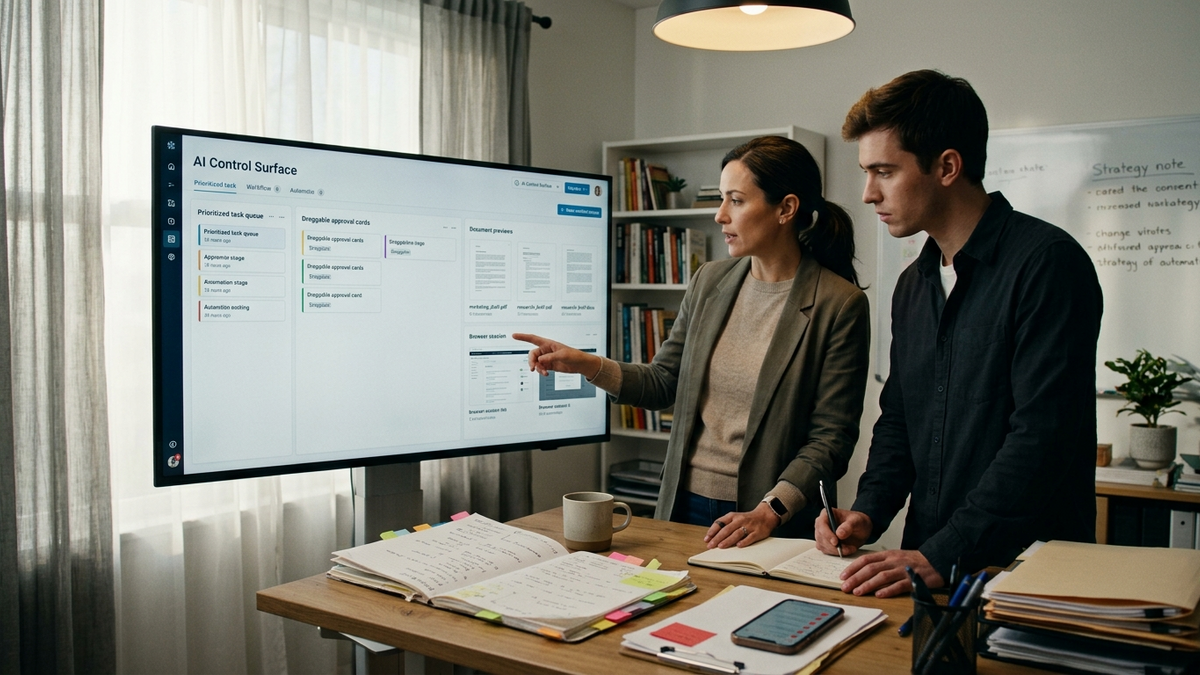
A practical AI agent trend on June 22, 2026 is that more tools are being packaged as operator harnesses instead of blank-slate assistants. The new pitch is less about handing a model unlimited autonomy and more about giving a solo operator or small team a controlled surface for long-running work: reusable instructions, visible task state, tool approvals, workflow files, and a place to interrupt or redirect the run. The AI agent harnesses reference compares eleven of them on exactly those points.
That shift matters because small teams usually do not fail on model quality alone. They fail on repeatability. A founder may get a strong result once in a chat window, then lose the exact prompt, the review checklist, the tool settings, and the stopping condition the next day. The latest releases from Mastra, GitHub, n8n, LlamaIndex, and Anthropic all point to the same implementation pattern: agent value is moving into the harness around the model.
Mastra is explicitly productizing the harness layer
The clearest example came on June 18, when Mastra announced Mastra Harness. Mastra described the harness as the layer around the agent loop, with a conversation an operator can watch, interrupt, and steer, plus memory for long runs, session storage, control over tool calls, subagent delegation, and switchable modes. That is notable because it treats supervision as the product, not as a bolt-on safety measure.
Mastra doubled down on that framing on June 15, when it said users could run Claude Code, Cursor, and Codex agents inside Mastra. The company said those subagents inherit a shared surface for workflow steps, observability, handoffs, permission controls, and cost tracking. For operators, the practical implication is that the surrounding control plane is becoming more durable than any single model vendor. That lines up with this site's earlier reporting on open-source agent tooling launches and the move toward reusable agent surfaces rather than one-off chat sessions.
GitHub is turning agent behavior into versioned workflow assets
GitHub's June 9 article on custom agents in GitHub Copilot CLI described agent profiles stored as Markdown files in the repository. GitHub said those files define the agent's role, tools, standards, and guardrails, so behavior stays consistent wherever it runs. That is a strong signal that practical agent systems are becoming file-based and reviewable.
GitHub reinforced the same idea on June 2, when the Copilot SDK reached general availability. GitHub said the SDK exposes planning, tool invocation, file edits, streaming, multi-turn sessions, MCP connectivity, tracing, and hooks for permission requests. For a small shop, that lowers the cost of embedding a reliable agent runtime into an internal tool instead of inventing a full orchestration layer from scratch. It also fits the broader shift from prompt-to-workflow patterns into versioned operating logic.
Workflow builders are making the harness visible to non-engineers
The same trend shows up in low-code tooling. n8n's documentation for AI Workflow Builder says users can create, refine, and debug workflows from natural-language goals, while the system handles node selection, placement, and configuration. Just as important, n8n says operators then review credentials, parameters, and the generated flow before refining it further.
That review step is what makes the harness valuable for SMB and creator use cases. A marketer or agency operator does not need a deep agent framework as much as they need a visible graph they can inspect when a lead-routing, post scheduling, or reporting workflow behaves oddly. The interface becomes a debugging surface for operations, not just a convenience layer for prompt entry. That is the same implementation logic behind knowledge-base patterns like custom skills and scheduled runs, where the durable artifact matters as much as the model response.
Local utilities are becoming first-class pieces of the harness
LlamaIndex's launch of LiteParse adds another useful clue. The company said it open-sourced the core of its document parsing stack as a local CLI and TypeScript library for agents, designed to parse PDFs, Office files, and images without Python dependencies. LlamaIndex also described a practical pattern for agent work: parse text quickly, then fall back to screenshots when deeper visual reasoning is needed.
That sounds narrow, but it is exactly how small teams make agent workflows dependable. They do not need a general intelligence breakthrough to process a vendor invoice, pull details from a contract, or prep a monthly packet. They need a stable local tool in the harness that handles one messy document task the same way every time. In other words, the tool stack around the agent is becoming more specialized and more reusable.
Even commercial SMB launches are converging on approval-first harnesses
Anthropic's Claude for Small Business announcement is not an open-source launch, but it supports the same market conclusion. Anthropic said connected tools can handle jobs like payroll planning, invoicing, lead triage, campaign attribution, contract routing, and content generation. The company also said each task is initiated by the user, with the operator approving the plan first or letting it run end-to-end once they are comfortable.
That is the key point. The most credible products for smaller operators are not pretending that oversight disappears. They are making oversight easier to package. The harness now includes the connector set, the review checkpoint, the skill file, the run history, and the local utilities needed to finish the job. For creators, agencies, and lean software teams, that is a more useful trend than broad claims about autonomy.
The near-term implementation pattern
The practical pattern emerging in mid-2026 is simple: choose one recurring task, define it in a durable file or builder, attach only the tools it truly needs, make the intermediate state visible, and give a human a clean review point. Teams that do that can run research loops, document intake, content packaging, support triage, and repo maintenance with far less drift than they get from ad hoc prompting alone.
The AI agent story for smaller operators is therefore becoming easier to describe. Winning systems are not just smarter models. They are harnessed workflows: inspectable, interruptible, and narrow enough to trust. That is where the most practical product movement is happening today.
Related on this site: the Claude Code guide shows how hooks and the new function hook plugins make a harnessed workflow inspectable and interruptible in practice, and the harness guides collect the walkthroughs.