
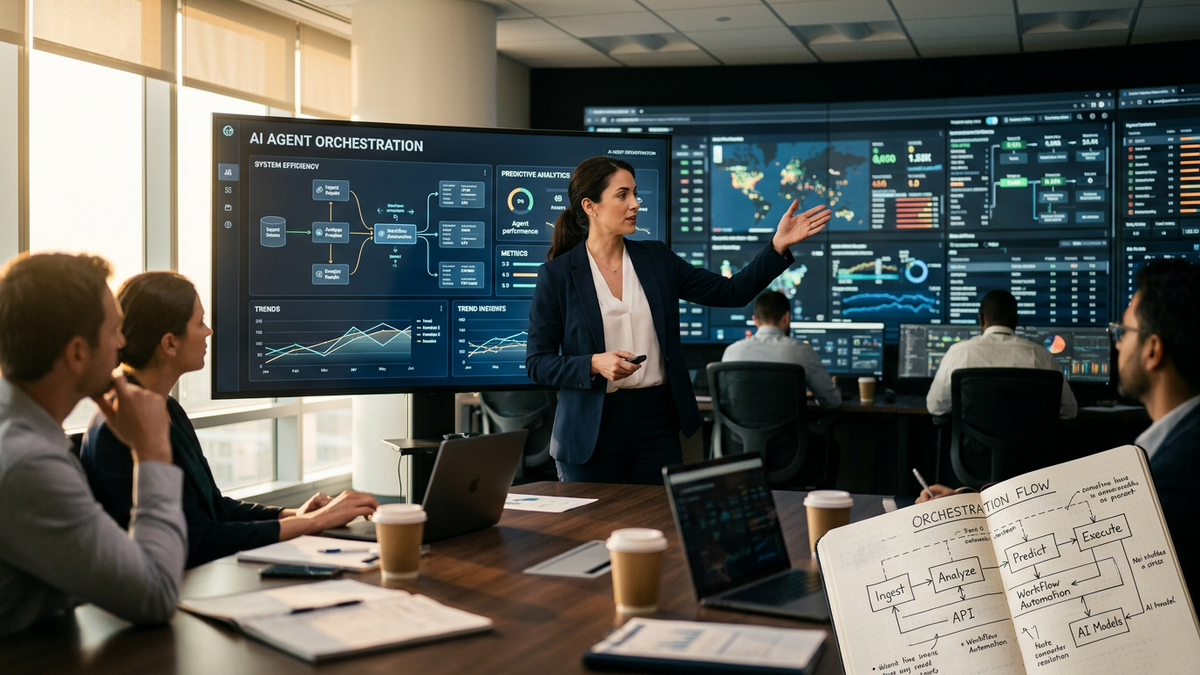
On March 16, 2026, NVIDIA announced Agent Toolkit, a comprehensive open-source software stack for building autonomous enterprise AI agents. The announcement, made at the company's GTC conference, represents the industry's most significant infrastructure investment in multi-agent orchestration to date. NVIDIA CEO Jensen Huang characterized the release as extending "AI beyond generation and reasoning into action," framing autonomous agents as the next phase of enterprise AI deployment.
The announcement comes less than 24 hours after LangChain, whose open-source frameworks have surpassed 1 billion downloads, announced a comprehensive integration with NVIDIA to deliver an enterprise-grade agentic AI development platform. The timing signals coordinated movement across the AI infrastructure stack toward production-ready agent orchestration capabilities.
OpenShell Runtime Addresses Security and Governance Gaps
The centerpiece of NVIDIA's Agent Toolkit is OpenShell, an open-source runtime that enforces policy-based security, network, and privacy guardrails for autonomous agents. OpenShell addresses what industry analysts have identified as the primary barrier to enterprise agent adoption: the absence of standardized security frameworks for systems that can autonomously execute actions across enterprise infrastructure.
"Employees will be supercharged by teams of frontier, specialized and custom-built agents they deploy and manage," Huang stated in the announcement. "The enterprise software industry will evolve into specialized agentic platforms, and the IT industry is on the brink of its next great expansion."
NVIDIA is collaborating with security providers including Cisco, CrowdStrike, Google, Microsoft Security, and TrendAI to build OpenShell compatibility with their cyber- and AI-security tools. CrowdStrike announced a Secure-by-Design AI Blueprint that embeds Falcon platform protection directly into NVIDIA AI agent architectures, including agents built on AI-Q and OpenShell. The integration provides managed detection and response capabilities specifically designed for agentic workflows.
AI-Q Blueprint Demonstrates Hybrid Model Economics
NVIDIA's AI-Q open agent blueprint implements what the company describes as a hybrid architecture: frontier models for orchestration combined with open models for research tasks. According to NVIDIA's published benchmarks, this approach can reduce query costs by more than 50 percent while maintaining accuracy levels that rank first on the DeepResearch Bench and DeepResearch Bench II leaderboards.
The AI-Q architecture uses frontier models to decompose tasks and coordinate workflows, while deploying NVIDIA's Nemotron open models for information retrieval and analysis subtasks. This division of labor between proprietary and open models represents a practical response to the cost structures that have constrained large-scale agent deployments in enterprise environments.
Harrison Chase, Cofounder and CEO of LangChain, emphasized the integration of AI-Q with LangChain's Deep Agents framework in the March 16 joint announcement. "With over 100 million monthly downloads of LangChain's frameworks, we've seen that frontier models must go beyond raw intelligence to enable reliable tool use, long-horizon reasoning and agent coordination," Chase stated. The LangChain-NVIDIA integration combines LangSmith's observability platform with NVIDIA NeMo Agent Toolkit profiling and optimization capabilities.
Enterprise Platform Adoption Reveals Orchestration Patterns
NVIDIA's announcement detailed partnerships with Adobe, Atlassian, Amdocs, Box, Cadence, Cisco, Cohesity, CrowdStrike, Dassault Systèmes, IQVIA, Red Hat, SAP, Salesforce, Siemens, ServiceNow, and Synopsys. The disclosed implementations reveal three dominant orchestration patterns in production enterprise deployments.
Salesforce's implementation with Agentforce demonstrates the orchestrator-worker pattern at scale. The architecture uses Slack as the primary conversational interface and orchestration layer, with Agentforce agents handling specialized tasks for service, sales, and marketing workflows. NVIDIA Nemotron models power the agent execution layer, pulling from data stores in both on-premises and cloud environments. This pattern, where a central orchestrator routes tasks to specialized worker agents, remains the most widely deployed in customer-facing enterprise applications.
ServiceNow's Autonomous Workforce implementation employs hierarchical orchestration, organizing agents into multi-level delegation structures. ServiceNow's AI Specialists are built on a combination of closed and open models, including NVIDIA Nemotron and ServiceNow's Apriel models. The hierarchical pattern allows ServiceNow to tackle enterprise workflows that span multiple business domains without requiring any single agent to hold the full context of the entire process.
IQVIA's deployment represents the most aggressive enterprise agent rollout disclosed in the announcement. The company has deployed more than 150 agents across internal teams and client environments, including 19 of the top 20 pharmaceutical companies. IQVIA integrates NVIDIA Nemotron into IQVIA.ai, a unified agentic AI platform designed for clinical, commercial, and real-world operations in life sciences organizations. The scale of IQVIA's deployment demonstrates that regulated industries are moving beyond pilot programs into production agent networks that handle mission-critical workflows.
LangGraph Acceleration Targets Latency Bottlenecks
The LangChain-NVIDIA integration introduces compiler-level optimizations for LangGraph workflows that address the latency accumulation problem in multi-agent systems. The optimizations include parallel execution, which automatically identifies independent nodes in agent graphs and runs them concurrently, and speculative execution, which runs both branches of conditional edges simultaneously and discards the incorrect branch once the routing condition resolves.
According to the joint announcement, these optimizations significantly reduce end-to-end latency for complex multi-step agent workflows without requiring changes to node logic or graph edges. The approach reflects industry recognition that orchestration overhead, the cumulative time spent coordinating between agents rather than executing productive work, represents a primary barrier to interactive agent applications.
Justin Boitano, Vice President of Enterprise AI at NVIDIA, positioned the integration as addressing the infrastructure gap that forces development teams to spend months building custom tooling. "Enterprises need open, flexible tooling to build AI agents customized for their workflows and deployed securely at scale," Boitano stated. "LangChain's framework and LangSmith's observability, combined with NVIDIA Nemotron models, Agent Toolkit and NIM microservices, give developers the complete foundation to move from prototype to production."
SMB Accessibility Through Hardware Partners
NVIDIA's announcement emphasized deployment options across the cost spectrum, from cloud-hosted infrastructure to desktop systems. Developers can access Agent Toolkit and OpenShell through inference providers including Baseten, Bitdeer AI, CoreWeave, DeepInfra, DigitalOcean, GMI Cloud, Fireworks, Lightning, Together AI, and Vultr. For local deployment, OpenShell runs on NVIDIA GeForce RTX PCs and laptops, NVIDIA RTX-powered workstations, and NVIDIA DGX Station and DGX Spark supercomputers from hardware partners including Altos Computing, ASUS, Dell Technologies, GIGABYTE, HP, Lenovo, MSI, and Supermicro.
The availability of local deployment options addresses a constraint that has limited SMB agent adoption: the requirement for cloud infrastructure and associated recurring costs. Organizations with existing workstation or desktop hardware investments can now deploy agent systems without cloud dependencies, reducing the total cost of ownership for smaller deployments.
Industry Analysis and Market Implications
Industry research firm Kore.ai published analysis on March 13, 2026, identifying multi-agent orchestration as the "real AI race" rather than larger models. The research noted that 61 percent of business leaders are deploying AI agents, according to TechRadar, while Gartner predicts that 15 percent of daily business decisions will be automated by AI agents by 2028. Forrester reports that 56 percent of organizations improve scalability when orchestration frameworks are implemented.
Gartner's 2025 Agentic AI research found that nearly 50 percent of surveyed vendors identified AI orchestration as their primary differentiator, suggesting that competitive positioning has shifted from model capabilities to coordination infrastructure. The NVIDIA announcement reinforces this trend by providing open-source orchestration primitives that enterprise software vendors can integrate into their platforms.
The emphasis on hybrid model architectures combining proprietary and open models addresses the cost dynamics that have constrained agent deployment at scale. Organizations evaluating AI agent ROI can now design systems where expensive frontier model calls are reserved for high-value reasoning tasks, while commodity inference handles routine subtasks. This economic model more closely resembles traditional enterprise software economics than the uniform per-token pricing that has characterized generative AI deployment to date.
Open Questions and Implementation Challenges
Despite the breadth of the NVIDIA announcement, several implementation questions remain unresolved. The security guarantees provided by OpenShell depend on correct policy definition, and the announcement did not detail mechanisms for policy auditing or conflict resolution when multiple security frameworks impose contradictory constraints. Organizations implementing OpenShell will need to develop governance processes that translate business requirements into enforceable agent policies.
The observability challenge also persists. While LangSmith provides application-level tracing and NeMo Agent Toolkit adds infrastructure profiling, distributed agent systems generate trace volumes that exceed human review capacity. The announcements did not address automated anomaly detection or the tooling required to identify coordination failures in systems with dozens or hundreds of active agents.
The disclosed enterprise implementations focus on structured workflows with well-defined domain boundaries. The orchestration patterns demonstrated by Salesforce, ServiceNow, and IQVIA may not generalize to less structured knowledge work where task decomposition itself requires substantial reasoning. Organizations attempting to deploy agents in exploratory or creative workflows will likely encounter coordination challenges not addressed by the current toolkit capabilities.
Industry Trajectory and Strategic Implications
The coordinated announcements from NVIDIA and LangChain on March 16, 2026, represent the most significant infrastructure commitment to enterprise agent orchestration since the initial release of agentic frameworks in 2024. The combination of security runtime (OpenShell), reference architecture (AI-Q), optimization tooling (NeMo Agent Toolkit), and enterprise platform partnerships establishes an open-source foundation for multi-agent systems that did not exist in consolidated form prior to this week.
For organizations that have delayed agent deployments due to security, governance, or cost concerns, the NVIDIA Agent Toolkit provides tested primitives that address the most commonly cited barriers. The disclosed enterprise implementations from Salesforce, ServiceNow, and IQVIA demonstrate that production agent systems can be deployed at meaningful scale in both customer-facing and internal workflows.
The strategic question for enterprise technology leaders is no longer whether autonomous agents are viable for production deployment, but which orchestration patterns align with their organization's workflow structures and risk tolerance. The NVIDIA announcement accelerates the timeline for answering that question by providing reference implementations, security frameworks, and economic models that reduce the cost and risk of initial deployments.
Sources:
• NVIDIA Corporation. (2026, March 16). NVIDIA Ignites the Next Industrial Revolution in Knowledge Work With Open Agent Development Platform. Globe Newswire. https://www.globenewswire.com/news-release/2026/03/16/3256734/0/en/NVIDIA-Ignites-the-Next-Industrial-Revolution-in-Knowledge-Work-With-Open-Agent-Development-Platform.html
• LangChain. (2026, March 16). LangChain Announces Enterprise Agentic AI Platform Built with NVIDIA. LangChain Blog. https://blog.langchain.com/nvidia-enterprise/
• Kore.ai. (2026, March 13). How multi-agent orchestration powers enterprise AI. Kore.ai Blog. https://www.kore.ai/blog/what-is-multi-agent-orchestration
• Gurusup. (2026, March 14). Agent Orchestration Patterns: Swarm vs Mesh vs Hierarchical vs Pipeline. Gurusup Blog. https://gurusup.com/blog/agent-orchestration-patterns
• Jotform. (2026, March 16). The 8 best AI orchestration tools for developers. The Jotform Blog. https://www.jotform.com/ai/agents/best-ai-orchestration-tools/
• CIO. (2026, March 9). 21 agent orchestration tools for managing your AI fleet. CIO. https://www.cio.com/article/4138739/21-agent-orchestration-tools-for-managing-your-ai-fleet.html